Most people chasing a “good” credit score focus on paying debt down fast—yet roughly a quarter of your score comes from something you can’t rush: time and variety. You’re about to hear why leaving old accounts open can quietly work harder than your next big payment.
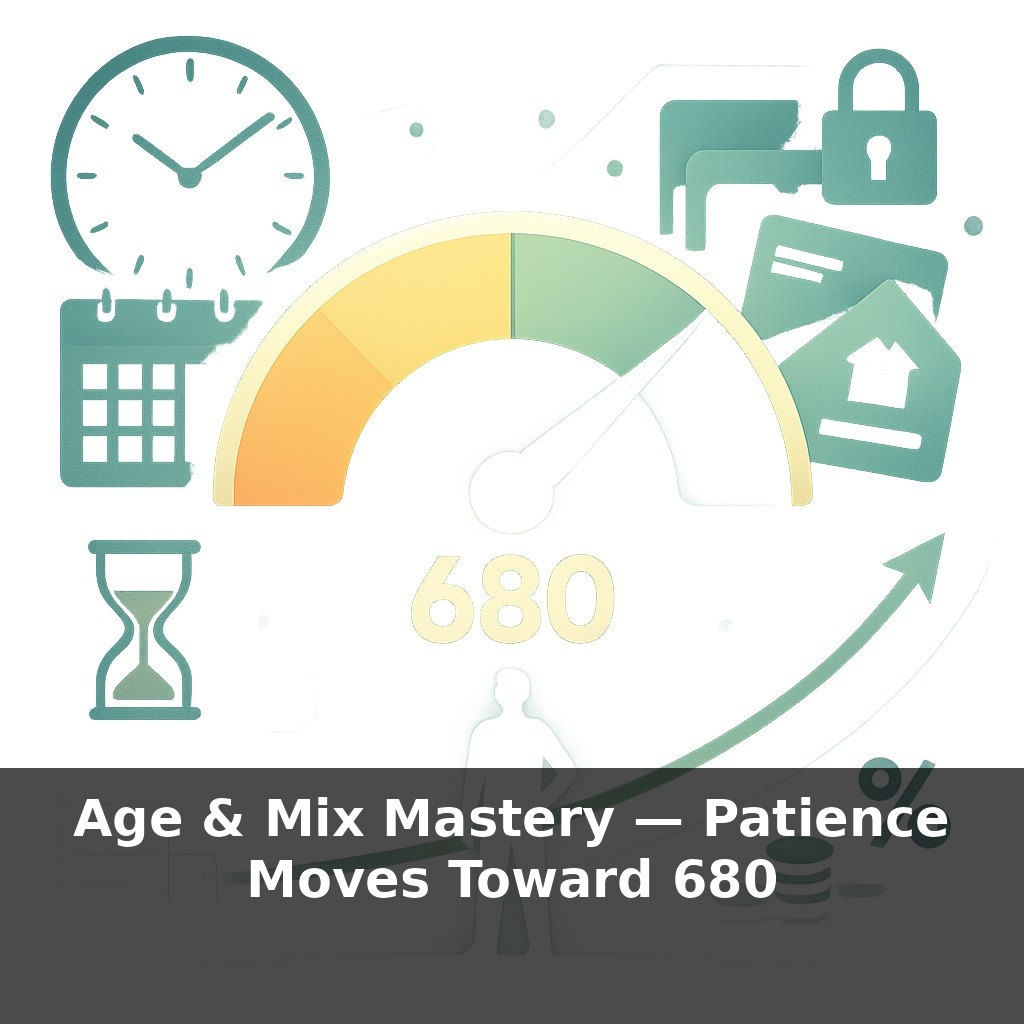
About 1 in 3 people who finally reach a 680+ score do it without paying off a huge chunk of debt or landing a big income jump—they simply stop working against their own credit age and mix. Not by doing nothing, but by making fewer, smarter moves.
We’ve talked about how time and variety quietly carry your score. Now we’ll zoom in on the decisions that either let those factors compound…or reset them over and over.
Think about moments like closing a “useless” old card, grabbing a store card for a quick discount, or skipping a small starter installment loan because it feels pointless. Each choice nudges the age and mix of your profile in ways that can add up to dozens of points over a year.
In this episode, you’ll see how to design those choices so that your default path slowly, predictably bends toward 680—without gimmicks, shortcuts, or score “hacks” that backfire later.
Lenders don’t just glance at your score; they read your history like a timeline, asking, “How long has this person handled different kinds of promises?” A thin, recent file can feel like a short résumé with only one job listed. What starts to shift things is consistent behavior across several “chapters”: a card you’ve managed for years, a small fixed loan you’ve never missed, maybe a future car note that stays on track. The goal isn’t to collect accounts, but to let a few well-chosen ones quietly mature together, so each month adds evidence instead of noise.
Most people underestimate how “sticky” their credit timeline really is. The system quietly rewards people who stop constantly resetting the clock and instead let a simple structure play out for years.
Start with how new accounts interact with everything else. A fresh card can be useful, but every one you open shuffles the deck: new age recorded, new inquiry, new potential for mistakes. That’s why spacing out new credit matters. Think in terms of seasons, not weeks: if you’re under 680, clustering two or three new accounts within six months often does more harm than the added flexibility can fix.
Instead, map roles. One main everyday card you actually use and pay in full. One or two “supporting” cards that stay open with a tiny recurring bill. Then, one installment line when it genuinely fits your life—a credit‑builder loan, small personal loan, or, later, an auto loan you can comfortably carry. You’re not chasing variety; you’re assigning each account a job so it can quietly build history.
Now layer in timing. Before applying for anything new, look 6–12 months ahead. Are you eyeing a car, apartment, or mortgage? That’s usually a “no‑new‑stuff” window. Evaluate whether a card offer or store discount is worth even a temporary score dip when a lender is about to judge you.
A subtle lever many people miss is how you treat low‑activity cards. Letting them go completely unused risks closure by the issuer. Instead, schedule a small subscription or quarterly charge, then autopay. This turns potential dead weight into consistent, low‑maintenance history that keeps your average age resilient if you eventually add something new.
Here’s where patience feels slow but compounds: every month you don’t close an aged account, don’t add a random card, and don’t miss a payment, the “average” on your file shifts a little in your favor. Surge behavior—three new cards this year, two closures next year—keeps resetting that average just when it’s starting to work for you.
Like a long, steady medical treatment plan, the win isn’t in dramatic interventions, but in avoiding setbacks: no sudden cancellations, no bursts of applications, no risky shortcuts that could require years of “recovery” later.
Think of three real people.
Person A: They’ve had a student card since 2012, then added one travel card in 2018 and a small credit‑builder loan in 2023. They use autopay on everything and only add new accounts when their life changes—job, move, car. Ten years in, their report looks “boring,” and that boring pattern is exactly what underwriters prize.
Person B: Same age, similar income, but they chase sign‑up bonuses and store discounts. Six cards in four years, two closed when fees kicked in. On paper, it’s noisy: short relationships, shifting limits, frequent checks. Their score jumps and dips instead of gliding upward.
Person C: They’re early in the journey with just one secured card. Rather than grabbing three new products, they add one low‑fee card a year apart, then a small shared‑secured loan at their credit union. It’s closer to a training plan than a shopping list.
If A, B, and C all earn an extra $200 next month, only C’s slower, staged build can realistically track toward 680 without drama.
New rules are quietly forming underneath the old playbook. As rent, utilities, and even subscription data start to count, your record may look less like a single snapshot and more like a time‑lapse. Patterns of steady cash flow, not just traditional accounts, could matter more—like judging a musician by years of live shows, not one studio track. That shift may soften the penalty for starting late, but it still rewards the same thing: showing up reliably, month after month, with no sudden drama.
You don’t need a perfect script, just a repeatable rhythm. Think in “seasons”: a stretch to stabilize balances, a stretch to let new accounts settle, a stretch to stay inquiry‑free. Your challenge this week: sketch the next 12 months like a tour schedule—when you’ll apply, when you’ll pause—so progress isn’t random, it’s on purpose.