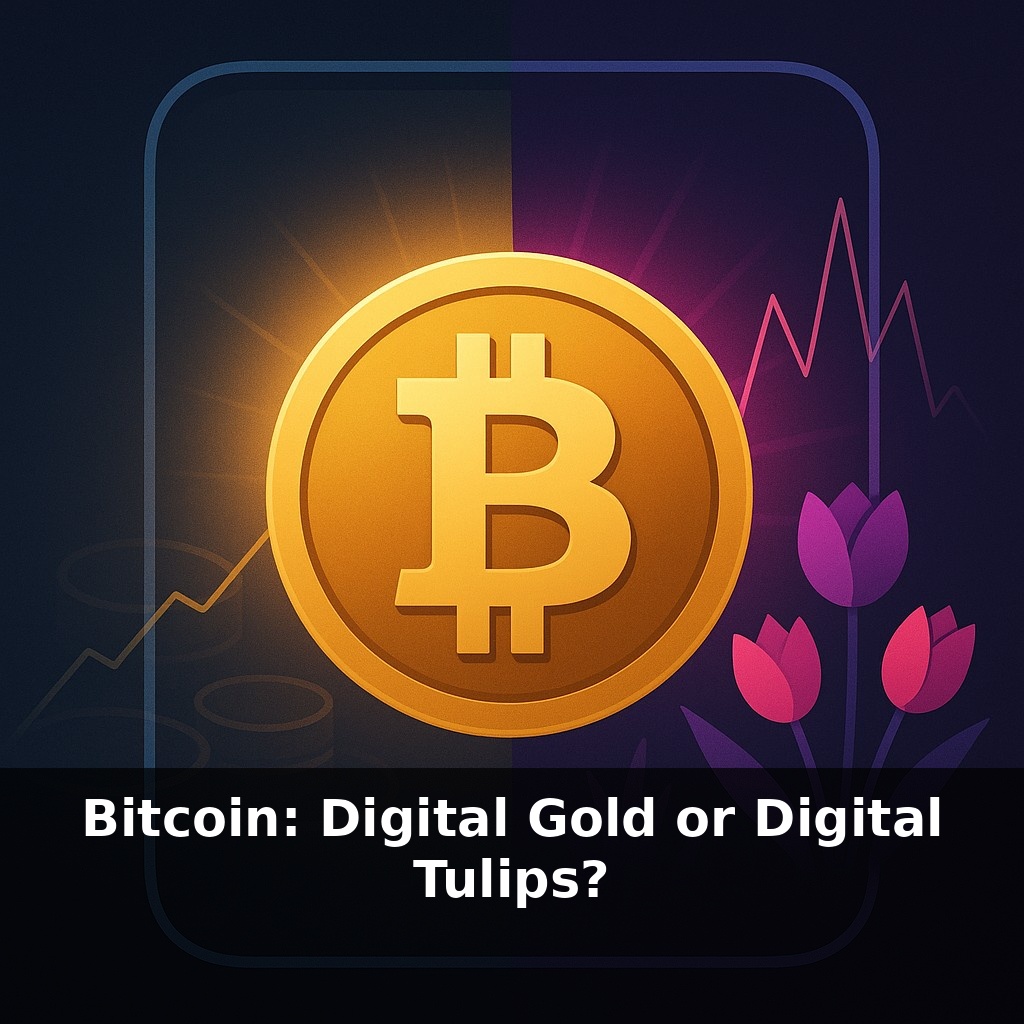
Bitcoin has died in headlines more times than we can count—yet today, it still represents roughly half of the entire crypto market. One person calls it “digital gold,” another swears it’s the next tulip mania. You’re holding your phone. Which story do you actually believe—and why?
Scroll through financial Twitter on a volatile day and you’ll see the split-screen narrative in real time: one camp posting long-term price charts, another sharing memes of bubbles popping. Underneath the noise, though, is a quieter question serious investors keep asking: what, exactly, is the role Bitcoin might play in a modern portfolio?
Some treat it like a high-beta tech stock, trading every spike and dip. Others tuck it away for years, the way a musician might stash away a rare synth, betting future artists will covet it even more. Meanwhile, institutions run stress tests: How does Bitcoin behave during inflation scares? Liquidity crunches? Regulatory shocks?
In this episode, we’ll look at hard data, not headlines: ownership patterns, settlement volumes, and how its risk/return profile stacks up against traditional assets.
Now zoom in from the 30,000-foot view to the messy ground level where decisions are actually made. When someone buys Bitcoin, they’re rarely thinking in clean academic categories like “inflation hedge” or “non-correlated asset.” They’re reacting to headlines, friends’ gains, institutional moves, and their own time horizon. Miners respond to electricity prices and halving schedules, traders to funding rates and liquidity, long-term holders to conviction and tax rules. Around all of that, policymakers, asset managers, and fintech platforms quietly reshape how easy—or hard—it is to treat BTC as a serious financial instrument.
Start with the paradox: Bitcoin looks like a “do nothing” asset—you can’t live in it, eat it, or plug it in—but its network silently moves tens of billions of dollars a week without a central operator. That gap between what it *is* (a bare digital bearer asset) and what it *does* (enable value transfer and storage outside traditional rails) is where the “gold vs. tulips” debate actually lives.
At one extreme is the pure speculation lens: price is just a voting machine for crowd emotion. In that view, every sharp rally is reflexive—higher prices attract more attention, which attracts more buyers, and so on, until liquidity thins and the cycle snaps back. Crypto-native leverage, perpetual futures, and easy onboarding all amplify this; you can see it in funding-rate spikes and cascading liquidations that have little to do with macro data.
At the other extreme is the monetary-network lens: value accrues because a critical mass of people choose to *settle* serious value on this particular ledger instead of others. Here, the interesting signals aren’t memes; they’re things like how often large holders move coins, how many entities secure the network, and whether new layers are being built on top. That’s where you get questions like: is Bitcoin slowly ossifying into a base layer for high-value settlement and collateral, while faster systems handle day-to-day payments?
Regulation adds a third dimension. In some jurisdictions, spot ETFs and clear tax rules nudge Bitcoin toward “alternative asset” status; in others, capital controls and banking friction push it toward “exit valve” for local currency risk. The same protocol can behave like a tech growth bet in one portfolio, a geopolitical hedge in another, and a short-term volatility trade on a prop desk.
The music-industry parallel is hard to ignore: a new format appears, dismissed as a fad, then either fades or becomes infrastructure. Early MP3s looked like piracy; two decades later, streaming is just “how music works.” Whether Bitcoin ends up as background plumbing or a historical curiosity will depend less on slogans and more on slow, cumulative choices: which institutions adopt it, which legal precedents crystallize, and how its users respond to future crises.
Watch how different players “use” the same Bitcoin and its story starts to look less binary. A retail trader riding five-minute charts treats it like a volatile microcap stock; a family office wiring funds to an overseas custodian may care only that a large transfer clears without a bank in the middle. For miners, it’s closer to an industrial commodity: they convert electricity and hardware into coins, then manage treasury risk across cycles. Payment firms sometimes treat BTC as a rails-only asset—instantly bought and sold in the background—where the end user barely notices it was involved.
Large corporates add yet another layer. When a listed company parks part of its treasury in BTC, analysts suddenly have to decide whether that ticker is a software business, a quasi-ETF, or both. Meanwhile, in countries with unstable banking, small merchants might use BTC-linked apps as a passthrough into more stable currencies, never holding coins for long.
Owning Bitcoin is like owning a plot of land in a virtual downtown: there will never be more prime lots than already exist, so as the city (the digital economy) grows, scarcity can drive value. The open question for serious investors is whether you see yourself as tenant, developer, or long-term landlord. That choice shapes everything: your time horizon, your risk tolerance, and even which metrics you watch. Are you tracking daily price swings, multi-year adoption trends, or how regulators and institutions slowly rewrite the “zoning laws” around this digital real estate?
Your challenge this week: pick a single lens—trader, treasurer, miner, or “virtual landlord”—and map out how *that* actor would evaluate Bitcoin over the next five years. What data would they monitor monthly? What kind of shock would make them sell, double down, or simply ignore the noise and keep holding?
If Bitcoin keeps compounding trust, future portfolios may treat it less like a moonshot and more like a volatile, but standard, building block. Think of analysts adding a new “liquidity tide” column next to rates and credit spreads, watching how Bitcoin reacts to stress. If on-chain signals start guiding treasury, trading, and even policy decisions, its narrative shifts from debate topic to quiet infrastructure, humming under traditional finance rather than shouting over it.
In the end, Bitcoin’s story may hinge less on ideology and more on behavior: do people actually keep trusting it when headlines turn ugly and alternatives improve? Like a new language spreading through global finance, its fate depends on who chooses to stay fluent, who drifts away, and whether future crises make its grammar more, or less, indispensable.
Try this experiment: Pick a small, affordable amount of money (say, the cost of a nice dinner) and split it in two—put half into Bitcoin and half into a simple index fund or savings account today. For the next 30 days, track the value of each every 2–3 days in a simple spreadsheet, along with one note on how you *feel* about the swings (excited, anxious, indifferent). At the end of the month, compare not just which performed better, but which experience you actually preferred living with—and use that to decide whether Bitcoin is “digital gold” *for you* or just too tulip-like for your nerves.