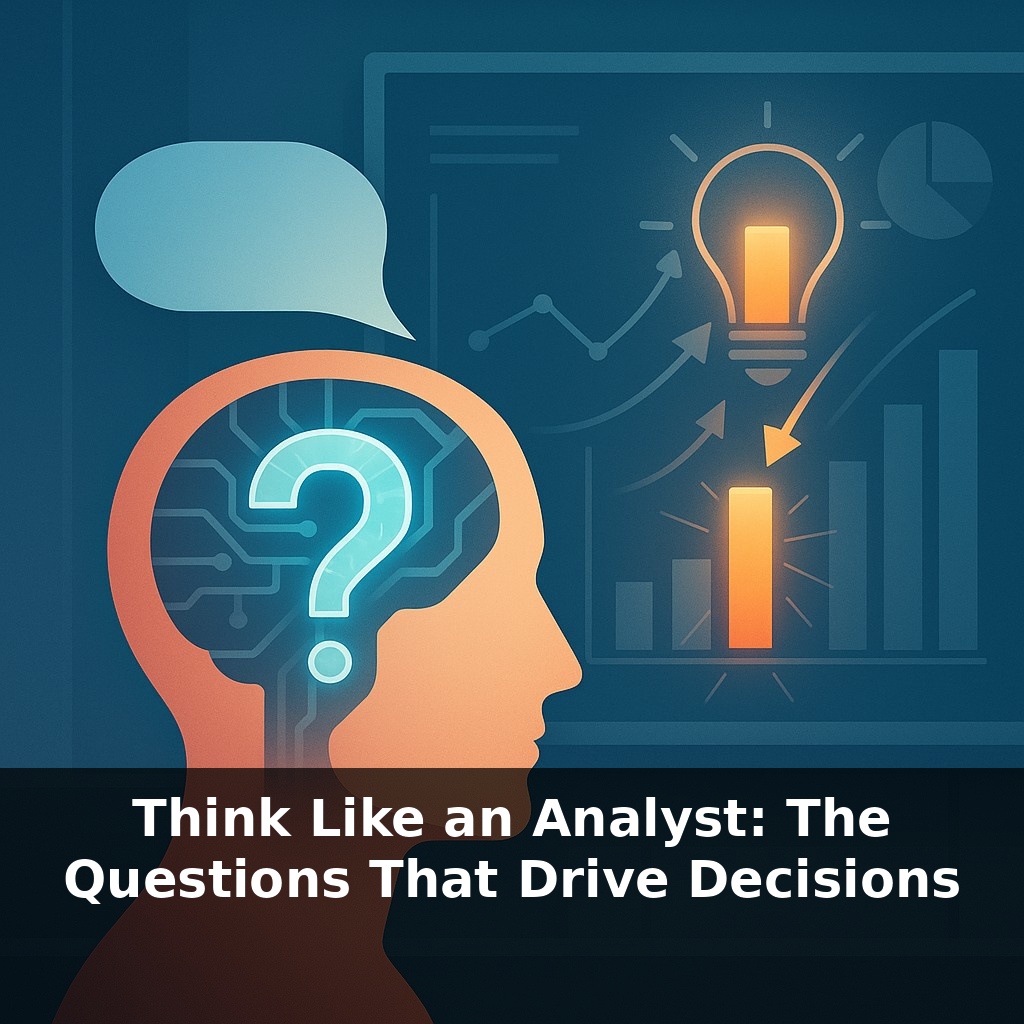
Think Like an Analyst: The Questions That Drive Decisions
📝 Transcript
A Harvard review found the biggest gap between average and top analysts isn’t tools or coding—it’s the questions they ask. You’re in a meeting, a dashboard full of charts on the screen. Numbers look fine. Then one sharp question suddenly flips the whole decision.
Most people open a dataset and immediately ask, “What can I do with this?” Analysts who consistently drive impact start somewhere else: “What *must* I learn to change this outcome?” That tiny shift turns a pile of numbers into a focused search. Think about how a good editor treats a messy draft: they don’t fix every sentence; they hunt for the one structural issue that, if clarified, makes everything else fall into place. Analysts do the same with information. They’re not chasing more charts; they’re chasing sharper prompts. Each refinement trims the noise, revealing which metrics actually move revenue, risk, or customer behavior. Over time, this habit changes how you walk into any problem. You’re no longer the person asked to “pull some data.” You become the one people turn to when the room is stuck and someone needs to ask, “Are we even solving the right thing?”
Strong analysts don’t wait for perfect data or fancy tools; they create clarity by deliberately zooming in and out. At the widest level, they anchor on business stakes: revenue, risk, cost, reputation. Then they tighten the lens: which behaviors, segments, or time windows could actually move those outcomes? Instead of accepting a vague ask like “understand churn,” they peel it back: churn of whom, when, after which events, compared to what? This layered questioning turns a foggy request into a map of sub-questions you can test, prioritize, and sequence, so each step in your work has a reason to exist.
The analysts who change outcomes treat their questions like prototypes, not pronouncements. They don’t ask one “big” question and disappear into a spreadsheet; they iterate through layers of smaller, testable ones that evolve as they learn.
Start with the most concrete layer: *observable change*. Something moved—sign‑ups dipped, complaints spiked, conversion ticked up on mobile. Effective analysts first pin this down with precision: “Which exact metric moved, by how much, over what window, and for which slice of users or products?” Until that’s nailed, anything upstream is guesswork.
Next comes *structure*: “How can I break this vague topic into mutually exclusive, collectively exhaustive buckets?” Instead of “Why are sales down?” you might push into: “Is this volume, price, or mix? New customers or existing? Specific regions or channels?” Each sub-question is a fork in the road that eliminates whole swaths of irrelevant data.
Then they move to *mechanisms*: questions about behaviors and sequences rather than aggregates. “What common sequence of actions do churned customers show in the 30 days before they leave?” or “Which touchpoints appear in 80% of our highest‑value journeys?” Now your questions start aligning with levers the business can realistically pull—product changes, pricing tests, message tweaks.
Alongside this, strong analysts continually ask *comparative* questions. Rarely is an absolute number as revealing as a contrast: this month vs. last, exposed vs. not exposed, customers who saw feature X vs. those who didn’t. “Compared to what?” becomes a reflex, because comparison naturally points toward causality candidates, even before formal modeling.
They also learn to ask *constraints* questions early, because a beautiful analysis that can’t influence action is theater: “What decisions are actually on the table?” “What’s the time horizon?” “What can’t we change, no matter what the data says?” These boundaries sharpen the scope of your work more than another ten filters ever will.
Underneath all of this sits one quiet habit: they write their questions down, in order, as they go. That evolving list—what you believed, what you asked next, what you ruled out—becomes both a thinking tool and an audit trail. It keeps you from chasing every curiosity and helps you explain, in plain language, why your recommendation makes sense.
Consider a real scenario: a retailer sees loyalty-app usage stall. A weak prompt is, “Pull everything on app engagement.” A stronger analyst asks instead, “Which three customer behaviors, if changed, would most increase repeat purchases through the app?” From there, they might line up testable sub‑questions: “Do push notifications nudge lapsed users back?” “Does simplifying checkout lift completion?” The questions now point to experiments, not just dashboards.
Or take Amazon’s recommendations. The engine didn’t start from “Show more products.” It started from a focused curiosity: “What related products meaningfully increase a customer’s order value without annoying them?” That framing steered which signals to collect, how to evaluate relevance, and how to measure success.
In practice, you can borrow this mindset even without advanced tooling. Before opening a spreadsheet, draft two versions of your core prompt: one vague, one uncomfortably specific. Then ask: “What analysis would *not* change based on how I answer this?” If nothing would change, your question is still too soft. Keep tightening until a “yes” or “no” would clearly alter your next step.
As tools grow more automated, the real leverage shifts to how you frame what’s worth exploring. Think of future analysts less as number‑crunchers and more as editors, deciding which “storylines” in the data deserve a deeper chapter. Augmented analytics will propose angles you’d miss, but you’ll be the one judging which paths are ethical, strategically aligned, and feasible. That judgment will be a differentiator, not a commodity—and it’s built one disciplined question at a time.
Treat this like learning a new language: fluency comes from daily use, not theory. Your challenge this week: before any report or meeting, draft one “too narrow” and one “too broad” version of your core prompt. Then adjust until it feels slightly uncomfortable. That edge is where better patterns, bolder options, and clearer trade‑offs start to surface.
From this course
Data Analysis Without Code: Excel to Insights
7 episodesUnlock all episodes
Full access to 7 episodes and everything on OwlUp.
Subscribe — $1.99/monthLess than a coffee ☕ · Cancel anytime

