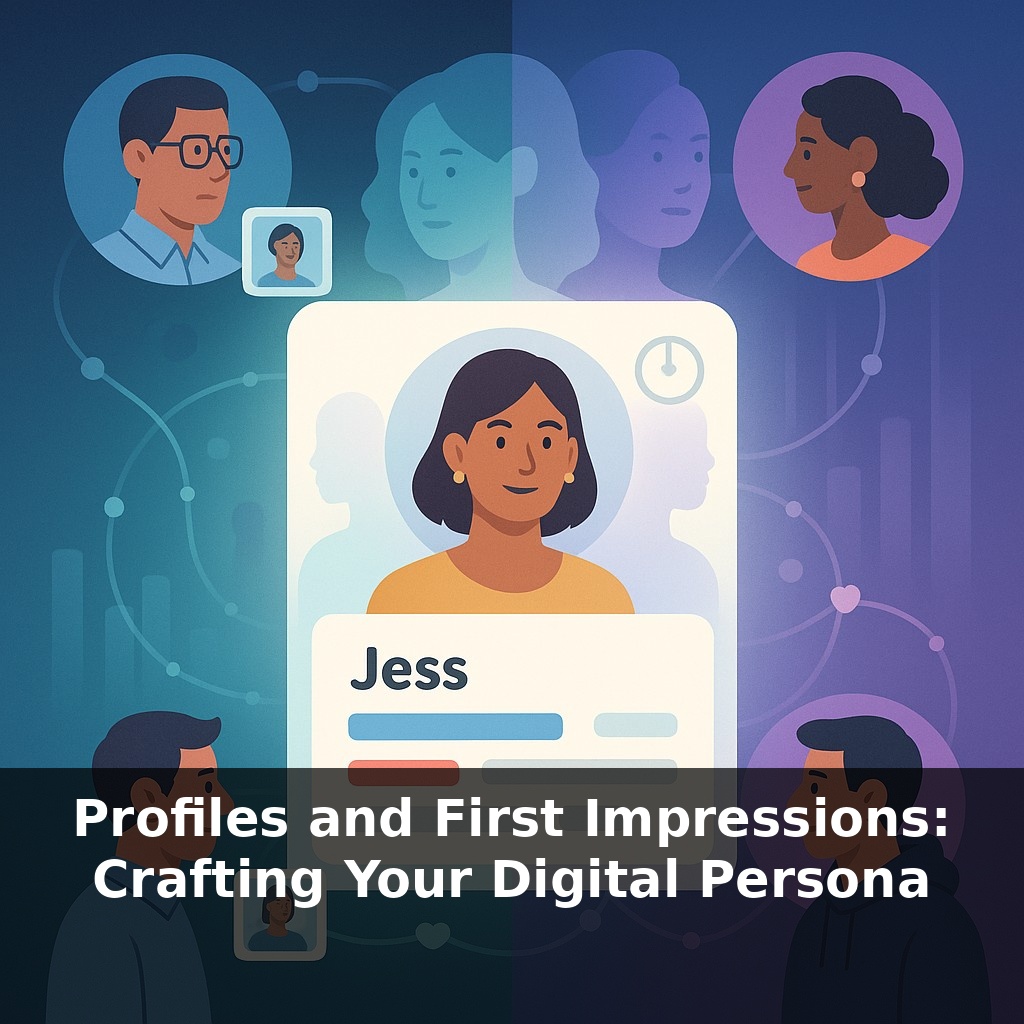
In roughly six seconds, a stranger online decides if you’re competent, likable, and worth their time. Meet Jess, a marketing consultant whose online profile seems ordinary. But today, a recruiter, a potential client, and a former classmate all stumble upon her profile, each forming a unique story of who Jess really is.
Now add algorithms to that mix—quietly deciding who even gets to see you in the first place. Your headline, photo, and the words you tuck into your “About” section don’t just speak to humans; they signal to machines what rooms you belong in: which searches you appear in, which feeds you surface on, which opportunities drift past without you ever knowing. A sparse or inconsistent profile can be technically “correct” yet practically invisible, while a thoughtfully tuned one keeps showing up in the right places. This isn’t about pretending to be someone you’re not. It’s about choosing which three or four aspects of your real self you want amplified, then aligning your story, visuals, and keywords so both people and platforms can recognize you—and remember you.
Your digital persona is also shaped by tiny, often overlooked details: tense (“I design” vs. “I designed”), verbs (“led” vs. “helped”), even whether you list outcomes or only duties. These cues quietly anchor you in a reader’s mind as either future-facing or stuck in the past, decisive or tentative, signal or noise. Platforms reinforce this: consistent language across your headline, experiences, and featured work teaches both humans and systems what to associate you with. Over time, that consistency can turn scattered roles and projects into a recognizable throughline instead of a confusing grab bag of activities.
Scroll through a few profiles and you’ll notice something subtle: the ones that feel “solid” don’t necessarily belong to the most accomplished people, but to the ones whose details agree with each other. The job titles, dates, skills, recommendations, and even the way they describe side projects all seem to point in the same direction. That consistency is doing invisible work. It reassures a recruiter that nothing is off. It helps a collaborator quickly see, “Oh, you’re the person for X.” And it gives algorithms a clean, repeated pattern to latch onto.
Where most people stumble is in the seams between platforms and time periods. Your LinkedIn says “Product Manager,” your portfolio calls you a “UX Strategist,” and your last conference bio introduces you as a “Growth Lead.” None of those are wrong, but together they blur into a fog. The same happens when your older content showcases a completely different tone or focus than your newer work, with no hint of a transition. To someone scanning fast, it can read less like evolution and more like contradiction.
This is where selective emphasis matters. You don’t need every skill and every chapter of your career to be foregrounded equally. Instead, you choose a small set of “anchor themes” that everything else orbits around: maybe “data-informed design,” “community building,” or “technical leadership.” Then you audit your headings, blurbs, and featured links to see whether they actually reinforce those anchors or pull away from them.
One practical way to think about this: your public profiles function like a version-controlled software project. Old code (past roles, abandoned side projects) doesn’t disappear, but you can refactor how it’s documented, label what’s deprecated, and highlight the current release. A short line in a summary—“Earlier in my career, I worked primarily in editorial roles before moving into analytics”—can stitch together what would otherwise look like a jarring jump.
Done well, this kind of alignment doesn’t flatten you into a slogan. It gives people a stable mental handle to grab onto, so as they encounter you in different contexts—search results, posts, bylines—they keep recognizing the same person, just in new scenes.
Think of a profile review like tuning a racing bike before a long ride. You’re not changing who’s riding; you’re tightening what already exists so the motion feels clean and intentional.
Take Maya, who’s worked as a teacher, then a customer support rep, and now wants to move into learning-tech. In her current profiles, each role reads like a separate island. In a tuned version, her headline becomes “Customer Education Specialist | Turning complex tools into clear learning journeys.” Her teaching job highlights curriculum design and measurable learning outcomes; her support role emphasizes translating user pain into clear guidance. A short featured section links to a help-center article she wrote that cut tickets by 18%.
Or consider Leo, a mid-level engineer aiming for staff roles. Instead of listing every framework he’s touched, he foregrounds “systems that survive scale.” His examples: a logging pipeline that cut incident debug time by 40%, a rewrite that halved infrastructure costs, a doc set that onboarded new hires in two days instead of five.
Recruiters may soon expect your history to read less like a static CV and more like a live system status page: current focus, recent changes, known “bugs,” and upcoming “releases.” As verified credentials, AI-driven summaries, and always-on checks spread, the gap between who you are, what you’ve done, and what’s discoverable about you will shrink. The practical shift: treating every project, talk, and even comment as part of a traceable, evolving professional log.
Treat this less as “branding” and more as ongoing maintenance. Profiles calcify when you only touch them for big events—a job hunt, a promotion. Instead, adjust them like a playlist: add one new project, retire one outdated detail, nudge one line closer to where you’re heading. Over months, those tiny edits compound into a persona that quietly opens doors.
Here’s your challenge this week: Choose one platform you actually use (LinkedIn, Instagram, or your portfolio site) and rewrite your bio so it passes the “stranger test”: a total stranger should immediately get who you are, what you do, and what you want next. Replace your current profile photo with one that clearly shows your face, has a clean background, and matches the vibe you want to be known for (creative, analytical, friendly, etc.). Then, update your top 6–9 visible posts (or pinned posts) so they all point in the same direction—same niche, same tone, same kind of work you want more of—and remove or archive anything that clashes with that story. Finally, send your updated profile to two people who don’t know you well and ask them, “What three words come to mind when you see this?”—if they don’t match what you were going for, tweak and try again.