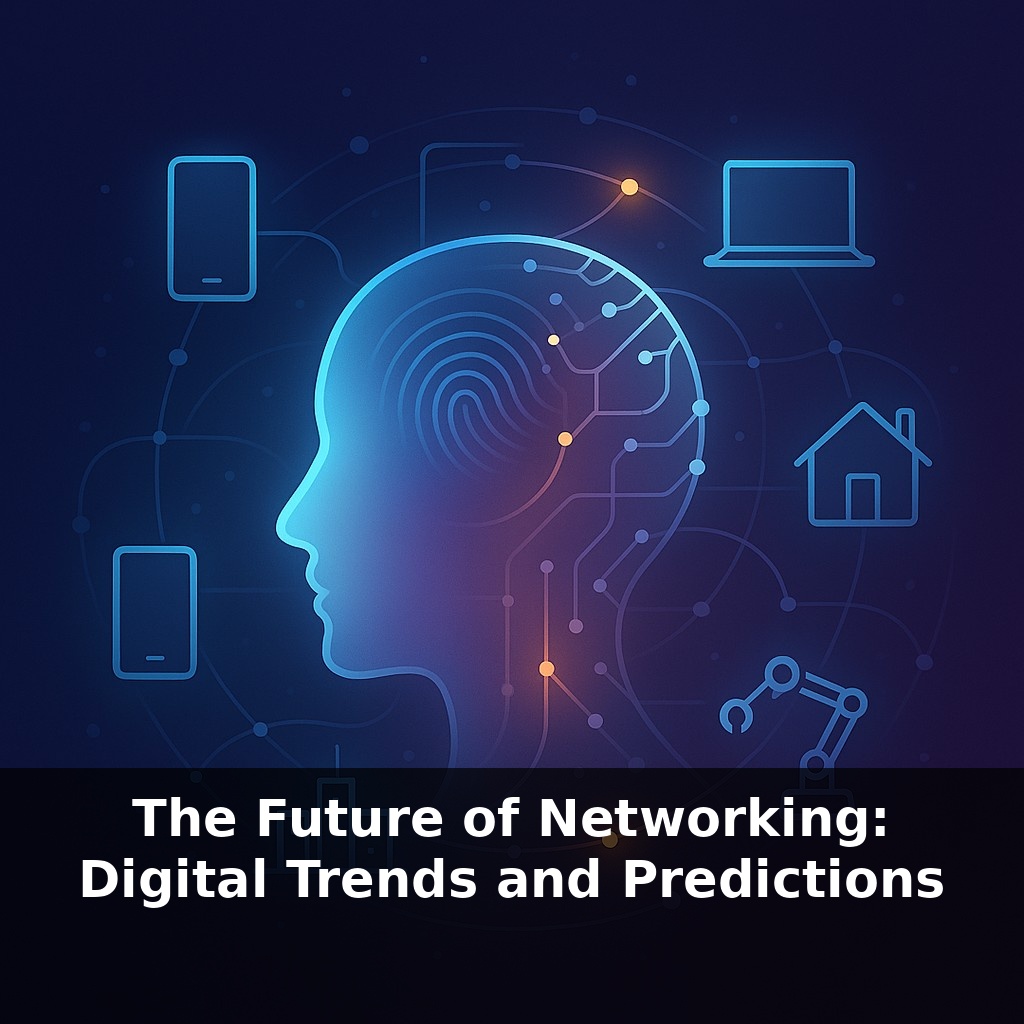
Nearly four devices exist online for each person, yet your network still sees them as identical strangers. Let's explore a future where networks learn to discern identities and intents seamlessly. In this episode, we step into a future where the network actually understands who’s asking, why, and how urgent the request really is.
By the time 6G matures, your “network” won’t feel like a place you connect to—it’ll feel like an invisible utility woven into every interaction, from a factory robot handoff to a doctor guiding a remote surgery. Instead of one big pipe, connectivity will splinter into thousands of micro-paths, each tuned to a task: ultra-reliable for machines, privacy-hardened for identities, blisteringly fast for immersive media. Edge locations will quietly take over jobs the central cloud can’t do fast enough, like real-time fraud detection at a payment terminal or instant language translation in AR glasses. At the same time, cryptographic tools like decentralized identifiers will let you prove “this is me” without constantly handing over all your data. Layer on early quantum-secure links, and we’re moving toward a world where trust and speed are no longer trade-offs, but defaults.
Soon, the real shift won’t just be faster links; it’ll be who gets to *shape* them. As software-defined control spreads, networks start behaving less like fixed roads and more like programmable cities: policies, priority lanes, and invisible zoning updated in code instead of concrete. AI agents will quietly negotiate which flows matter most—your live surgery feed or a background update—without asking you every time. Meanwhile, early quantum-safe techniques will be tested in high-stakes sectors first: interbank transfers, power grids, defense. Whatever proves resilient there will later trickle down into everyday collaboration and consumer tools.
Think of today’s infrastructure teams staring at dashboards full of red, yellow, and green lights; in the future, much of that “watching” turns into “directing.” As links get faster and more distributed, the real advantage shifts to whoever can describe *intent* clearly and let software orchestrate the rest.
That starts with translating business language into policy. “Never let a trading order exceed 5 ms round-trip,” “Always encrypt customer identifiers end-to-end,” “Prioritize telepresence rooms over casual streaming during work hours.” Intent-based systems parse those rules, simulate their impact, then push them down into switches, radios, and firewalls. Instead of tweaking VLANs at 2 a.m., engineers will debate whether a new AI product deserves higher priority than a real-time analytics feed—and the system will run “what if” scenarios before anything breaks.
Ultra-low-latency 5G and early 6G prototypes add a new twist: *time-bound guarantees*. A robot arm in a factory, an autonomous drone fleet, or a multiplayer AR game can all request specific latency and reliability levels per session. The challenge shifts from “Is the link up?” to “Can we admit this new demand without violating anyone else’s promise?” Expect admission control algorithms, powered by AI, to become as critical as capacity itself.
At the same time, identity stops being just a login screen and becomes a signaling layer. When a device presents a decentralized identifier, the surrounding infrastructure can adapt in milliseconds: grant access to a local edge workload, redirect to a quantum-safe channel for high-value transactions, or sandbox suspicious behavior without blocking everything. The paradox is that better identity can reduce *friction* while actually tightening security.
Quantum networking, for now, lives mostly in experiments and specialized corridors connecting banks, data centers, and research labs. But its presence will force architects to think in “crypto agility” terms: can your environment swap in quantum-safe protocols without rewriting every app? Early adopters will bake this flexibility into software-defined overlays, so when quantum links expand, the logical fabric is already prepared.
Your challenge this week: Map one real workflow—something time-critical in your world—and label three tiers: “must never fail,” “must stay fast,” and “must stay private.” Then ask: if the underlying connectivity suddenly became programmable, what *intent statements* would you write to protect those three tiers differently?
Picture a hospital shifting from “best effort” Wi‑Fi to a programmable fabric. An AI triage system flags a stroke case; instantly, the patient’s scans, vitals, and tele-neurology consult are pushed onto a high-priority lane, while less urgent file sync jobs are quietly throttled. No one files a ticket—clinical intent is translated into routing and quality choices on the fly.
In a stadium, thousands of fans stream, bet, and share AR replays. The venue’s software-defined core carves out a reserved slice for safety systems and payment terminals, then dynamically reallocates spare capacity to cameras when a game-winning play triggers a spike in uploads. The “rules of the venue” become code, not laminated binders.
For a distributed startup, laptops, sensors, and build pipelines negotiate for bandwidth continuously. Daily standups get crisp video, CI pipelines burst to the cloud when links are cheap, and sensitive design reviews automatically shift to hardened paths with stricter verification—policy following context, not just users.
By 2035, “online vs offline” blurs into constant ambient presence: apps quietly negotiate priority like drivers merging on a smart highway, with AI refereeing who moves first. Offices, homes, and cities start to feel less like fixed locations and more like “performance profiles” you switch between—focus mode, collaboration mode, high-security mode—each reshaping routes, quality, and safeguards in seconds. The practical skill isn’t wiring boxes; it’s designing these profiles so they align with real human stakes.
Soon, “going online” will feel as dated as “dialing in.” You’ll just move through layers of context: street, office, train, home. Each moment will quietly renegotiate speed, trust, and cost, the way dynamic lighting follows performers on a stage. The real frontier isn’t more bandwidth—it’s choreographing these invisible spotlights around what actually matters.
Before next week, ask yourself: 1) “If my LinkedIn and other digital profiles were the *only* way someone could ‘meet’ me, what specific updates (headline, banner, featured work, recent posts) would actually reflect the network I want to build in the next 12 months?” 2) “Looking at the digital communities and niche Slack/Discord groups I’m already in, which 3 people working on AI, Web3, or remote-collaboration tools could I send a short, personalized voice or video message to this week—sharing a concrete way I can be useful to them?” 3) “If networking is moving toward ongoing micro-interactions instead of big one-off events, what is one recurring digital ‘touchpoint’ I can start this week (e.g., a weekly insight post, a short Loom recap, or a curated resource email) that would genuinely help my existing network stay ahead of these trends?”