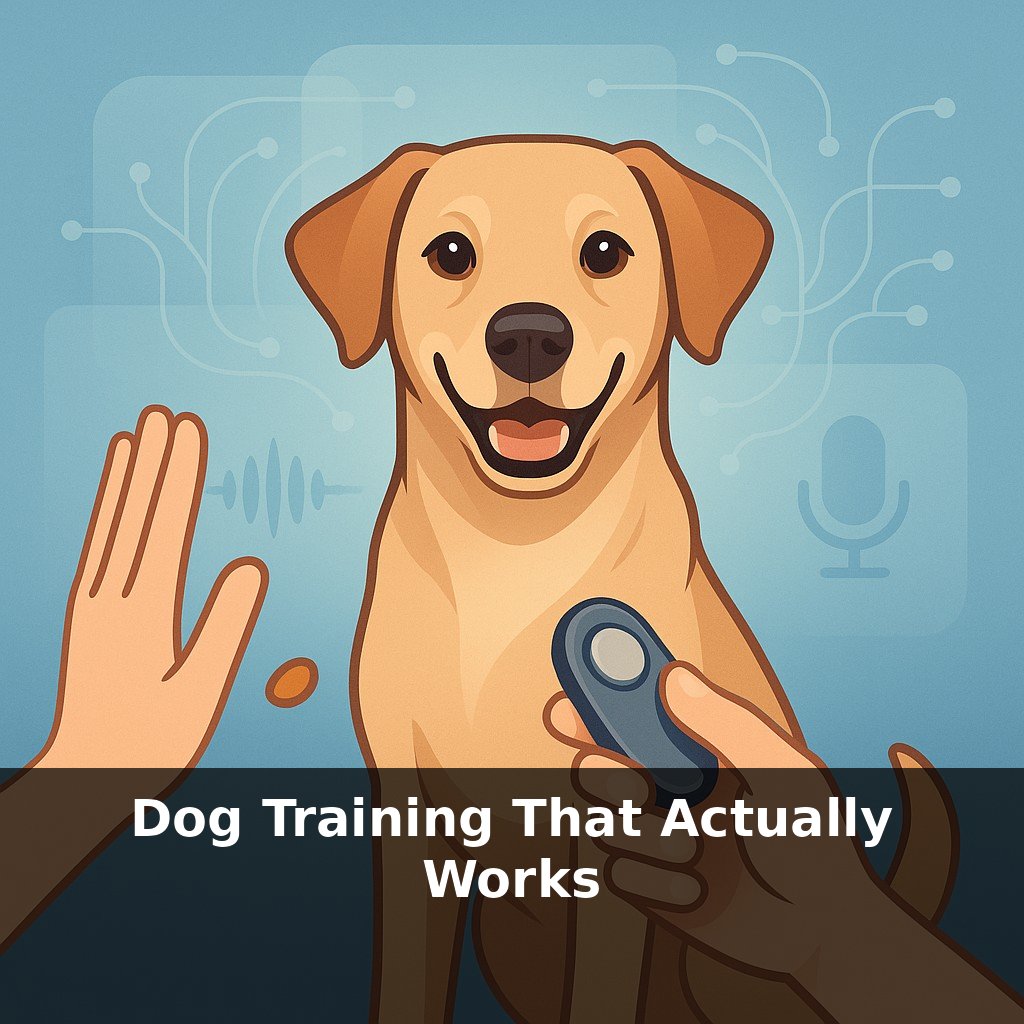
Dogs trained mostly with punishment are nearly three times more likely to show aggression—yet many owners still think being “firm” means being harsh. Your dog is learning from every interaction. The real question is: are you teaching cooperation…or just avoiding conflict?
In science-based training, “being in charge” doesn’t mean out-muscling your dog—it means understanding how their brain links actions to outcomes. Every sit, pull, lick, or bark is followed by *something*: a treat, eye contact, a laugh, or you walking faster. Over time, your dog learns a simple rule: *Do what reliably makes good stuff happen; avoid what makes good stuff stop.*
Decades of research in animal behavior show that when rewards clearly follow the behaviors we like, dogs learn faster, stay more engaged, and show fewer signs of stress. Instead of guessing what your dog “should” understand, you’re running tiny behavioral experiments: change one thing (timing, reward, environment), watch what your dog does, and adjust. The goal isn’t a perfectly obedient robot—it’s a responsive partner whose choices make sense because the learning process has been made crystal clear.
Science-based training starts by asking, “What does the dog’s behavior *do* in this moment?” Barking might make the mail carrier leave, jumping might produce laughter, sitting might open the back door. To a dog, these consequences are like labels on buttons: “Press this, and that happens.” Researchers call this the *function* of behavior, and it’s why the same action can mean different things in different contexts. A bark at the window, for instance, is less a moral issue and more a feedback loop you can redesign by changing what happens next.
Science-based trainers build on that “what does the behavior *do*?” question by looking at three pieces around every action: what happens *before* (the setup), what the dog *does*, and what happens *after*. In research terms, that’s the ABC: Antecedent, Behavior, Consequence. You don’t need the jargon—but you *do* need the habit of zooming out from the moment your dog “messes up” and asking, “What set this up, and what payoff is keeping it alive?”
Take leash pulling. Before the pull: you clip the leash and head toward the park—huge anticipation. Behavior: your dog forges ahead. After: you follow. You might be muttering “heel, heel,” but from your dog’s perspective, pulling is the button that makes the park arrive faster. A science-based plan doesn’t start with yanking back; it starts with changing the pattern so that only loose-leash steps make the world move forward.
This is where *classical* conditioning quietly supports the picture. All the things that come right *before* something meaningful—like the sound of your treat pouch, the doorbell, or another dog appearing—gain emotional weight. Over time, your dog doesn’t just react to food or visitors; they react to the *predictors* of food or visitors. That’s why thoughtful trainers care so much about creating “good news” pairings: other dogs appear, and good things rain from you; the harness comes out, and a calm, predictable routine follows. You’re not just teaching skills; you’re shaping how the world *feels* to your dog.
Reward type matters, too. Food is efficient, but not the only currency. Many pet dogs will work hard for tug, a chance to sniff, greeting a friend, or access to the yard. Working teams take this even further: detection dogs may earn a tossed ball; guide dogs often earn quiet praise and a brief pause. The science isn’t “always use treats”; it’s “find what your individual dog will happily ‘work for,’ then pay reliably for the behaviors you care about.”
Think of it like fitting a tailored suit: the cut (timing, environment, criteria) is based on general principles, but the final fit is customized to the dog in front of you.
Think of this like composing a song together with your dog: the notes are small choices, and science helps you arrange them into a melody that makes sense to both of you.
Say your dog explosively barks at the door. Instead of just silencing the noise, you can design a new “sequence.” Doorbell rings → dog runs to a mat → you toss a treat there → then calmly open the door. After enough repetitions, many dogs *race* to the mat when the bell sounds, because that’s where the good part of the song happens.
Or consider a dog that freezes when cars pass. Rather than dragging them closer, you might start far away where they can still eat, then pair each passing car with a tiny treat party, gradually moving closer only as they stay loose and curious. You’re not forcing bravery; you’re reshaping what “cars” predict.
These small, structured shifts compound. Over weeks, routines that once felt chaotic begin to run almost on autopilot—because you’ve rewritten the underlying “music” your dog is dancing to.
A 10‑minute session can change more than manners—it can reshape your dog’s daily welfare. As tracking tech and AI tools mature, “good training” may look less like drills and more like tuning a living dashboard of mood, focus, and needs. You might spot patterns: your dog relaxes faster after scent games than fetch, or learns new cues best on quiet mornings. Like adjusting a camera’s settings to match the light, science-based choices will increasingly let you customize life, not just commands.
Your challenge this week: turn one routine into a mini “field study.” Choose a daily moment—going out the door, feeding time, or bedtime—and film it for three days in a row, doing everything as you normally would. On day four, change just one thing to make it easier or calmer for your dog (shorter session, richer reward, more distance, softer voice). Compare the videos: does your dog’s body language look looser, more focused, or quicker to respond after your tweak?
Each adjustment you test is like tuning a radio: slight turns can suddenly bring your dog’s needs and preferences into clearer signal. Over time, you’ll spot subtle “stations”—the walk pace that keeps them loose, the game that settles them fastest—and training becomes less about control, more about co-authoring a daily routine that fits you both.
Before next week, ask yourself: 1) “When my dog does something I don’t like (barking, jumping, pulling), what exactly is *reinforcing* that behavior right now, and how could I calmly change the situation so that only the behavior I *do* want gets rewarded?” 2) “In one everyday routine—like feeding, leash walking, or greeting me at the door—how can I turn it into a ‘training moment’ using clear cues, timely rewards, and criteria my dog can realistically succeed at today?” 3) “The next time I feel frustrated with my dog, what data-based question can I pause and ask—such as ‘Did I make the behavior easy enough?’ or ‘Was my timing of the reward clear?’—before I decide whether the training ‘isn’t working’?”