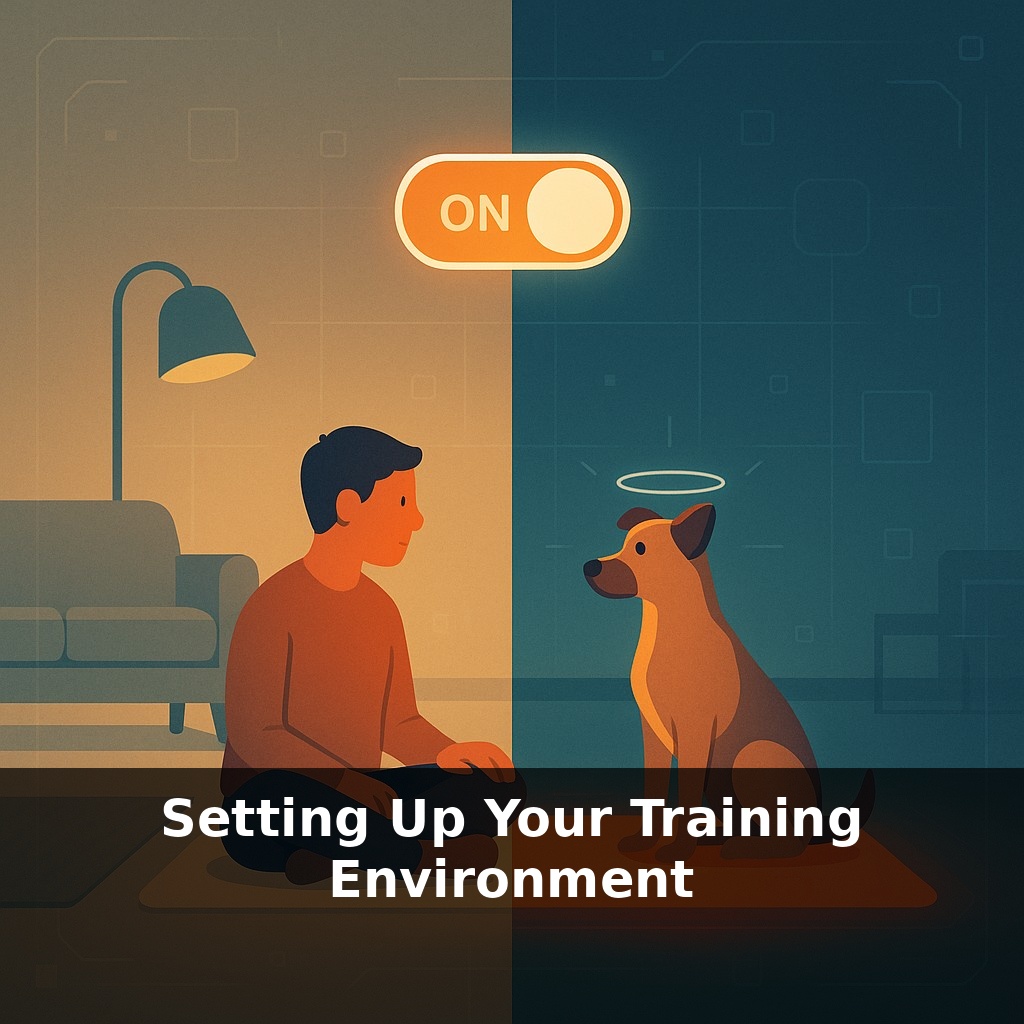
Dogs learn new skills up to three times faster in the right room—even with the same treats and the same trainer. You’re on the floor, cue ready, but your dog is staring at a drifting dust mote. Same dog, same cue… different space, completely different brain.
So instead of fighting your living room, we’re going to redesign it—just enough that your dog’s brain says, “Oh, this is the place where focusing is easy.” Think less about buying new gear and more about toggling a “training mode” in your home. That might be as simple as always using the same corner, laying down the same mat, and turning off one specific source of noise that reliably pulls your dog’s attention away, like an always-on TV or street-facing window.
We’ll also get precise about distractions. “Calm” isn’t a vibe; it’s a list: sounds, smells, movements, surfaces. Once you can name those, you can control them. Then we’ll stack them intentionally—from “quiet back bedroom” to “kids running through the kitchen”—so your dog isn’t thrown into the deep end every time you want to teach something new.
Think of this like setting up audio gear: before you fine‑tune a song, you choose the right room, angle the speakers, and kill the feedback. With your dog, that means looking beyond “quiet” and asking: what does this specific dog notice first—floor texture, door sounds, food smells, people movement? A senior, slippery‑floor‑averse dog may focus better on a yoga mat in a hallway than on hardwood in a wide‑open living room. A teen dog who reacts to doors might work best facing a blank wall. You’re not decorating; you’re curating the few details their brain can handle at once.
Start by deciding where your “classroom zone” actually is. You don’t need a spare room; you need a predictable patch of floor where your dog’s body feels safe and their brain isn’t constantly auditing the world. For many teams, that ends up being a corner of the bedroom, a hallway, or one end of the couch area—not the whole room.
Next, audit the *ground*. Many dogs work poorly not because they’re “stubborn,” but because they’re bracing on slick floors or tensing against small slips. Lay down something with grip: a rubber-backed rug, yoga mat, gym tiles. Watch your dog walk onto it. Do their steps look longer and looser? That’s the body saying, “I can move here without worrying.” You’ve just freed up bandwidth for learning.
Now look at the *walls* of the space. Not literally repainting, but reducing visual noise inside your dog’s field of view. Clear the immediate zone of toy piles, laundry, food bowls—anything that tends to grab their attention mid-rep. You’re not aiming for sterile, just “nothing that routinely sucks their eyes away from you.” If you can, position your dog so they’re not facing windows, doors, or high‑traffic pathways.
Then deal with *sound*. Instead of adding random TV chatter, choose whether you want a relatively quiet room or a steady, boring sound backdrop. A fan or soft white‑noise at a low, consistent volume can help dampen sudden outdoor spikes that jerk your dog out of focus. The key is predictability: the fewer surprise sounds, the less your dog has to keep half an ear on the world.
Finally, establish a *ritual* that flips this space into training mode. Same mat, same treat container, same 3–5 minute bursts, several times a day. Think of it like a pre‑flight checklist: mat down, noise source on or off, high‑value rewards ready, phone out of reach. After a week of this, most dogs start walking into that area already expecting to work.
Your challenge this week: claim a specific 6×6 ft spot as your training zone, modify the floor, sightlines, and sound once, and then run at least two tiny sessions a day there—no training anywhere else until your dog visibly relaxes and orients to you as soon as you step into that space together.
A simple way to test whether your setup is working: notice how quickly your dog “boots up” when you step into the zone. In a well‑tuned space, you’ll see tiny tells—ears flick to you, body settles, maybe a quick sit without being asked. Treat those micro‑responses like a green light that the session can start. If instead your dog’s eyes keep darting to one corner, treat that as data: maybe the litter box, shoe rack, or treat cupboard lives there and needs to move.
Use small experiments. One day, add a chair to your zone and see if your dog’s focus changes when you’re sitting versus kneeling. Another day, try training at two different times—early morning vs. pre‑dinner—and compare how fast your dog offers the first behavior. Like a traveler learning which airport lines move fastest, you’re mapping which versions of this same space give you the smoothest “check‑in” for training, so future sessions start on an easier setting instead of hard mode.
Your dog’s first “classroom” might soon be smarter than your phone. As homes add sensors and AR tools, you’ll get live feedback on things you can’t easily feel: stale air, rising humidity, even subtle echoes that nudge some dogs toward tension. Think of it less like gadget clutter and more like a mixing board in a studio—tiny sliders you can adjust to tune the room for focus. The big opportunity isn’t more tech, but tech that quietly suggests one small, timely tweak you wouldn’t have spotted alone.
As you refine this zone, you’re also training *your own* attention. Noticing tiny shifts in posture or breathing turns you from “person with treats” into something closer to a sound engineer riding the faders. Over time, that habit follows you outside this space, so busy sidewalks feel less like chaos and more like a puzzle you know how to dial down.
Before next week, ask yourself: 1) “If I walked into my training space tomorrow ready for a focused session, what exact pieces of equipment, apps, and metrics (e.g., heart rate monitor, barbell, timer, training log) would need to be laid out and ready—and what can I set up or rearrange today to make that true?” 2) “Which current distractions in my environment (phone notifications, cluttered garage, shared living room, uncomfortable shoes, poor lighting) most often derail my training, and what is one concrete change I can make today—like silencing my phone, clearing a 6x6 ft area, or setting up a ‘no-interrupt’ rule during sessions—to remove or reduce them?” 3) “How can I make my environment positively cue my training habits—could I leave my gym shoes by the door, pre-load the bar with my warm-up weight, or pin tomorrow’s workout on the wall—so that when I see my space later this week, it practically ‘pulls’ me into starting?”