The Revolution Through Marie's Eyes
📝 Transcript
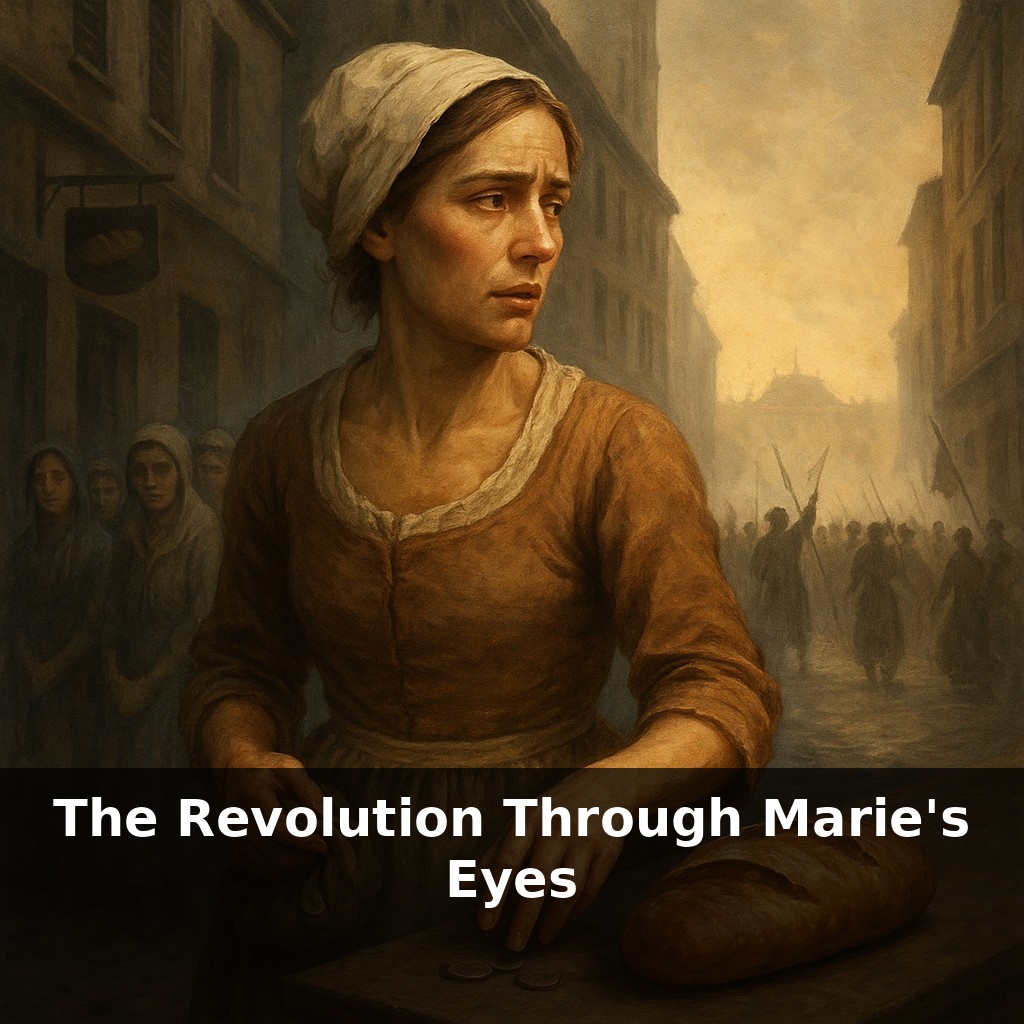
A starving city overthrows a king—but through the eyes of a woman who can’t afford a loaf of bread. Marie stands in a bakery line, hears shouts about rights and liberty, and must decide: follow the crowd toward Versailles…or go home and hope her children eat tonight.
Thirty-two sous. That’s the number echoing in Marie’s mind—the day’s wage her husband earns, and almost every coin now vanishes into a single loaf. Since the grain crisis of 1788–89, bread has swollen to nearly four-fifths of what a laborer brings home. Each sunrise feels like opening an empty cupboard and finding one more shelf stripped bare.
News travels faster than bread: talk of new assemblies, whispered names of deputies, rumors of “citizens” who finally have a voice. Yet Marie’s world measures politics in crumbs and queues. While philosophers argue in salons, she overhears a different debate in the washhouse and the market stall: How long can a family live on soup stretched thinner than the hope that tomorrow’s prices will fall?
Outside, posters bloom on walls like urgent notices on a factory bulletin board—calls to meet, to march, to speak. For women like Marie, the street is becoming a rough, improvised parliament.
Today, the city hums with new sounds: drumbeats from the National Guard, printers’ presses clacking like looms turning ink into arguments, distant cheers from the latest speech in a crowded club. Names—Jacobin, Cordelier—filter into Marie’s world not as theories, but as places where neighbors vanish for hours and return changed, speaking of “sovereignty” with the urgency of unpaid rent. At the fountain, someone passes a handwritten petition, its edges damp from too many hands. Sign, they say, and your anger becomes more than a sigh in a queue; it enters the record, like a worker’s mark on a ledger.
The first time Marie follows a crowd instead of a bread line, her feet hurt long before her conscience does. Nineteen kilometres of mud, blisters, and shouted slogans: the road to Versailles is less a glorious march than an endless shuffle of wet skirts and growling stomachs. Beside her, fishwives curse like sailors, market-sellers bargain for a place under a shared cloak, and someone up ahead manages to keep a drum beating in rhythm with their steps.
History will condense this into a neat phrase—the October Women’s March—but in Marie’s memory it’s mostly rain, the stink of unwashed wool, and the shock of seeing the National Guard fall in behind them, uniforms mingling with bare feet. For once, the city’s official defenders are not blocking women’s path; they are lengthening it.
In these hours, Marie discovers something unsettling: anger can be organised. A neighbour who once only complained in queues now shouts demands clearly enough that men on horseback must listen. Another, who can barely sign her name, repeats a list of prices and grievances with the precision of a trained clerk. Later, pamphlets will praise “the people” as if it were an abstract force; Marie realises “the people” has calloused hands and a hoarse voice.
Back in Paris, the energy doesn’t vanish when the mud dries. New clubs open their doors to spectators on the benches, and women like Marie slip in at the edges. They cannot vote there, but they can clap, hiss, and interrupt. Some nights, the commentary in the cheap seats steers the mood of the room as sharply as any orator at the podium.
From these back rows, women begin drafting their own texts. Between 1789 and 1793, dozens of petitions arrive at the Assembly signed by “citizenesses” demanding weapons for the defence of the city, schooling for girls, the right to wear the revolutionary cockade, or to form armed battalions. On paper, Marie and her peers claim identities the law does not yet recognise.
The Revolution’s architects imagine a clean blueprint for a new order, but Marie experiences something closer to a building site in motion: walls half-raised, rules improvised, danger everywhere, and yet—at last—a door she can push against.
At first, Marie’s world of clubs and petitions feels as distant as a map of a city she’s never crossed. Then the map folds into her street. A neighbour joins a political society and starts bringing back scraps of news, dates of key votes, names of deputies who sneer at “citizenesses.” Another learns to read minutes from a club the way others read parish registers, tracing who spoke, who stayed silent, who shifted sides overnight.
Here, politics functions like a prototype under constant testing: each new regulation about markets, wages, or the price of candles is released into Marie’s quarter, where women “debug” it in real time—spot the flaws, feel the crashes, report the damage in angry delegations or sharply worded complaints. When militias are formed, some women drill in courtyards at dawn, wooden pikes on their shoulders, while others sew uniforms or stash powder, turning attics into improvised arsenals. Even choices about colours, ribbons, and caps take on meaning; wearing or refusing a cockade can tilt a conversation at the well toward friendship, suspicion, or open threat.
Marie’s footsteps echo forward. If we trace them with parish lists, complaint letters, even arrest records, the archive starts to look less like a dusty attic and more like a busy train station: routes crossing, voices overlapping, departures noted but not yet fully mapped. With digitised sources and AI, we can follow these routes at scale, spotting patterns no single reader could catch—and asking why so few monuments or street names mark where women once changed a city’s direction.
Marie’s story won’t appear on classroom timelines, but its traces survive in wage disputes, baptism notes, and police reports—the “footnotes” of history. Your challenge this week: follow one unnoticed thread in your own city—a plaque, alley name, or workers’ memorial—and ask whose everyday revolutions it quietly records.

Unlock all episodes
Full access to 7 episodes and everything on OwlUp.
Subscribe — $1.99/monthLess than a coffee ☕ · Cancel anytime