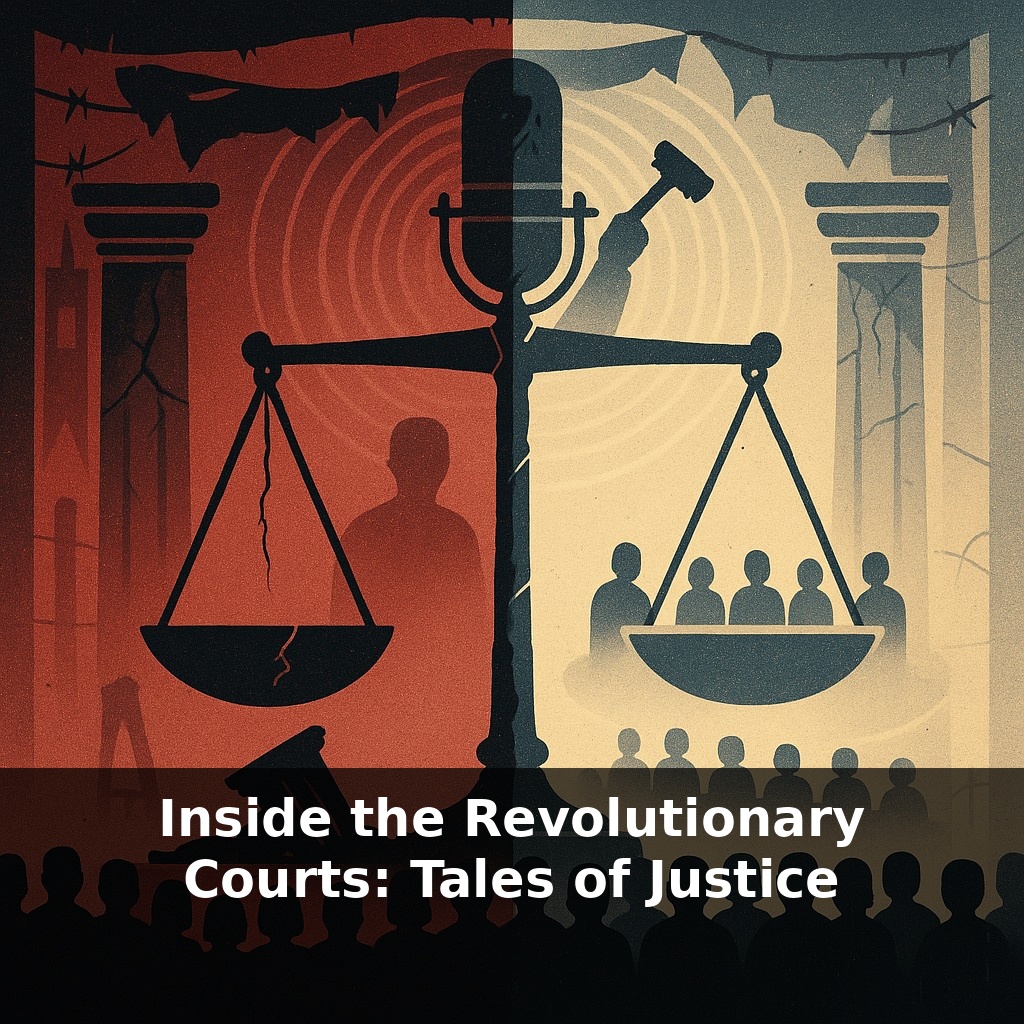
A man walks into court and walks out headless—sometimes in less than an hour. In another revolution, trials turn into island‑wide radio spectacles. In some uprisings, judges demand blood; in others, they ask for truth. So what exactly counts as “justice” when a regime has just fallen?
Five hundred people executed in four months: that’s roughly four deaths a day, every day, just from one revolution’s courts. Yet not all upheavals answered violence with more violence. Some built rooms where former enemies sat facing each other, not to deny the past, but to narrate it out loud. Others turned legal proceedings into something closer to a live‑streamed event than a closed chamber, inviting whole nations to listen in, judge, and remember.
As we move deeper into these revolutionary courtrooms, the key question shifts. It’s no longer only “What did they do?” but “Who was watching—and what were they meant to feel?” Laws are written on paper, but in these moments they’re also written into public memory, like wet concrete that will harden into the story a country tells about itself for generations.
Sometimes the first thing a new regime builds isn’t a school, a road, or even a prison—it’s a special courtroom. The rules inside can look familiar on paper: judges, charges, witnesses. But the purpose has shifted. These forums decide more than individual guilt; they declare who belongs in the new “us” and who will be fixed forever in the role of enemy. A whispered accusation can matter as much as hard evidence. Leaders know that every verdict sends a signal outward, like a broadcast tower quietly redrawing the moral map of the country in real time.
A hearing that ends in under an hour doesn’t just compress testimony; it compresses doubt. In France in 1793–94, average Revolutionary Tribunal cases moved so fast that hesitation itself became suspicious. When Georges Danton finally spoke in his own defense, he talked for two solid hours—only to be executed the next day. The message was clear: eloquence could not compete with momentum. Once the machinery was running, slowing it looked like sabotage.
Other revolutions re‑engineered that machinery instead of merely speeding it up. In Cuba in 1959, proceedings against Batista’s officials were wired into microphones and blasted across the island. Roughly 80% of radio listeners could follow along. That reach turned each hearing into a kind of national town hall with no open floor. People yelled at their receivers, argued in kitchens, listened in barracks. The state didn’t just punish; it curated how millions would first “see” the defeated order, even if they never set foot near a courthouse.
Iran in 1979 pursued another path: density. Within four months, roughly 500 former officials had been executed. Files were thin, hearings brief, turnover relentless. Numbers did political work: they announced that the old hierarchy was not being negotiated with, but erased. Decades later, Revolutionary Courts still operate, proof that what begins as an emergency measure can calcify into a permanent layer of the new state.
Not all post‑upheaval forums pointed toward the scaffold. South Africa’s Truth and Reconciliation Commission, though not a conventional court, required perpetrators to recount what they had done in excruciating detail in exchange for possible amnesty. Instead of centering sentence length, it centered disclosure. The “verdict,” in many cases, was whether a story rang true enough to be tolerated in public.
Across these examples runs the same tension: speed versus scrutiny, symbolism versus procedure. Revolutionary leaders rarely advertise that trade‑off. They talk about “the people,” “the nation,” “the victims.” But under the slogans sits a quieter calculation: how much uncertainty can they afford to allow, and for how long, before the new order itself begins to look vulnerable?
Some new regimes tried to slow the tempo by inserting friction—extra signatures, mandatory panels, outside observers. On paper, those small hurdles look bureaucratic; in practice, they can be the only moments where someone asks, “Are we sure?” Others experimented with who gets to speak. In a few Latin American transitions, victims’ groups were given fixed blocks of time to respond publicly to official findings, forcing the state to share the stage instead of owning the narrative outright.
Modern technology has supercharged these choices. Livestreamed hearings, leaked transcripts, and viral clips can widen the audience far beyond what 20th‑century revolutionaries imagined. A shaky phone video from inside a chamber can compete with a polished state broadcast, offering an alternate script of the same day. That dual record can haunt a new order later, when today’s “obvious” villains begin to look more complicated and yesterday’s confident slogans echo against a more skeptical generation.
A century from now, today’s emergency tribunals may read less like law and more like product launches: tightly scripted, obsessively branded, and A/B‑tested in real time through clicks and shares. As AI helps sift evidence and deepfakes blur what counts as proof, the struggle shifts from “who is guilty?” to “who controls the filter?” Your future jury might be less a panel of peers than an algorithm deciding which fragments of the past you’re allowed to see.
In the end, every upheaval leaves behind more than ruins or monuments; it leaves an archive of decisions. Future activists, judges, and even protestors will sift those records like old playlists, sampling what fits their moment and remixing the rest. The danger—and the possibility—is that each remix can either reopen old wounds or tune a society toward fairer hearings.
Here’s your challenge this week: Choose one real case mentioned in the episode (for example, a show trial from the early days of the Revolutionary Courts) and spend 20 focused minutes tracing what actually happened to the defendant using at least two independent sources outside your usual news bubble (e.g., a human-rights report and a legal analysis). Then, draft a 150–200 word “mini-verdict” in plain language where you explain whether you think that trial met basic standards of due process—citing at least three concrete elements from the episode (like secret evidence, revolutionary judges, or mass confessions). Before the week ends, share that mini-verdict with one person who hasn’t heard the podcast, ask them if they would have felt safe under that court system, and note their reaction in one or two sentences.