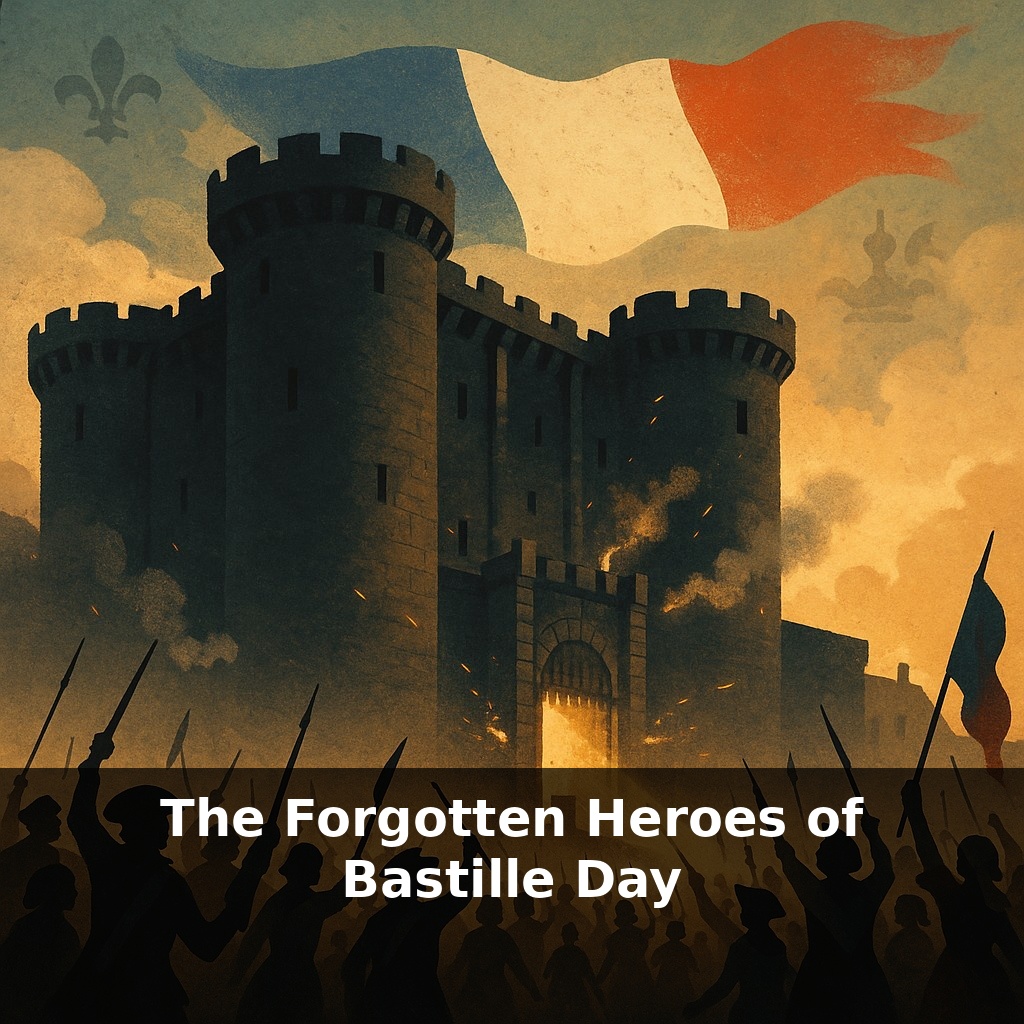
Gunfire cracks, a drawbridge groans, and hundreds of Parisians surge toward a fortress most of them had never seen inside—risking their lives to rescue just seven prisoners. So why did this small, chaotic clash become the birth scene of a revolution that reshaped the world?
On most July 14th ceremonies, speeches drift toward big names and big ideals: “the people,” “liberty,” “the Revolution.” But if you zoom in on the actual courtyard of the Bastille that afternoon, you don’t see abstractions—you see confusion, misfires, and a crowd that could easily have scattered and gone home. The difference between a bloody fiasco and a turning point came down to a few largely forgotten people who refused to let the moment dissolve. They spotted weak points in the walls, positioned muskets at key angles, argued under fire with officers inside, and rallied panicked volunteers who had never seen battle. Like a hastily assembled project team suddenly forced to ship a crucial release, these improvised leaders learned on the job—with history watching—and somehow delivered.
To see these “forgotten heroes” clearly, you have to strip away the later legend that painted 14 July as a neat uprising of “the people” against “tyranny.” On the ground, roles were far messier. Hulin arrived not as a famous tribune, but as an ex-officer who understood artillery and armories. Elie came with the discipline of a professional soldier suddenly aligned with a street crowd. Maillard, a clerk turned National Guardsman, brought stamina and a talent for navigating authority. None were planning to found a national holiday; they were trying to solve a fast-moving urban crisis, one decision at a time.
Start with the simple, unglamorous problem these Parisians were trying to solve on 14 July: the city was full of weapons but short on gunpowder. That’s why hours before anyone charged a fortress, men like Pierre‑Auguste Hulin were already in motion. Drawing on his experience at the Hôtel des Invalides, Hulin helped direct the seizure of cannons and muskets there—hardware that suddenly gave the crowd leverage. When the rumor spread that the Bastille held the powder they needed, he was one of the few who understood both what those guns could do and what it would take to make a garrison surrender.
Jacob Elie, a sergeant from the Gardes Françaises, brought something different: discipline under fire. He and other defecting soldiers threaded through the mass of citizens, turning clusters of anxious volunteers into something closer to firing squads: placing men at windows, correcting their aim, choosing when to shoot and when to hold back so as not to waste powder or hit their own side. From the fortress, the governor saw not a mindless crowd but lines of muskets gradually tightening the noose.
Stanislas Maillard emerged in the dangerous space between those barrels and the Bastille’s walls. He moved repeatedly to the front with flags of truce, shouted terms up to the battlements, and helped carry messages back to the square—roles that demanded nerve as much as negotiation. At a moment when a badly chosen word could trigger a massacre, he became a kind of human hinge between two worlds that no longer trusted each other.
If later commemorations polished this day into a symbol of unity, the reality was closer to a fraught group chat with too many admins: city authorities hesitating, royal officers bargaining for honor, armed citizens arguing over whether to talk or fire. What stands out is how often low‑ranking figures stepped into gaps left by their supposed superiors. Hulin pushing cannon forward through the crowd, Elie insisting on a second demand for surrender, Maillard clambering onto the drawbridge—each nudged events away from a stalemate the monarchy might still have salvaged, and toward an irreversible break whose authorship has mostly been filed under “the people” and then forgotten.
Think of how we credit “the internet” to a few Silicon Valley founders, while thousands of sysadmins, protocol nerds, and anonymous coders actually kept packets flowing. Bastille Day memory works the same way: it zooms in on orators and monarchs and quietly crops out the people who handled logistics under pressure. One vivid example: in the hours after 14 July, Hulin wasn’t paraded as a mythic conqueror; he was drowning in paperwork—inventorying seized arms, drafting reports, and justifying every action to jittery authorities. Elie spent those same days trying to prevent score‑settling in the streets by steering newly armed men into some kind of discipline. Maillard, instead of retiring as a “hero of the Bastille,” got pulled into new confrontations, from the Women’s March to the September prison visits, where his authority was questioned, twisted, and eventually used against him. Their reward for stepping up once was to be drafted, informally, into an entirely new kind of politics that didn’t yet have rules.
Textbooks rarely mention that some attackers later applied for state pensions, attaching testimonies that now sit in quiet archives. Those files are becoming a kind of historical “version history,” letting researchers track who did what and how memories shifted. Your challenge this week: when you see a big public event reported, actively ask, “Whose names are missing here?” Then try to identify at least one overlooked contributor and learn their story.
History, like a wide‑angle photograph, keeps the skyline and blurs the pedestrians. Yet those pedestrians chose where to walk. Follow that thought beyond Paris: in any protest, launch, or local vote today, dozens of “Hulins” and “Maillards” are shaping outcomes in untelevised ways. Let Bastille Day be a reminder to zoom in before you decide who mattered.
Start with this tiny habit: When you see today’s date or check the time on your phone, whisper the name of one “forgotten” figure from Bastille Day—like Théroigne de Méricourt or the women who marched to Versailles—and picture what they might have actually looked like in the crowd. Then, tap your browser search bar and type just one extra word next to their name (like “letter,” “speech,” or “painting”) and open the first result, even if you only glance at it for 10 seconds. This way, you’re building a reflex to reconnect the holiday with real, overlooked people every time you glance at the clock.