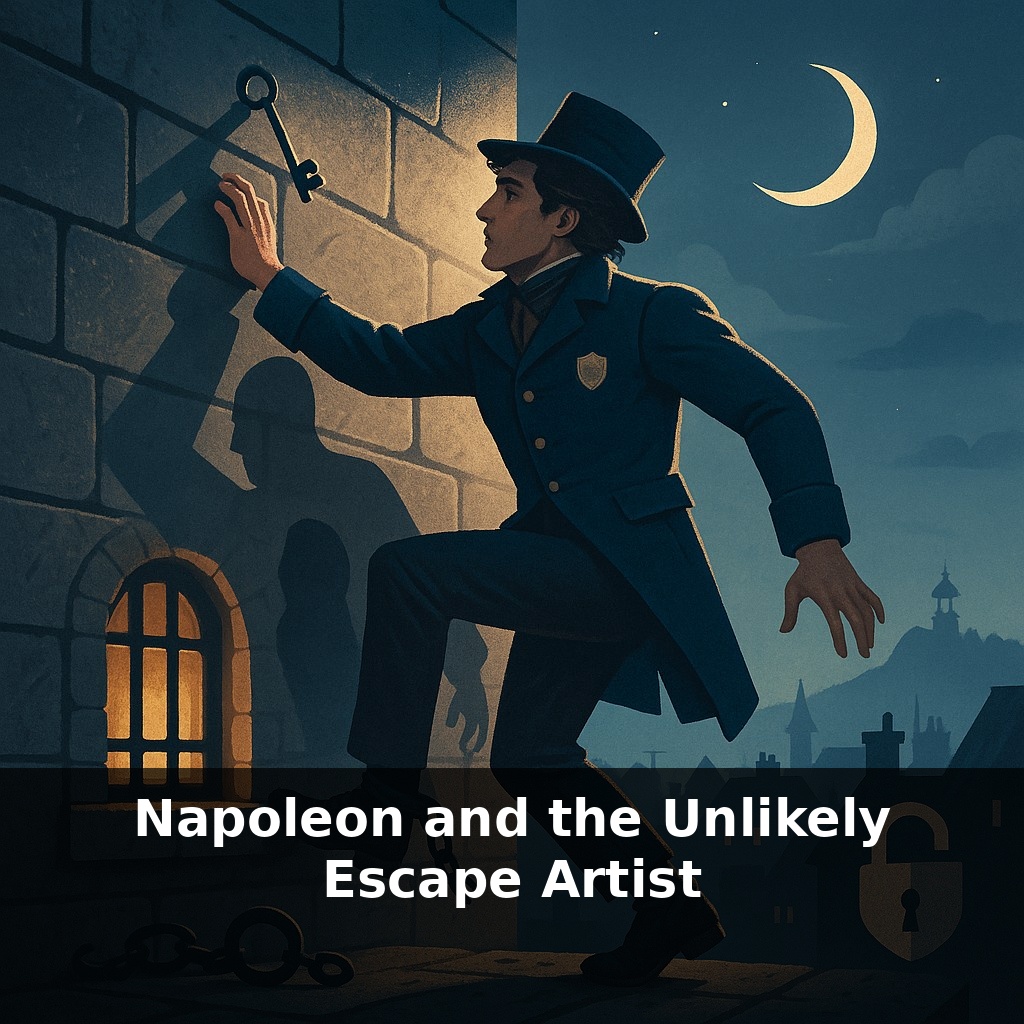
A future police chief begins his career not in a classroom, but dangling from a prison wall. In one decade, Napoleon’s France sees one man break out of jail again and again—then get hired to hunt people exactly like himself. So here’s the puzzle: who trusts a thief to guard the vault?
By 1809, that human escape hatch had a name: Eugène-François Vidocq, a man whose résumé looked less like a career path and more like a rap sheet written in disappearing ink. While judges saw a repeat offender, Joseph Fouché—Napoleon’s cold-eyed Minister of Police—saw something closer to a living blueprint of the underworld. Paris was swelling, restless, full of veterans, drifters, and profiteers; crime was no longer a series of local nuisances but a kind of shadow network, adapting faster than the officials chasing it. Where most administrators added more guards and thicker doors, Fouché gambled on something stranger: turning a serial fugitive into a compass for this hidden city. If you want to redesign a maze, you ask the person who’s already memorized every turn in the dark.
By the time Fouché made his gamble, France was still raw from revolution and war: institutions kept changing names, but street crime did not bother to rebrand. Courts clung to confessions and eyewitnesses the way a nervous student clings to outdated notes before an exam, even as criminals experimented with disguises, aliases, and forged papers. Into this mismatch stepped Vidocq, not as a moral convert but as a technician of survival. He knew which taverns laundered goods, which fences changed identities as easily as coins, and how rumors moved faster than patrols through cramped Paris alleys. All of that was uncharted data—if someone could learn to read it.
Vidocq’s first assignment was almost insultingly simple: go back to the world he’d slipped out of and just listen. No uniform, no badge—only a promise that if he delivered results, some of his own charges might quietly evaporate. So he rented a cheap room, drifted through dockside taverns, and let old contacts assume he’d simply resumed his career. The twist was that every whispered plan for a robbery, every brag about a successful scam, now fed into a growing mental map he started handing, piece by piece, to Fouché’s office.
He noticed patterns that bureaucrats missed. Certain burglaries clustered along delivery routes; counterfeit notes surged right after specific army payments; the same names kept surfacing in unrelated cases. Instead of treating each theft as an isolated event, he began to link them like entries in a ledger. That mindset—following chains instead of individual crimes—was the seed of what we’d now call criminal intelligence.
By 1811, Fouché agreed to give this experiment a skeleton crew. Vidocq recruited people who could move in places the regular police terrified: former pickpockets who knew how crowds breathe, ex-forgers who recognized a shaky signature at a glance, smugglers who could read river traffic the way sailors read the sky. About half had spent time on the wrong side of the bars. To outside observers, it looked like Paris had armed its own fever dream.
Operationally, the new brigade worked more like a small, agile startup than a ministry office. They kept their own notebooks on suspects, cross-referenced addresses, tracked aliases, compared handwriting. When a jeweler was hit in one arrondissement and a pawnbroker in another suddenly displayed unusual stock, someone in Vidocq’s team was already walking there with a story prepared and an exit route planned.
The real innovation came when he began preserving traces that most people dismissed as dirt or coincidence. In one countryside case, he found a clear footprint near a crime scene and decided not to just sketch it but fill it, carefully, with plaster of Paris. The solid cast turned a fading mark in the ground into an object that could be carried into court, matched, argued over. It was a small shift in thinking—like turning fleeting smoke into something you could weigh—that pointed toward a future where crimes would be reconstructed from fragments, not merely confessed in a judge’s office.
Vidocq’s real leap wasn’t just chasing criminals more cleverly; it was treating crime like a pattern that could be modeled, tested, and even predicted. He began keeping informal “profiles” long before the word existed: how certain burglars preferred rooftop entries, which swindlers favored marketplaces over salons, who fell apart under pressure and who stayed ice-calm in interrogation. These weren’t moral judgments so much as behavioral templates that could be reused. Think of it as an early software patch for public order: each case added new “code” to a system that got harder to outwit.
He also toyed with controlled leaks—planting rumors in the same taverns where he once hustled for survival, then watching whose plans shifted. A false story about increased patrols on one quay might quietly reroute contraband to another, where his team waited. In doing so, he turned gossip into something measurable. The state, which had relied on decrees and visible force, was learning to flex softer tools: misdirection, data, patience.
Vidocq hints at where we’re heading: systems that learn from the rule‑breakers as much as from the rule‑makers. Today’s equivalents aren’t lurking in alleys but inside algorithms—pattern engines trained on oceans of behaviour. The risk is that “success” becomes self‑justifying: a tool that catches some threats is kept, even if it quietly redraws the line between public safety and private life. The open question is who gets to audit that line—and how often it must be redrawn.
Vidocq’s legacy sits in that gray zone where order borrows tricks from chaos. His methods echo in open‑source investigators, data journalists, even whistleblowers who flip insider knowledge outward. Your challenge this week: notice every story where a rule‑breaker becomes a rule‑maker, and ask whether the system changed—or merely absorbed its cleverest critic.