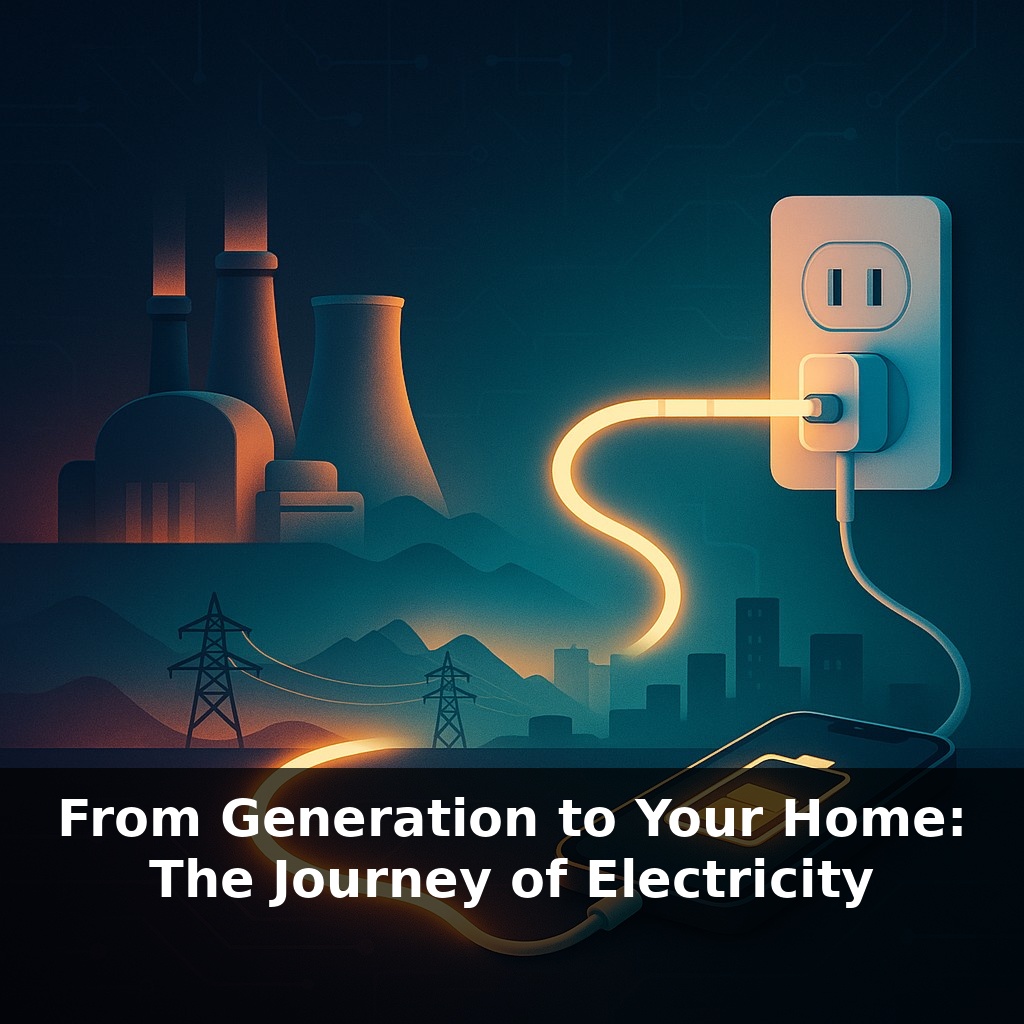
Right now, a beam of energy that started its life in a distant power plant is arriving at your phone charger… perfectly timed, perfectly matched to what you need. No battery, no pause. In this episode, we’ll trace that split‑second journey from roaring generator to quiet wall outlet.
The wire in your wall is the final stop on a trip that crosses deserts, mountains, and city skylines in a fraction of a second. By the time electricity reaches you, it has passed through a chain of quiet decisions made by machines: how high the voltage should be, which route is least congested, which line is still healthy in a storm.
We usually treat the outlet as a finish line, but for the grid it’s more like a constantly shifting goalpost. Every light switch you flip, every device that wakes up to charge, slightly reshapes what the grid has to do everywhere else.
In this episode, we’ll zoom out from your walls to follow that chain: from giant spinning turbines to high‑voltage highways, down through neighborhood equipment you’ve probably walked past without noticing—while invisible rules keep the whole system in balance.
What we call “the grid” is really a stitched‑together ecosystem: thousands of generators, millions of transformers, and a lattice of wires so long it could loop around Earth hundreds of times. Most of it isn’t in far‑off power stations—it’s above your street, under sidewalks, tucked behind grocery stores. Even your neighbor’s rooftop solar or a local battery can now feed into this mesh. When a storm takes down a line states away, automated systems quietly reroute power so your coffee maker still works. In this episode, we’ll look at how all those hidden pieces cooperate to keep your outlets alive.
Stand on a hill in the U.S. and chances are there’s part of the grid within sight: a transmission tower on the horizon, a gray substation at the edge of town, or a squat transformer can on a pole. Connect all of those up and you get about 7 million miles of power lines—enough wire to wrap around Earth roughly 280 times. That sheer scale is what allows the system to treat your single outlet as part of one giant, shared machine.
The journey home starts just after electricity leaves the big machines that first create it. Before it ever touches local streets, it joins a continent‑spanning network of high‑voltage lines that move bulk power across states and between regions. Those lines operate at voltages far above anything you’ll see in a neighborhood, precisely because cranking voltage up and current down slashes the energy lost as heat. It’s the difference between trickling energy along a warm wire and sending it racing across the map with only about 2–6% lost on the way.
As power flows toward cities, it encounters a series of checkpoints: regional substations that monitor line health, measure flows, and step voltages down to levels that make sense for shorter runs. From there, medium‑voltage feeders spread out like branches, looping through districts so that if one section fails, switches can reroute around the damage in seconds or minutes.
Closer to your home, the gear gets smaller but no less deliberate. A typical neighborhood transformer takes something like 13.2 kilovolts on its input and quietly delivers the 120/240 volts your appliances expect. The metal box on the sidewalk or the cylinder on a pole near your house is doing that 24/7, adjusting nothing consciously yet sitting inside a web of protections that will trip in milliseconds if something goes wrong.
Along the way, there are some unintuitive quirks. Birds sitting on a single wire are fine because both feet sit at essentially the same electrical potential—there’s no meaningful voltage difference across their bodies, so almost no current flows through them. Touch that wire and a differently‑charged object at the same time, though, and you’ve created a path.
Despite all this complexity, the experience at your end is mostly: it works, until it doesn’t. In 2021, the average U.S. customer was without power about 7 hours total, including major storms. Those rare dark hours are when you suddenly notice the entire chain you usually ignore.
Stand under a streetlight at night and you’re seeing just one “player” in a much bigger game. That same circuit might also be feeding a grocery store’s freezers, a bank’s ATMs, and a row of apartments—each flicking devices on and off without coordination, yet all sharing the same invisible budget of amps on that feeder. When a big load starts up, like a rooftop AC unit, nearby lights may dip for a blink as the system absorbs the sudden ask and snaps back into shape.
Think of the grid as a relay team of specialists: some generators excel at sprinting—ramping up quickly when a TV audience all hits “on” before a big game—while others are marathoners, running steadily for days to anchor the whole system. Behind the scenes, software is constantly deciding which “runner” should carry more of the baton, second by second.
Your challenge this week: each time you notice lights flicker, a device hum on, or a transformer buzz while you walk past, pause and guess what just changed on that shared circuit.
Tomorrow’s grid may feel less like a one-way delivery service and more like a living marketplace. Rooftop solar, home batteries, and EVs will let homes “bid” energy back, with algorithms choreographing millions of tiny trades. On hot days, your car might briefly power your block; during storms, a microgrid could island your neighborhood while the wider network recovers. The challenge: making this flexibility secure and fair so everyone, not just tech‑savvy owners, benefits from the new choreography.
Every time you flip a switch now, you’re nudging a vast, shared instrument that spans continents. As homes add smart panels, EVs, and solar, your outlet becomes less a passive socket and more a voting booth for how, when, and from whom you draw power. The more we understand that invisible conversation, the better we can tune it for resilience and choice.
Before next week, ask yourself: Where in my home does electricity work the hardest—think AC, water heater, fridge, always-on chargers—and what’s one device I can actually unplug, put on a smart plug, or time-shift to a different hour of the day? When I picture the full path from the power plant or solar farm through high‑voltage lines, substations, and neighborhood transformers to my breaker panel, where might failures or overloads realistically affect me, and what’s one backup or safety step (like a surge protector or labeled breaker) I can put in place? Looking at my utility bill or online portal, what patterns do I notice in my usage across peak vs. off‑peak hours, and how could I move one real task this week—like running the dishwasher or charging an EV—into a cheaper, less grid‑stressful time window?