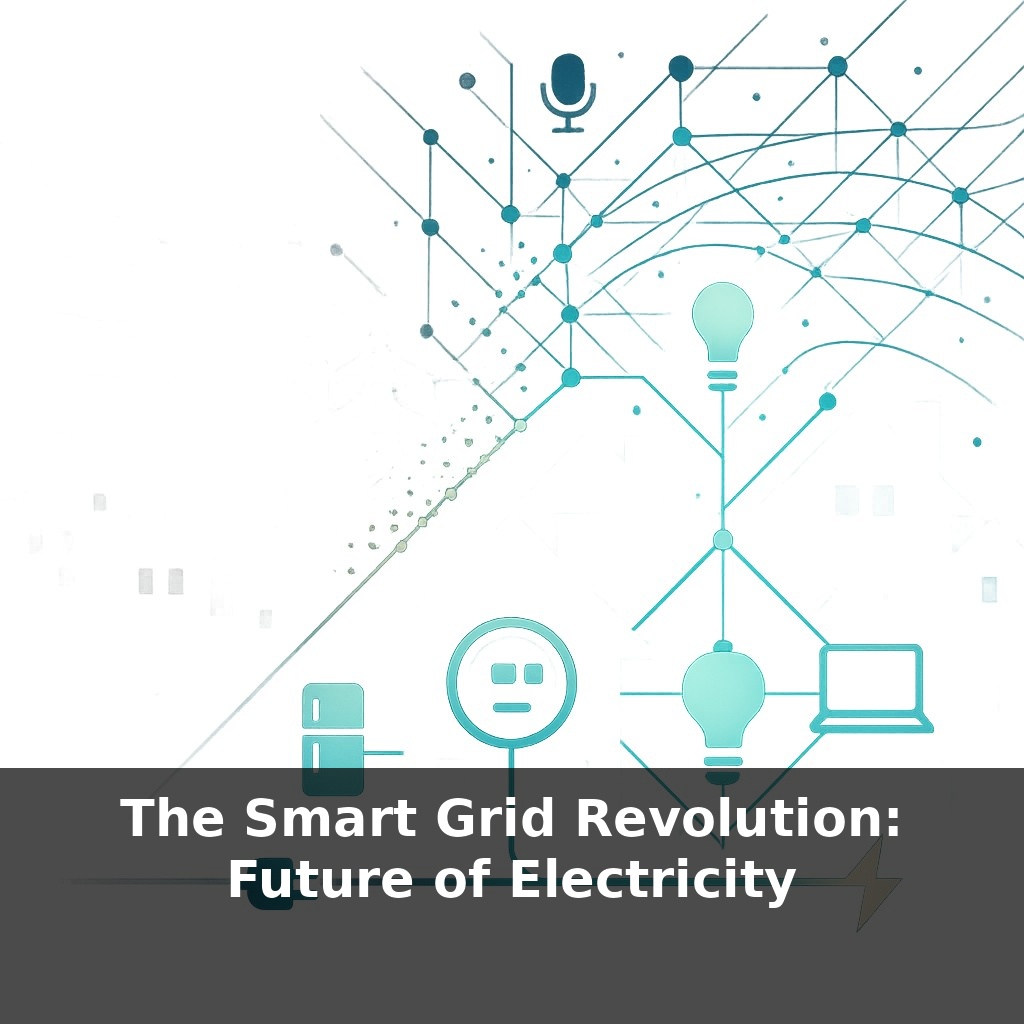
Right now, your fridge, lights, and laptop are quietly making decisions about the future of electricity—without asking you. In some cities, they’re already turning themselves up and down to help balance the grid. The twist? Most people have no idea they’re part of the system.
By 2025, more than a billion smart meters will be installed around the world—yet most of the grid they’re connected to was designed before the internet even existed. That mismatch is exactly what the “smart grid” is trying to fix.
So far we’ve looked at how decisions are already being made in your home and how devices help balance supply and demand. Now zoom out: utilities are wiring the entire system with sensors, two-way communication, and software that doesn’t just react to problems, but predicts and prevents them.
Think of a storm rolling in: old grids wait for something to break; smart grids see trouble coming through weather data, load forecasts, and line sensors, then re-route power in seconds. The same intelligence lets them absorb surges of rooftop solar at noon, charge millions of EVs at night, and turn flexible demand into a resource as real as a power plant.
Here’s the twist: the “smart” part isn’t just about keeping the lights on more reliably—it’s about who gets to participate in the system. As digital grid investment passes tens of billions of dollars a year, utilities are quietly wiring in capabilities that let homes, EVs, batteries, and even office buildings act like tiny power plants or flexible loads. That’s how we get from a world where big generators dominated to one where your street can host solar, storage, and electric cars without chaos. It’s also how countries plan to absorb far more wind and solar without building backup gas plants for every cloudy, windless day.
Call it a quiet rebuild of the world’s largest machine. Utilities are spending over US$50 billion a year not on new power plants, but on the “nervous system” that lets the grid see, think, and act in finer detail than ever before.
A big piece of that is automation. On a traditional feeder line, a fault can black out thousands of customers until a crew finds and isolates the problem. With self-healing automation, field devices talk to each other and to control centres, isolating the fault and reconfiguring flows in seconds. Studies show these systems can cut outage durations by as much as half—not magic, just extremely fast coordination.
Another piece is data. Those smart meters and field sensors feed into analytics platforms that spot patterns humans would miss: a cable that always runs a little too hot on humid days, a substation whose voltage droops when nearby EV chargers ramp up, a neighbourhood where rooftop solar regularly pushes power back toward the substation. Instead of reacting to failures, planners can see these weak spots years early and decide whether to reinforce wires, add local storage, or use flexible demand.
Then come the “prosumers.” A home battery, an office building’s HVAC, a supermarket’s refrigerated storage, an EV fleet in a depot—each can act as a tiny, schedulable resource. Aggregators bundle thousands of these into virtual power plants that bid into energy and capacity markets like any generator. In a heatwave, they can collectively turn down consumption or discharge stored energy, avoiding the need to fire up the dirtiest peaker plants.
This is where decarbonisation accelerates. A grid that can flex demand, steer power along alternate paths, and coordinate storage can comfortably host very high shares of wind and solar. The IEA estimates that this kind of digital flexibility could avoid over a gigatonne of CO₂ every year by 2030—not by building a single new turbine, but by using what we already have far more intelligently.
The misconception is that all this “smart” tech is just a fancy meter on your wall. In reality, the real transformation is deeper: it’s in who gets to provide energy services, how quickly the system can adapt, and how confidently we can lean on renewables without keeping fossil backups idling in the background.
In Brisbane, Australia, a “virtual power plant” links thousands of home batteries and rooftop solar systems so they can move together, like a well-coached cycling team taking turns at the front. When wholesale prices spike or a coal unit trips, the fleet responds within seconds, easing strain before larger plants even ramp.
In Denmark, flexible data centres earn revenue by briefly pausing non-urgent computing when the grid is tight, then overclocking later. They don’t see this as sacrifice; it’s a new line item in the business model.
Some cities use AI to compare hospital, transit, and telecom power needs hour by hour, reserving backup capacity for critical services while nudging less vital users to shift. Greenhouse growers, for example, may dim lights slightly on peak evenings and boost them overnight when clean wind is abundant.
You also see experiments where neighbourhoods agree on “energy rules”: EVs charge slowly unless there’s surplus wind, or shared batteries guarantee a baseline of local backup during storms, no diesel required.
Blackouts may soon feel as outdated as dial‑up tones. As grids get smarter, whole districts could glide through storms while older networks around them go dark. Local energy “clubs” might trade spare rooftop power like neighbours swapping homegrown vegetables. Cities could treat carbon like a budget: spend it on hospitals and transit first, then adjust everyone else. The open question: who gets to write these rules—and how do we keep the system fair when electrons can follow money so quickly?
Your home’s connection may soon feel less like a bill and more like a membership. As tariffs shift by the hour, you might “season” laundry, EV charging, and heating like a recipe, tuning comfort against cost and carbon. The next step isn’t just smarter wires—it’s rules, apps, and norms that decide whose preferences shape this shared electric ecosystem.
Before next week, ask yourself: If time-of-use pricing came to my area tomorrow, what’s one specific high-usage appliance (like my EV charger, dryer, or water heater) I’d deliberately shift to off-peak hours, and how would I actually change my routine to do it? If my utility suddenly offered a demand-response program that briefly adjusts my thermostat during peak times, what comfort limits (exact temperature ranges and times of day) would I realistically be okay with in exchange for lower bills and a more stable grid? Looking at the devices already in my home, which two could I connect to a smart plug or app today so I can start seeing, in real numbers, when and how I’m using the most electricity—and what surprising habit might I be ready to change once I see that data?