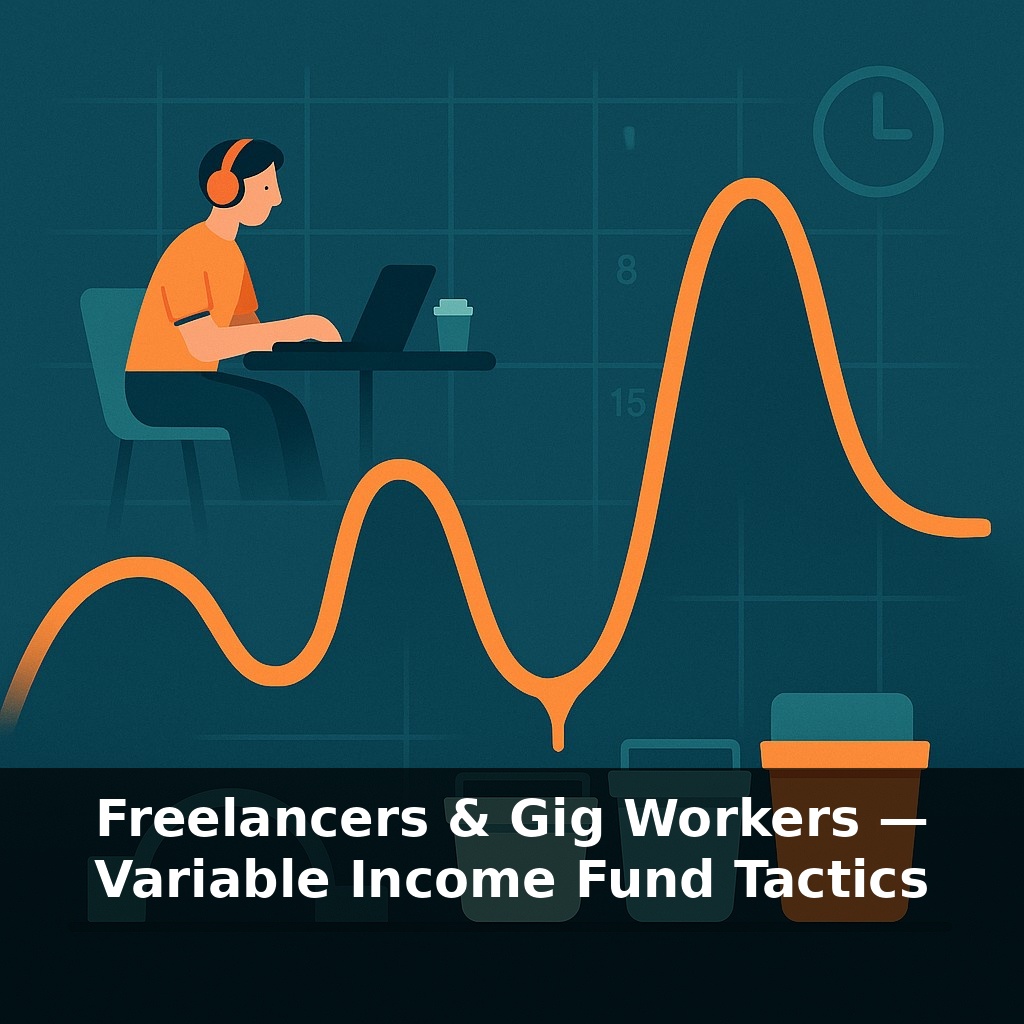
About three‑quarters of full‑time freelancers say their income jumps or drops by at least a quarter from month to month—yet most still try to budget as if every month will look “normal.” Today, we’re stepping right into that gap between how money arrives and how it actually needs to work.
Seventy‑four percent of full‑time freelancers see their income swing at least 25% month to month—but the real story isn’t the swings, it’s what you do *between* them. In earlier episodes, we talked about smoothing the ride with basic buffers and automation. Here, we go a level deeper: designing a fund that doesn’t just catch emergencies, but actively absorbs your slow seasons and surprise tax bills without panic.
Think less “one big rainy‑day jar,” more like a well‑marked palette: one color for core living costs, one for taxes, one for business expenses, one for your own paycheck. The point isn’t to predict each month perfectly—it’s to create a system that keeps working even when your income doesn’t.
In this episode, we’ll break down how to calculate your true baseline, route every payment automatically, and set hard rules for when you’re allowed to tap the reserve.
Unlike a traditional paycheck, freelance income often lands in random bursts: a big project here, three small invoices there, then silence. That makes a “normal” month more of an average than a reality. So instead of trying to predict each deposit, you’ll be designing rails for every dollar that shows up—no matter when or how it arrives. Think of today’s work as drafting a standing “order set” like a good doctor uses: same tests, same checks, every time a new case walks in. Your percentages won’t be guesses; they’ll be grounded in your actual baseline and your real‑world dry spells.
For variable earners, the real power move is turning chaos into a repeatable script. Start with your **baseline**—but now zoom in: split it into *non‑negotiables* (rent, basic food, insurance, minimum debt payments) and *flexibles* (restaurants, subscriptions, upgrades). Your emergency buffer’s job is to fully cover the first group and only partially support the second when things get tight. That’s how you stretch a 6‑month reserve to behave more like 9–12 months.
Next, build a **percentage “routing table”** for every deposit, no matter how random: - X% → tax bucket (using that 25–30% safe‑harbor rule as a ceiling) - Y% → business costs (software, gear, marketing) - Z% → personal “salary” account - Remainder → buffer / emergency reserve
You’re not guessing these. Look back 6–12 months and calculate: - average tax bite as a percentage of net income - average monthly business costs - target “pretend paycheck” you want to pay yourself consistently
Then adjust your routing so those needs are met *first*, and only *then* do you expand lifestyle.
Now layer on **dry‑season rules**. Examples: - You only tap the buffer when income over the last 30 days is under 60% of your average. - Any month you pull from the buffer, you freeze all non‑essential annual commitments and new subscriptions. - When income rebounds above 120% of average, at least half of that “extra” automatically replenishes the buffer until it’s back at target.
To make this painless, set up **multiple, clearly named sub‑accounts** inside one high‑yield savings or checking‑plus‑savings setup: “Tax,” “Ops,” “Buffer,” “Next Month Paycheck.” Then automate transfers based on percentages, not flat amounts, so a $300 check and a $3,000 check both follow the same script.
Finally, smooth your life with that **pretend salary**: pay yourself the *same* amount on the same day each month from “Next Month Paycheck,” which is refilled by your percentage rules. Over time, the reserve becomes less of a fire extinguisher and more of a quiet climate‑control system that keeps things livable whether you’re in a heatwave of work or a cold snap of silence.
Think of a working photographer who books weddings, brand shoots, and last‑minute gigs. Instead of chasing “normal,” they create a standing script: every payment lands in one hub account, then fans out the same way. A $600 mini‑session weekend? Same pattern as a $6,000 campaign.
They decide their “bare-minimum month” is $2,800 and their ideal take‑home is $4,000. During heavy season, deposits overflow that target, so the extra quietly stacks in a “Future Slow Months” pocket. In January and February, when bookings vanish, they still transfer that same $4,000 “paycheck” from the pocket—no scrambling, no panic‑editing their lifestyle overnight.
You can extend this further: create a small “Gear Refresh” pocket that only gets funded when your income tops a certain threshold—say, 110% of your recent average. That way, big wins upgrade your tools instead of inflating everyday spending, while your core system keeps your rent and groceries on autopilot regardless of what this month’s inbox looks like.
Platforms are quietly edging toward becoming your financial “operating system.” As more work funnels through a few apps, expect dashboards that flag when your pipeline looks thin, suggest temporary pay cuts to stretch reserves, or auto‑stash a slice of surge pricing into a future‑month bucket. Think less “bank plus spreadsheet,” more adaptive exoskeleton: tools that flex with each contract, nudge you before trouble hits, and make solo income feel closer to a stable, small studio’s cash flow.
As you refine this system, notice how it changes your decisions on busy days versus quiet ones. Instead of chasing each invoice, you’re curating a flow: some money stays liquid for near-term needs, some accepts a little volatility in low-cost index funds, and some waits for big goals. Over time, the question shifts from “Can I make it?” to “What am I building?”
Try this experiment: For the next 30 days, send every single payment you receive from clients (Upwork, Fiverr, Stripe, direct invoices—everything) into a separate “Variable Income Buffer” checking account first, and pay yourself a fixed “salary” from it once a week (e.g., every Friday: $800). Before you transfer that weekly salary, automatically skim 10% of whatever came in that week into a “Quiet Months Fund” savings account and 5% into a “Taxes” savings account. At the end of the month, compare how stressed you felt about money versus last month and note whether your main spending account balance stayed more stable—even if your client payments were all over the place.