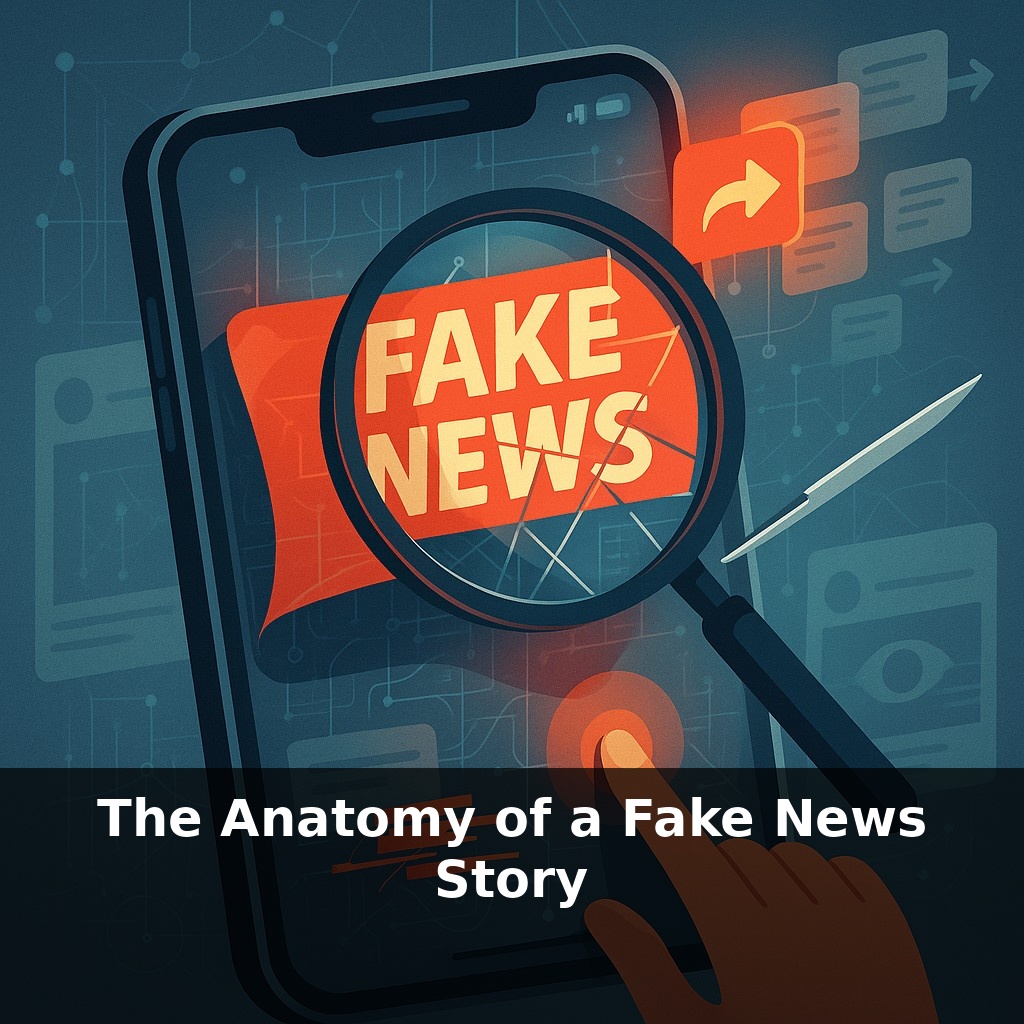
The Anatomy of a Fake News Story
📝 Transcript
A lie on social media can race through thousands of feeds before a single correction wakes up. A headline screams, a shocking photo flashes, your friend hits “share”… and almost no one checks what’s behind the link. In this episode, we’ll pause that sprint and dissect the story itself.
That sprint of misinformation doesn’t start by accident—it’s engineered. Behind the scenes, someone chooses a target, crafts a storyline, and reverse‑engineers a “news” piece not to inform, but to provoke. They test which words spike outrage, which images nudge you to click, which angles line up neatly with what certain groups already believe. It’s less like reporting and more like designing a viral marketing campaign—except the product is a narrative about reality.
In this episode, we’ll zoom in on that design. We’ll look at how bogus details get mixed with just enough truth to feel plausible, how sketchy “experts” and made‑up organizations are pulled in to decorate the story, and how timing is chosen to hit when emotions are already running high—elections, crises, scandals. By the end, you’ll start to recognize the recurring patterns in these stories, the way you can instantly spot a familiar spam email format after seeing it a few times.
If we zoom in even further, a fake news story starts to look less like a single post and more like a small operation. There’s usually a blueprint: a dramatic hook, a villain or hero, a “secret” explanation for something confusing in the real world. Then come the support beams: distorted stats, recycled images from old events, maybe a screenshot that looks official but isn’t. Finally, there’s the distribution plan—coordinated drops in groups, bots priming the pump, and influencers giving it a human face so the whole structure feels sturdy enough to stand on first glance.
Scroll down a typical fake news article and you can almost feel the gears turning. It usually starts with a headline that doesn’t just inform, it dares you not to click: emotionally loaded verbs, absolutist phrases (“proved once and for all”), and neat moral framing—someone is clearly right, someone else is clearly evil or stupid. Ambiguity is sanded off; uncertainty doesn’t perform well.
Inside, the structure often follows a predictable arc. First: a simple, gripping story about why something happened, focused on people, not processes. Complicated systems—elections, pandemics, markets—get boiled down to a single schemer pulling strings. This satisfies a craving for clarity: one cause, one culprit, one solution. The messier the real situation, the more tempting this shortcut feels.
Then come the decorative “facts.” Not the obviously fake kind, but selective fragments: one alarming statistic without context, a cherry‑picked quote, a screenshot of a document whose origin you’re never invited to verify. The goal isn’t airtight proof; it’s to supply just enough scaffolding that your mind fills in the rest. Confirmation bias does the heavy lifting—if the story fits what you already fear or hope, your brain quietly lowers its standards of proof.
Imagery in these pieces works the same way. A photo may be real but from a different event, or cropped to hide contradicting details. Visuals are chosen not to represent reality, but to match the emotional temperature of the text—anger, disgust, triumph, fear. That emotional jolt primes you to accept the next claim with less resistance.
Crucially, fake news stories are written to be quoted and screen‑shotted. Short, punchy lines double as ready‑made captions. Outrageous claims are front‑loaded so they survive even when people share without clicking—something research shows happens most of the time. The story is optimized less for careful reading than for rapid, frictionless repetition across networks.
If you think of each element as part of an architecture plan, the design becomes clearer: a flashy entrance (headline), a straight, unobstructed hallway to a satisfying culprit, and plenty of emotionally sticky details along the way so you don’t exit through skepticism. Once you see that layout, you can start noticing when a piece of “news” feels weirdly familiar—not because it’s true, but because you’ve walked through the same blueprint before.
Your challenge this week: pick two viral “news” posts from your feed that really grab you. Don’t fact‑check them yet. First, map their structure: circle the emotional words in the headline, underline any clear “villain,” box every number or “fact,” and note where images appear. Only after this structural autopsy, then check credibility. Over time, see if you can spot the blueprint before you even touch the share button.
Think of how a pro sports team practices set plays: the movements look spontaneous during a game, but they’ve been drilled over and over. Fake news stories work similarly. The people behind them test dozens of “plays” to see which combinations of wording, images, and placement trigger the biggest reaction. A headline that barely moved the needle last month might be quietly retired, while a slightly tweaked version—one extra emotionally loaded adjective, a new buzzword—gets copied across dozens of sites.
Sometimes, entire “leagues” form around these tactics. One page invents a claim, others echo it with minor variations, and suddenly you’re seeing “independent” repetition that feels like corroboration. Add in coordinated replies that flood comment sections with the same talking points, and it starts to resemble a choreographed offense: multiple angles, same objective—push the story into your attention until it feels too present to ignore, and too familiar to fully distrust.
Soon, fake stories won’t just sit on a page; they’ll talk back. Generative systems can tailor scripts to your mood, then spin matching audio and video on demand. A clip of a “mayor” announcing a policy could be rendered in minutes, customized to your city and accent. To cope, we’ll likely lean more on machine‑readable fingerprints attached at creation, and on tools in our browsers that flag unverifiable material the way ad‑blockers flag trackers—quietly, constantly, in the background.
Over time, you’ll start to notice recurring “tells”: drama without doubt, certainty without nuance, numbers with no path back to where they came from. Treat each wild claim like a pop-up window on your mental desktop—before you click, ask who built it, who benefits if you believe it, and what changes if you simply close it and move on.
Try this experiment: For the next 48 hours, any time you see a sensational political headline on social media, **stop and run a 4-step “fake news stress test”**: (1) click through and see if the headline matches the article, (2) google the exact headline in quotes and see if multiple credible outlets report it, (3) paste a suspicious claim into a fact-check site like Snopes or PolitiFact, and (4) look up who owns or funds the site using “about” pages or MediaBiasFactCheck. Keep a simple tally of how many stories “fail” one of these steps. At the end of the two days, look at your tally and decide whether you trust your feed more, less, or the same—and whether you want to change who you follow or what you share.
From this course
Fake News: The Quest for Truth in a Post-Truth World
5 episodesUnlock all episodes
Full access to 5 episodes and everything on OwlUp.
Subscribe — $1.99/monthLess than a coffee ☕ · Cancel anytime