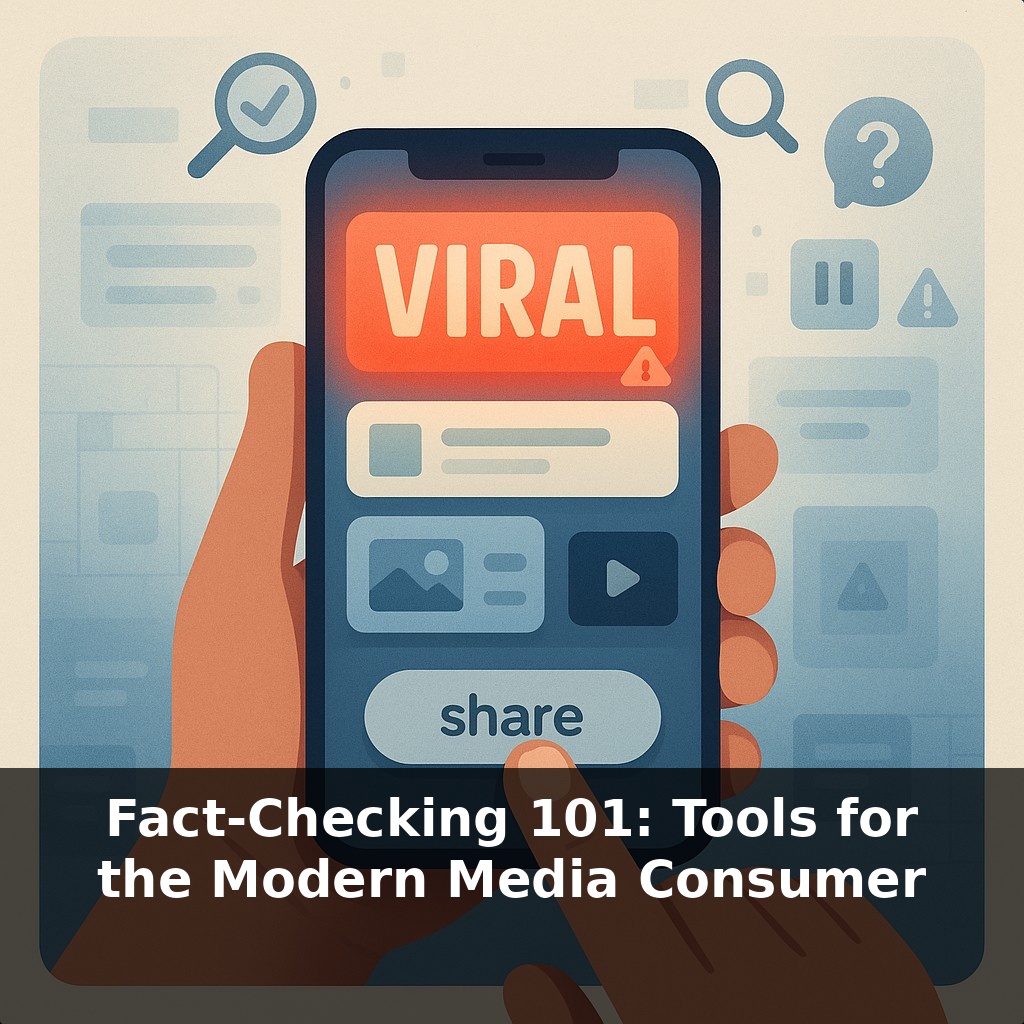
A false story online can outrun the truth by a huge margin—spreading to thousands before a correction reaches dozens. You’re scrolling, half-distracted, when a shocking headline flashes by. Do you tap “share”… or pause, and quietly run your own mini-investigation first?
You don’t need a journalism degree or a bunker full of servers to push back against misinformation; you just need a small set of smart habits and tools you can reach for in the moment. Think of your feed as a fast-moving crowd: some people are shouting rumors, some are whispering useful tips, and a few are calmly holding documents and data. Your job isn’t to silence the noise—it’s to quickly figure out who’s worth listening to before you pass their words along. That’s where modern fact-checking comes in. Today, a curious media consumer can tap into professional fact-checking databases, scan a viral photo’s origins, or rewind a deleted page in seconds. In this episode, we’ll assemble a practical, real-world toolkit you can actually use mid-scroll, turning that quick pause before you share into a powerful, everyday safety check.
Most of what hits your screen arrives without labels: no “tested,” no “may contain nonsense,” no “out of context.” Yet nearly two-thirds of adults now say they’re unsure what to trust online, and they’re not wrong to hesitate. A screenshot of a chart, a clipped quote, or a grainy video can all be tweaked just enough to feel real but steer you off course. That’s where tools, methods, and mindset work together. In practice, this means learning to treat a post like a suspicious USB drive—never “plugging it in” to your beliefs before you’ve scanned it with a few quick checks drawn from your own verification toolkit.
Start with the lowest-friction move: don’t investigate the whole internet, investigate the claim right in front of you. One of the fastest ways to do that is what researchers call “lateral reading”: instead of diving deeper into the post or article, you step sideways and see what the wider web already knows about it.
Say you see a quote attributed to a public figure. Highlight the key phrase plus the person’s name and drop it into a search engine. Then scan *who* is talking about it: do reputable outlets, official transcripts, or established fact-checkers mention it—or is it bouncing only between anonymous accounts and meme pages? You’re not asking “do I like this quote?” but “does this quote exist anywhere outside this screenshot?”
Now layer in some targeted tools. A quick stop at Google’s Fact Check Explorer can reveal whether professional fact-checkers have already dissected a similar claim. Paste in a sentence or a few keywords; if something pops up, you’ll often see not just a verdict but sources and context you’d never see in the original post.
Images and videos demand their own path. Reverse-image searches with tools like TinEye or the image tab of a search engine help you see earlier uses of the same visual: was that “breaking” protest photo actually taken years ago in another country? Video frames can be checked with extensions such as InVID, which let you pull stills and hunt for their history elsewhere online.
Links and websites add another layer. A quick WHOIS lookup can show when a domain was created and who controls it. A newsy-looking site registered last week, with no staff page and no contact details, should raise questions. The Wayback Machine lets you scroll back through older versions of a page: did a headline change after publication? Was a key paragraph quietly removed?
Alongside these tools, you’re also running an internal diagnostic: Why does this post make me feel rushed, outraged, or triumphant? Emotional spikes are often used to short-circuit patience. Naming your own reaction (“this is flattering my side,” “this is trying to scare me”) keeps you from mistaking intensity of feeling for strength of evidence.
Over time, these moves blend into a quick sequence: step sideways, scan the wider web, test the visuals, peek behind the site, check your own pulse. It’s less about becoming a professional debunker and more about refusing to be an effortless amplifier for anyone who learns how to push your buttons.
You’re mid-scroll and a chart pops up claiming a “dramatic spike” in some risk, complete with scary red bars. Instead of arguing in the comments, you treat it like a puzzle. First move: strip it down to its core claim. What *exactly* is it saying—numbers, location, time frame? Those details are your search terms. Drop them into your browser along with the source’s name. If official reports or neutral outlets don’t show the same pattern, you’ve learned something without a single shouting match.
Now try it with a “too perfect” quote. Maybe it nails your political enemy a little *too* neatly. Search the quote with quotation marks, then the person’s name alone. Often, you’ll find either a longer, less dramatic version—or nothing at all. That gap is a signal.
Think of this like debugging code in a complex app: you don’t rewrite the whole program, you run small tests on the part that’s behaving strangely, watching where it fails before you decide what to trust.
Misinformation’s next phase won’t just shout at crowds; it will quietly tailor stories to you—your habits, fears, and search history. AI systems can already generate endless variations of the same claim, test which one you linger on, then refine the message in real time. As provenance tech and browser defenses improve, expect a shift from “mass blast” hoaxes to “micro-targeted” narratives. That raises a civic question: when each person gets a customized feed, how do we even agree on what needs checking?
Your challenge this week: pick three posts that make you feel something *fast*—delight, outrage, triumph. For each, spend two extra minutes tracing where it came from and how the story travels. Notice which ones crumble on contact and which hold up, the way a sturdy bridge does when you finally walk across instead of just admiring the view.