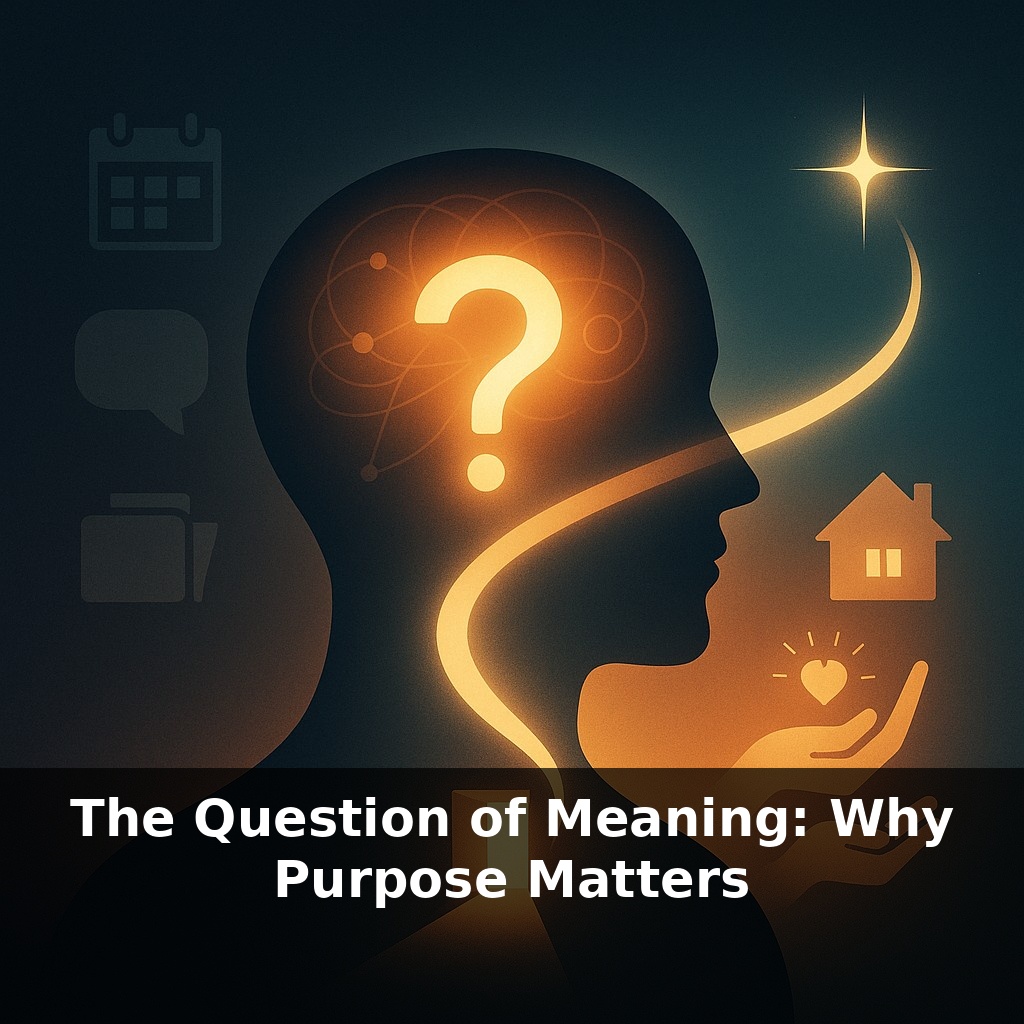
The Question of Meaning: Why Purpose Matters
📝 Transcript
Right now, as you listen to this, your brain is quietly asking one question: “What is all this for?” Neuroscientists find that when we feel a strong sense of purpose, our motivation systems light up more than when we get a raise. But here’s the twist: most of us never answer that question on purpose.
You can feel this in small, ordinary moments. Dragging yourself out of bed for yet another status meeting feels one way; getting up early to help a friend move house feels completely different—even if both demand the same effort. One drains you, the other somehow energises you. That contrast isn’t just mood; it’s a clue. Across thousands of studies, people who connect what they do to something that matters—to them or to others—show better focus, persistence, and even creativity. They bounce back faster when projects fail and criticism stings less, because the work is part of a bigger “why,” not just today’s to‑do list. Strikingly, this isn’t limited to grand callings or heroic careers. A barista who treats each interaction as a chance to brighten someone’s day can experience more meaning than a well‑paid executive who secretly believes their work doesn’t matter.
Purpose also shows up outside work, in how you spend a Tuesday night or a quiet Sunday morning. Some people feel it most while coaching a kids’ team, caring for an ageing parent, or tinkering with a side project that no one pays them for. Research suggests these “off‑the‑clock” choices can shape your health and resilience as much as your career does. Purpose weaves through roles—friend, neighbour, citizen—turning random tasks into part of a pattern. The question isn’t “Do I have a purpose?” so much as “Where is purpose already hiding in my life, and what am I willing to organise around it?”
If purpose matters so much, why does it feel so slippery when you try to pin it down? Part of the problem is that we’ve been sold a very narrow template: your “real” purpose is supposed to look like a world‑changing mission statement or a perfect-fit career. Under that pressure, everyday sources of meaning can look small or illegitimate, so you overlook them.
Research paints a different picture. When psychologists dissect what makes life feel meaningful, three ingredients keep appearing: coherence (your life feels like it makes sense), significance (it feels worth the effort), and direction (you have some sense of where you’re heading). Notice what’s missing: there’s no requirement that it be glamorous, monetised, or legible to anyone else. A quiet life built around raising kids, making honest art, or safeguarding a local river can score just as high as a CEO’s transformation plan.
Purpose also isn’t a single “true calling” you either find or miss forever. Longitudinal studies show that what people name as “most important” shifts with age and circumstance: adventure in your 20s, contribution in your 40s, legacy or wisdom-sharing later on. Trying to lock in one eternal answer can backfire, leaving you guilty or stuck when life changes. A more realistic question is, “What feels worth committing to in this season?” That keeps purpose responsive instead of brittle.
Just as importantly, purpose doesn’t have to be religious or spiritual. For some, faith traditions provide a ready‑made narrative about why life matters. For others, meaning emerges from secular commitments: scientific progress, social justice, craftsmanship, or simply reducing suffering in their immediate circle. Sociologists find that the psychological benefits look remarkably similar, whether the “why” is sacred or secular; what counts is the felt sense that your actions contribute to something that outlasts a single day’s hassles.
One helpful way to think about this: purpose functions less like a job title and more like a filter. It shapes which opportunities you say yes to, which you decline, and how you interpret what happens. The same setback—a project cancelled, a move to a new city—can feel like meaningless chaos or a painful but bearable plot twist, depending on the story you’re using to connect the dots.
Think of two people leaving the same office at 6 p.m. One heads straight to a community kitchen where they’ve committed to managing logistics once a week. The other opens a laptop at home to tweak a passion project—designing low-cost tools for language learners. Both are tired, but notice what their calendars reveal: their efforts line up around patterns they’ve chosen, not just obligations assigned by someone else. That self-chosen pattern is where direction quietly hardens into purpose.
You can also see this at the level of organisations. A hospital cleaner who decides their real job is “protecting patients from invisible threats” will notice different details, ask different questions, and feel different stakes than someone who sees the role as “mop the floor, empty the bin.” The tasks are identical; the story wrapped around them isn’t. Over time, that story shapes which skills they develop, which risks they’ll take, and how far they’ll go when nobody is watching, turning ordinary routines into a thread that actually feels worth following.
A world that takes purpose seriously will quietly rewire its systems. Schools might grade less on memorisation and more on experiments in “what feels worth doing.” Workplaces could treat personal missions like they treat skills—something to develop, not hide. Doctors and therapists may start asking “what do you care about next?” as routinely as they check blood pressure. Even city design could shift, adding spaces—labs, gardens, studios—where people test tiny bets on the kind of life they want to lead.
So instead of hunting for a grand calling, you might treat meaning like seasoning in cooking: added bit by bit, adjusted as you taste. Notice which conversations stretch time, which problems you can’t stop returning to, which evenings leave you quietly satisfied. Follow those small signals, and over time they can accumulate into a life that actually feels like your own.
To go deeper, here are 3 next steps: Explore Viktor Frankl’s *Man’s Search for Meaning* and underline every passage where he talks about “responsibility to something greater than oneself,” then journal how that connects (or doesn’t) with your current work. Take the free “Character Strengths” assessment at viacharacter.org and, using your top 5 strengths, redesign one recurring task this week so it better expresses those strengths (for example, turning a routine meeting into a space for curiosity or kindness). Listen to the “Purpose” episode of the *On Being with Krista Tippett* podcast and, while you walk or commute, pause after each big idea to record a 30-second voice memo about one concrete way you could serve something beyond your own success this month.
From this course
Find Your Purpose: A Journey to Meaning
8 episodesUnlock all episodes
Full access to 8 episodes and everything on OwlUp.
Subscribe — $1.99/monthLess than a coffee ☕ · Cancel anytime