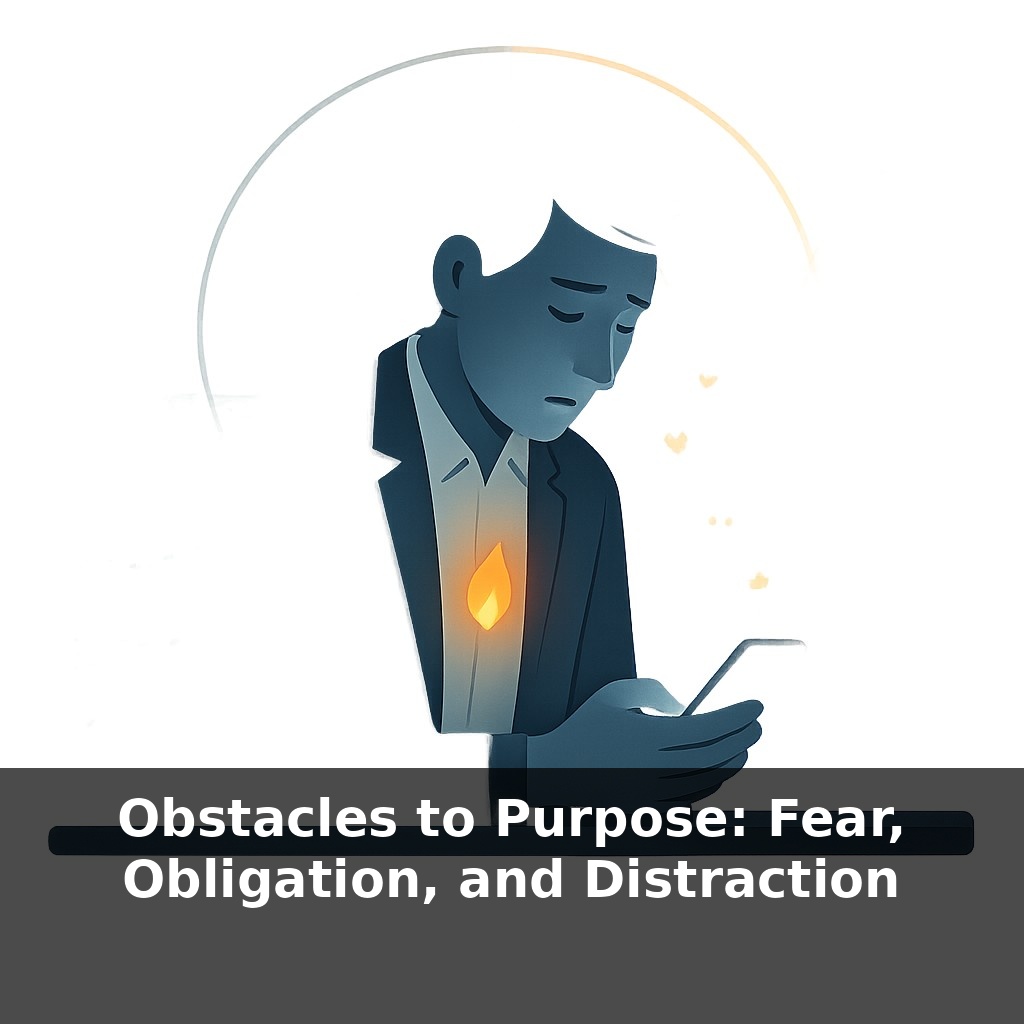
About a third of people who dream of starting a business never even try—blocked by fear of failure. Now zoom in: one person stuck in a job that pays the bills, scrolling their phone between meetings, feeling strangely hollow. They’re busy. They’re successful. But are they actually alive?
Fear doesn’t usually shout; it negotiates. “Stay here a little longer. It’s safer.” Obligation joins in: “You owe it to your boss, your parents, your résumé.” And distraction happily fills the remaining space with notifications, deadlines, and minor emergencies that feel urgent but leave nothing important behind. None of this looks dramatic from the outside. It looks… responsible. Productive. Connected.
Yet psychology and neuroscience point to a quieter story underneath: your brain can’t move toward a personally meaningful future if it’s constantly busy surviving the present. Purpose demands at least three capacities that these forces steadily erode: the courage to imagine a different path, the autonomy to choose it, and the focus to stay with it long enough for it to take shape. When those are compromised, you don’t just lose momentum—you slowly lose the sense that another life is even possible.
Most people don’t name these forces directly. They say “I’m realistic,” “I’m responsible,” or “I’m just too busy right now.” On the surface it sounds mature; underneath, something quieter is happening in the brain. You start editing your own possibilities before they’re fully formed, like deleting a draft email after the subject line. Over time, your inner life becomes more about managing expectations than exploring options. The research on purpose and well-being isn’t preaching hustle; it’s issuing a warning: when your days are packed but your direction is vague, your nervous system learns to treat long-term meaning as a luxury, not a necessity.
A third of aspiring entrepreneurs never start. Most employees don’t feel their work is meaningful. And the average person taps their phone well over a hundred times a day. On paper, these look like separate problems: career indecision, disengagement, “screen time.” Underneath, they share one pattern: your attention keeps getting pulled away from the slow, sometimes uncomfortable work of shaping a life that feels like yours.
To see how this plays out, zoom in on everyday moments, not life-or-death crossroads.
You’re in a meeting. An idea surfaces—small, half-baked, slightly risky. In the two seconds before you speak, three internal processes collide. A rapid threat-scan (“What if this sounds stupid?”). A loyalty check (“Does this align with what my manager wants?”). And a micro-urge to escape the tension (a glance at your inbox or phone). If the threat and the urge win, the idea dies silently. No drama, no visible loss—just one less data point about what energizes you.
Multiply that by weeks, then years. The brain learns a quiet rule: “Don’t reach too far. Stick to what keeps you approved and occupied.” Over time, this doesn’t just keep you from big risks; it narrows what you’re even able to imagine. Research on goal-setting shows that when people repeatedly suppress personally meaningful goals in favor of externally rewarded ones, their motivation shifts from “I want” to “I should”—and their sense of aliveness drops with it.
Now add distraction as a default exit route. Every time your device offers an easy micro-reward, it trains your nervous system to treat unease as a problem to be numbed, not a signal to be explored. The moment you feel restless in your role, instead of asking “What does this restlessness point to?” you swipe, scroll, or multitask. Short term, that works. Long term, it blurs the feedback loop between your values and your daily choices.
High-purpose people aren’t immune to any of this. The difference, studies suggest, is that they repeatedly do something slightly uncomfortable: they turn toward the friction. They notice the tiny wince before they speak up, the heaviness before saying yes, the impulse to check out when a task feels emotionally loaded—and treat those as information. Not commands, not emergencies—just data about where their current life and their deeper priorities are misaligned.
That noticing is where a different story can start.
Think of three different people. First, a senior engineer who quietly sketches product ideas in a notebook but never shares them. What finally shifts things isn’t a motivational speech; it’s noticing that her best ideas arrive in the 10 minutes after a run, before email pulls her into reactive mode. She starts protecting that window, treating it as “proposal time,” and suddenly there’s a prototype on her manager’s desk.
Second, a medical resident who said yes to the profession for family reasons. He can’t quit tomorrow, but he can run small experiments inside the life he already has: requesting one rotation that actually interests him, tracking which parts of a shift leave him drained versus quietly proud. Data accumulates; a different specialty appears on the horizon.
Third, someone whose phone is their default weekend companion. They install a simple friction: the device lives in another room for the first waking hour. The initial boredom feels loud—but in that space, an old interest in music reappears, not as a grand calling, just as 20 minutes with a guitar that finally moves from the closet to the couch.
Soon, your calendar may be scanned by algorithms asking a quiet question: “Is this person likely to stay, grow, or burn out here?” Metrics of alignment could shape promotions the way performance reviews once did. On the personal side, think of small, experimental projects—side courses, micro-volunteering, tiny ventures—as a “prototype lab” for your next chapter, long before a formal career change. The more such labs you run, the less any single role can trap or define you.
If you trace your days like a financial statement, you’ll see where your real investments go: which people, which problems, which tiny risks. Over time, those “transactions” hint at a direction more honest than any slogan about your life. You don’t need a grand revelation—just a slightly truer next step, repeated often enough to become a new baseline.
Here’s your challenge this week: Choose **one fear**, **one obligation**, and **one recurring distraction** that are currently pulling you away from your sense of purpose, and for the next **5 days**, run a real-life “experiment” with each. For fear: do one specific action that your fear has been talking you out of (e.g., sending the email, pitching the idea, sharing your work) and then, that same day, rate from 1–10 how bad the outcome actually was versus how bad you imagined it would be. For obligation: say a **clear, direct no** to one non-essential commitment you normally would have said yes to, and note exactly how the other person responds. For distraction: set a **30‑minute daily “no-distraction block”** (phone in another room, no tabs except what you need) and track how many focused minutes you actually get before you break it. At the end of the week, look at your notes and decide one concrete boundary or habit you’ll keep that made the biggest difference.