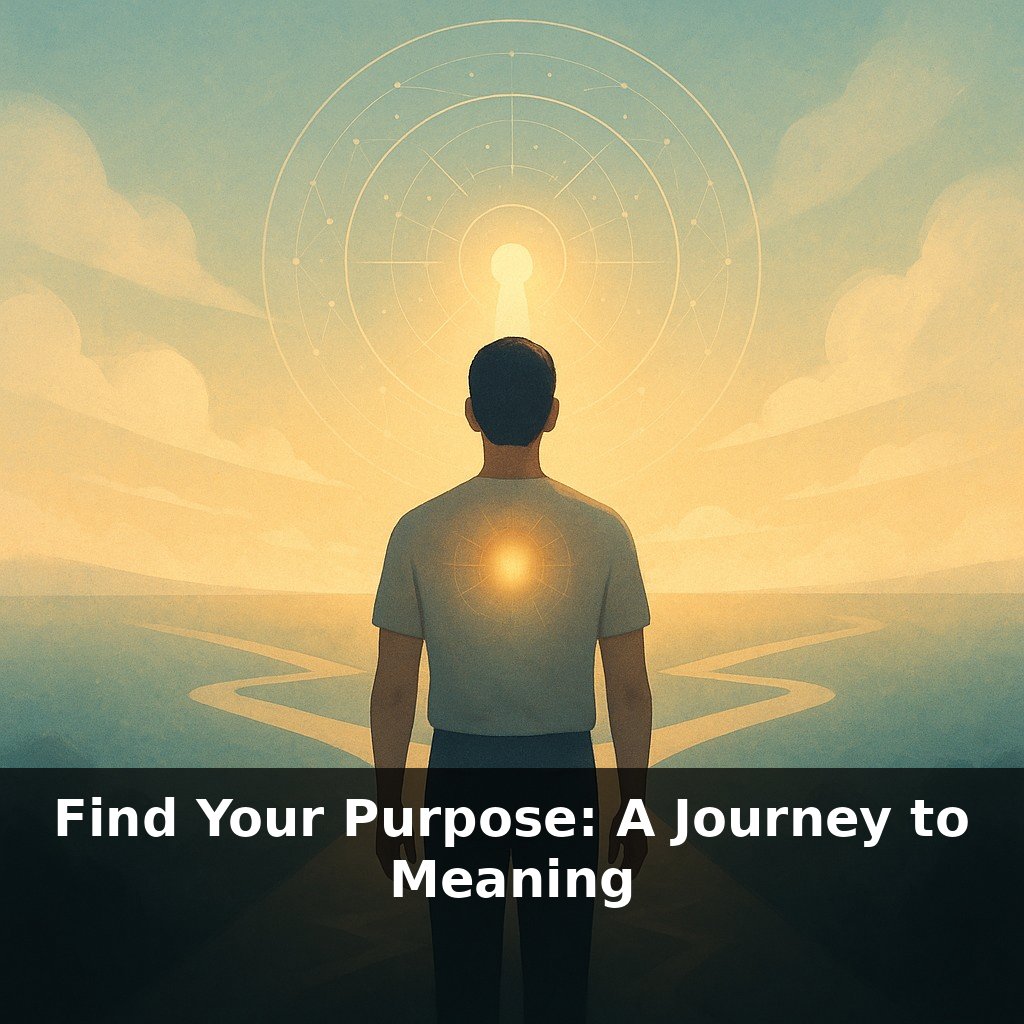
About half of people say their days feel busy but strangely empty—yet those who’ve written a simple life mission report noticeably higher well‑being. You’re racing through tasks; someone else is moving slower but feels on track. Same effort, totally different inner experience.
Seventeen percent. That’s how much lower the risk of mortality was for older adults who reported a strong sense of purpose. Not more supplements. Not more steps on a fitness tracker. More purpose. Yet most of us spend more time editing a LinkedIn bio than clarifying what we’re actually trying to do with our one life. We set scattered goals—get promoted, travel more, save some money—without checking whether they’re pulling in the same direction. The result is a kind of subtle friction: you’re busy, you’re not failing, but your choices don’t quite “click” together. In this episode, we’ll zoom in on one practical tool: a short personal mission statement. Not a grand slogan for the rest of your life, but a working draft that can guide what you say yes or no to this year, this week, even today.
Most people never write anything down; they just “know” roughly what matters and hope intuition will sort the rest out. But under stress, that vague sense tends to shrink to whatever is loudest or most urgent. That’s where a clear, written mission starts to earn its keep: it forces trade‑offs into the open. Research in motivation shows that when your daily actions feel connected to something bigger, your brain processes effort as investment, not just depletion. That shift doesn’t require a perfect sentence—only something concrete enough that, when two good options collide, you can say, “For me, this one wins.”
Here’s the twist: most people try to write a mission by staring at a blank page and waiting for “who I really am” to appear. Psychologically, that’s backwards. Purpose tends to emerge from *constraints*—from the roles you already occupy, the values you refuse to betray, and the kinds of problems you keep feeling pulled toward.
So instead of hunting for one perfect sentence, think in three layers:
**1. Roles: Where do you actually show up?** List the arenas where your behavior has real impact: “friend, partner, parent, manager, designer, neighbor, citizen, musician, learner.” Research on identity suggests that when we name our roles, we widen the lens beyond “my job” and start to see a more complete pattern of responsibility.
Then ask: In which of these roles do I feel most *alive*? In which do I feel most *obligated*? Both matter. Your mission usually sits at the intersection of what energizes you and where your actions truly affect others.
**2. Values: What must be true about how you operate?** Values are the non‑negotiable qualities of action that feel “right” to you—things like honesty, curiosity, courage, care, excellence, playfulness, steadiness. Instead of picking from a giant list, scan your last month:
- When were you proud of how you handled something? What quality showed up there? - When were you quietly disappointed in yourself? Which value did you sideline?
Self‑Determination Theory highlights autonomy, competence, and relatedness as universal needs; your personal values often describe *how* you want to meet those needs. Someone might express autonomy through creativity; another through integrity—still the same basic need, but different flavor.
**3. Contribution: What changes when you’ve done your part?** This is the “for the sake of what?” piece. Not a grand legacy, just a concrete difference. Smaller is often clearer:
- “Kids who feel heard.” - “Teams that tell the truth faster.” - “Students who trust their own questions.”
Now you can draft a working mission using a simple structure:
> “In my key roles as [A, B, C], I aim to live out [values X, Y, Z] by helping create [specific kinds of outcomes or experiences for others].”
It won’t be perfect. That’s the point. Written down, it becomes something you can test against real days and revise as you notice where it fits and where it chafes.
A concise mission doesn’t need fancy language; it needs to be *usable*. Try looking at it the way a good software engineer looks at code: is this something I can actually “run” today?
For example, someone might land on: “Through my roles as father, product designer, and friend, I practice candor, play, and reliability to help people feel both safe and stretched.”
Notice what this does: - It quietly ranks roles without saying any are worthless. - It turns vague ideals into behaviors you can see: telling the hard truth kindly, showing up when you said you would, leaving room for jokes in tense meetings. - It implies boundaries: projects that demand constant spin or flattery will clearly clash.
You can also write smaller “mission modules” for one sphere: - At work: “Build tools that reduce friction in people’s day.” - In community: “Spot and include the quiet person.”
These mini‑missions can sit under your main one, like reusable components in a well‑designed app you keep refactoring as your life evolves.
Most people will never read your mission—but algorithms might. As career platforms and learning apps mine patterns in your choices, a clear statement can act like high‑quality training data: sharpening recommendations instead of letting clickbait steer you. Your future self can also “query” it when making big moves—career shifts, relocations, even which skills to learn as industries change—using it as a filter to ask, “Does this path amplify or dilute what I’m really here to do?”
Treat this version as a draft contract with yourself, not sacred text. Expect edits. As life shifts—new job, breakup, child, illness—let your mission “re-base” like a git branch: same core intent, cleaner implementation. Your challenge this week: test it against three real decisions, and note where it clarifies, where it complicates, and where it surprises you.