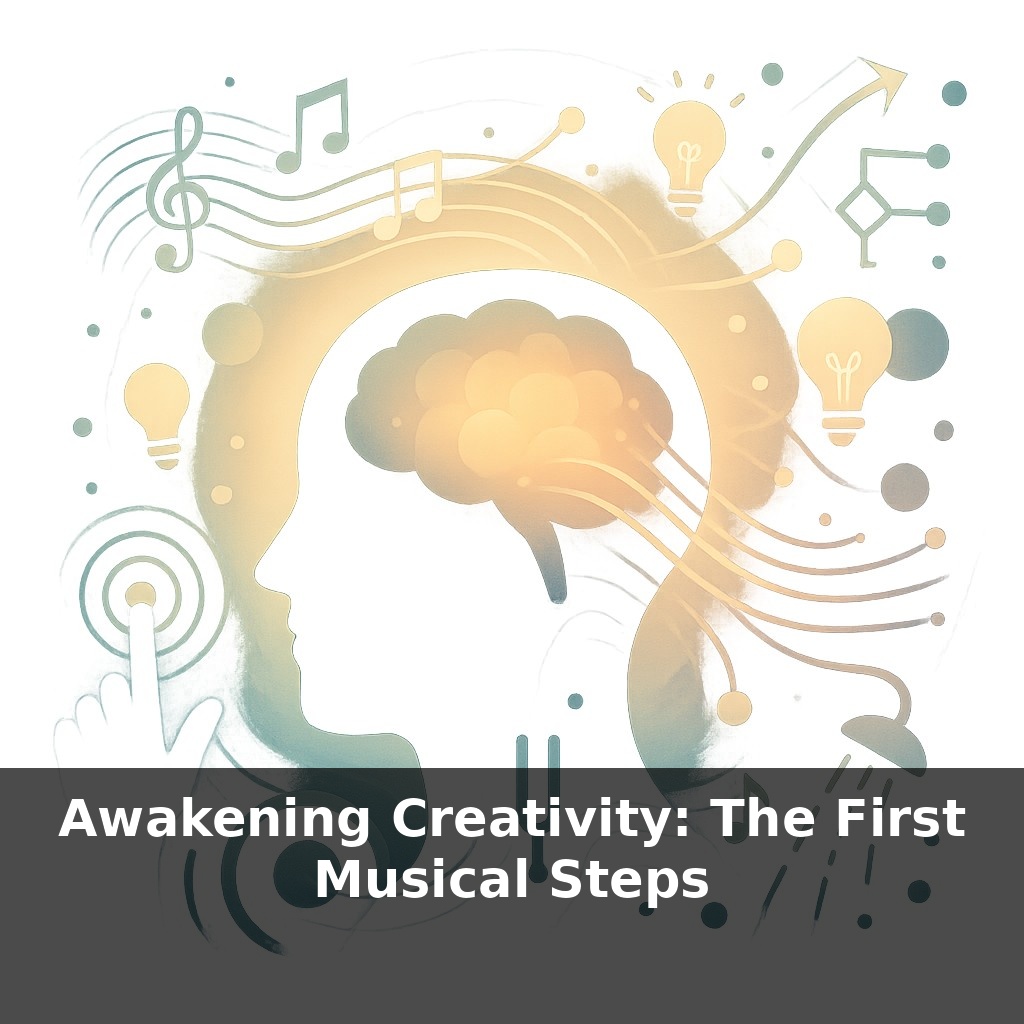
Awakening Creativity: The First Musical Steps
📝 Transcript
Right now, as you’re listening, your brain is quietly composing. Neuroscientists say even a short burst of music can switch on the networks for daydreaming and decision-making at the same time. So here’s the puzzle: if your brain is already musical, why does creativity feel so hard?
Maybe the problem isn’t that you’re “not creative,” but that your creativity has never been tuned. Think of those moments you tap a steering wheel in traffic or hum in the shower—tiny, throwaway rhythms your brain invents without permission. That’s raw material. The research now says even a few minutes of intentional musical play can tilt your mind toward new ideas, like turning a lens until a blurry image snaps into focus. You don’t need talent, theory, or an instrument that costs more than your rent. You need low-stakes experiments: a looped beat on your phone, a single note held a little too long, nonsense syllables that somehow feel true. In this series, we’ll treat these as training reps for your imagination, each one designed to loosen something that’s been stuck—not to make you a musician, but to help you hear what your own voice has been trying to say.
So in this first step, we’ll zoom in on something smaller than “learning music”: your very first musical decision. Not a song, not a practice routine—just choosing a sound on purpose. Think of a few notes on a keyboard app, a clap pattern on your desk, or looping a tiny snippet of a track until it starts to feel like a heartbeat in the room. That decision is where the shift begins: from passively absorbing sound to shaping it. We’ll explore how these micro-moments—barely long enough to feel serious—can still nudge your mood, widen your options, and quietly open a side door into fresh ideas.
Think of this first step as lighting a small pilot flame rather than launching fireworks. You’re not trying to “make art” yet; you’re just giving your nervous system a tiny, deliberate nudge. Research shows even 15 minutes of active music engagement can boost dopamine and norepinephrine—chemicals that make you more alert, curious, and willing to take mental risks. That’s the zone where odd connections suddenly feel possible, where a boring problem can tilt at a new angle.
Start with the simplest unit: one sound, chosen on purpose. Tap a single key on a virtual piano, hit a mug with a pen, or record your own voice on your phone saying a word you like. Now, repeat it. Stretch the gap between repetitions, then close it. Make three quick in a row, then wait. You’re not performing; you’re testing how tiny changes in timing or intensity shift your body and attention.
This is where improvisation begins—not as wild solos, but as micro-choices. Louder or softer? Higher or lower? Faster or slower? Each tweak is a fork in the road, and your brain tracks those forks as options. That “options list” is crucial for idea generation later, far beyond music. When you teach yourself that there’s always another possible rhythm, it becomes easier to believe there’s always another way to phrase an email, design a slide, frame an argument.
You can ground this in structure without killing the playfulness. Set a 5‑minute timer. For the first minute, stick to one sound. Next two minutes, add a second sound that only appears occasionally, like a surprise guest. Final two minutes, let the two sounds “talk”: alternate them, overlap them, leave long pauses. Notice what grabs your attention—a particular spacing, a certain order—and lean into it.
If you feel silly, good. That’s a sign you’ve slipped outside your usual productivity script. Many innovators quietly use rituals like this. Teams at places like NASA’s JPL have adopted short “music minutes” before problem‑solving sessions, not for entertainment, but because loosening rhythmic patterns seems to loosen habitual thinking.
Over time, these small experiments train a kind of internal “latency”: a tiny delay before you default to the obvious choice. In that sliver of space, you can ask: what if I changed the tempo of this conversation, softened this “note” in my response, or emphasized a different beat in my day?
Try this as a test bed in daily life: pick one routine moment and quietly “score” it. Waiting for coffee? Let your fingers drum a slow 4‑beat pattern on your leg, then slip in a tiny variation every fourth bar. Commuting? Loop a two‑note hum under your breath and nudge its speed whenever the environment shifts—a door opening, a light changing, someone getting on the train. You’re not composing a song; you’re attaching a movable frame to an ordinary scene and seeing what changes inside it.
Many people find it easier to start with borrowed structure. Use a metronome app at a soft volume and walk so your steps hit every click, then every second click, then randomly dodge the clicks altogether. Or take a familiar chorus you love and, instead of singing it, tap its rhythm with a pen while reading email. This sideways approach lets you feel patterns and deviation without the pressure to “sound good.”
Your challenge this week: once a day, for five minutes, pick one ordinary activity and secretly give it a rhythm. At the end of each mini‑session, ask yourself one question: “What did I almost do differently?” That “almost” is where your next idea lives.
Soon, these five‑minute sound experiments may plug into tools you already use. Think less “music app,” more subtle co‑pilot: your writing software lowering tempos as you edit, pulsing brighter rhythms when it senses you’re stuck. Classrooms could pair multiplication drills with claps and stomps, while therapists tune short playlists to help clients safely rehearse new reactions. As these practices spread, the real shift may be cultural: treating musical tinkering as hygiene for flexible thinking, not a rare talent.
Over time, these tiny sound choices start to leak into other parts of life: you notice pauses in conversations, gaps in routines, pockets where a new pattern could fit. A single tap, hum, or beat becomes more like toggling a setting in your operating system—subtle, but cumulative—until “I’m not creative” feels less like a truth and more like an old script.
Try this experiment: Pick a simple emotion you felt today (like “annoyed in traffic” or “quietly happy with my coffee”) and set a 5-minute timer to translate it into sound using just three notes on your instrument or voice. For the first 2 minutes, only explore different rhythms and dynamics (soft/loud, short/long) with those same three notes—no new notes allowed. For the next 3 minutes, record yourself improvising freely with those three notes, still staying inside that one emotion. When you’re done, listen back once and ask: “Does this *feel* like the emotion I started with?”—then tweak one thing (tempo, volume, or silence) and record a second, improved version.
Unlock all episodes
Full access to 5 episodes and everything on OwlUp.
Subscribe — $1.99/monthLess than a coffee ☕ · Cancel anytime