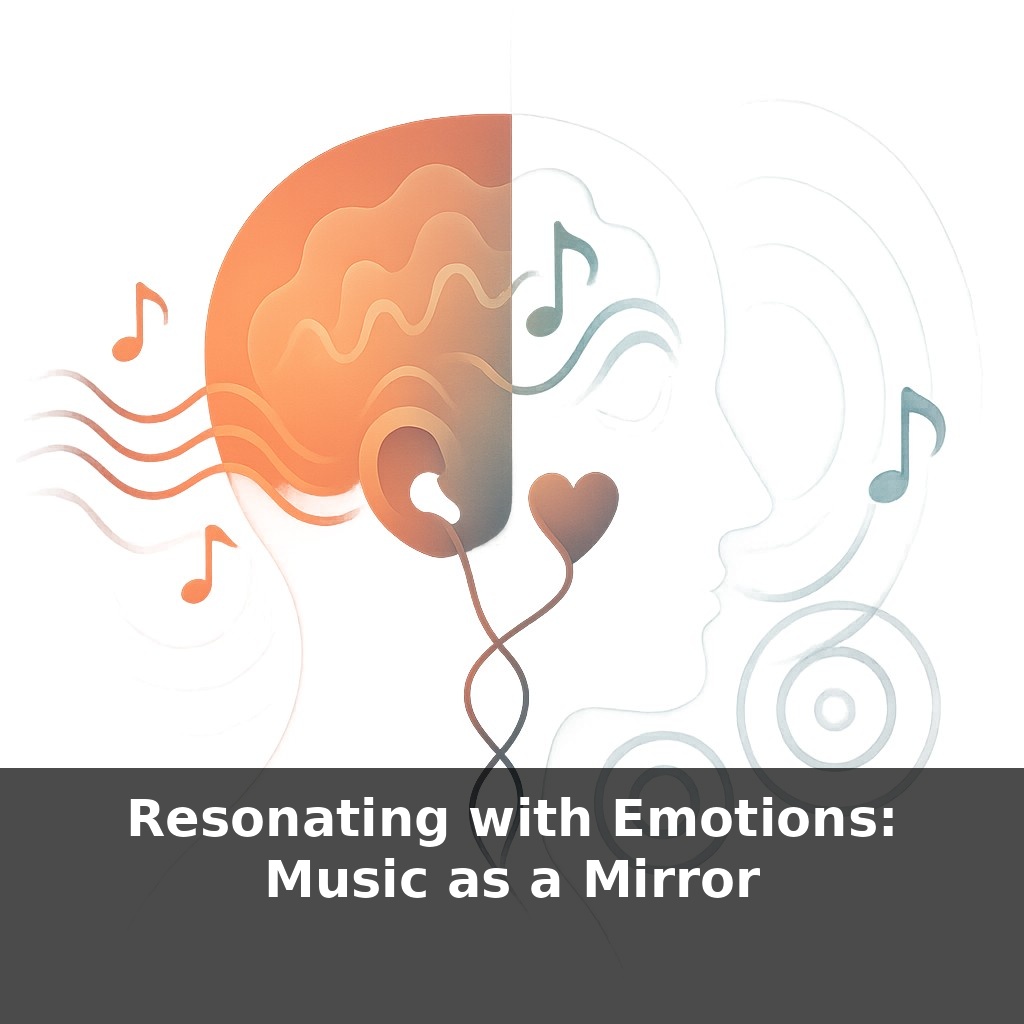
Right now, as you listen, your brain is tracking the emotion in music almost as well as it tracks real voices. Think of the last song that made you tear up in the car or feel oddly brave on a walk—how did it know what you were feeling before you had words for it?
Maybe you’ve noticed this: some days the “wrong” song feels abrasive, even if it’s a favorite, while another track suddenly fits your mood so precisely it’s almost unsettling. That mismatch—or eerie match—isn’t random. It’s your emotional state brushing up against the emotional shape of the music.
Where this gets interesting for creativity and self-understanding is what happens when you stop using music as background noise and start using it as a kind of emotional spotlight. The details you usually ignore—how quickly the drums move, how bright the chords feel, how close the singer’s voice seems—are all clues. They can reveal whether you’re restless or drained, hopeful or resigned, even when all you can consciously say is “I feel off.”
In this episode, we’ll turn your everyday listening into a low-pressure way to “overhear” what you’re really feeling.
Most of the time, we treat those musical “clues” as passing scenery: a hype playlist for the gym, a lo-fi mix for work, something loud enough to drown out traffic or quiet enough to fade behind emails. But if you pause and zoom in, the songs you reach for behave more like a search history than wallpaper. They quietly log what you’ve been needing—energy, comfort, nostalgia, release. One person’s endless breakup ballads, another’s relentless dance tracks, someone else’s ambient piano loop at 2 a.m.—each is a different emotional question your mind keeps re-typing into sound.
Think of this episode as shifting from “I like this song” to “what, exactly, is this song doing to me?” To get there, it helps to break music into a few emotional dials you can actually notice and play with.
Start with **tempo**. Instead of “fast vs slow,” try asking: does this track push me forward or let me sink back? Notice when you reach for something driving and relentless—do you actually need more energy, or are you trying not to feel how tired you are? And when you drift to very slow tracks, are you soothing yourself, or sliding into a fog?
Then there’s **mode and harmony**—the overall color of the chords. Some songs lean bright and open, others feel tense or unresolved. Pay attention to where your attention lands: do you perk up on the hopeful lift of a chorus, or relax into the bittersweet verses? That tug-of-war often mirrors how conflicted you are about a situation in your life.
Next, listen for **timbre**—the texture of the sounds. A raw, raspy vocal, glossy synth pads, a dry, intimate piano, a distant reverb-soaked guitar: each carries a different emotional temperature. Which textures feel “too much” right now? Which feel like home? Your tolerance (or intolerance) can tell you whether you’re craving contact or distance, sharpness or softness.
If there are **lyrics**, separate what they say from how they’re delivered. You might find yourself drawn to songs whose words don’t fit your story at all, but whose emotional delivery does. That mismatch is interesting data: maybe your life looks fine on paper, yet you keep playing songs about leaving, or starting over, or being seen for the first time.
Finally, notice **sequence**: over a day or a week, how do your choices evolve? Do you start with something angry, then slowly move toward something more grounded? Or hover in one emotional zone for hours? Those arcs often trace the emotional journey you wish you were on—even if your outer day looks static.
This isn’t about diagnosing yourself through playlists. It’s about treating each track as a small emotional check-in: “What about this feels right, and what feels wrong, for me, right now?” Over time, that question turns background noise into a running translation of your inner weather, one song at a time.
Think about three ordinary listening moments and how they might quietly map your inner world. First, the rushed commute: you flip through tracks impatiently until one finally “clicks.” Instead of blaming the algorithm, you could ask: what exact quality made you stop—sharp drums, wide echo, steady pulse? That’s a live snapshot of what feels regulating, not just entertaining. Second, a late-night scroll, headphones on, landing on a song you loop embarrassingly often. Treat that loop like a bookmarked sentence in a long book: what part of your current chapter does it underline? Third, background music while cooking or cleaning. Without touching your playlist, just notice when your body syncs up—a stirring rhythm matching your movements, or a chorus that makes you pause mid-task. In each case, you’re not trying to “fix” a mood. You’re collecting tiny, concrete signals about pace, tension, and texture that line up with how you’re really doing, beneath whatever story you’d normally tell.
Soon, your playlist habits may matter as much as your search history. As wearables quietly log pulse, breath, even tiny changes in your voice, music apps could start nudging you: softening a playlist after a tense call, or surfacing bolder tracks when you keep shrinking back. The promise is a kind of emotional co-pilot; the risk is letting opaque systems steer your moods for you. The real frontier isn’t smarter algorithms, but how deliberately you choose to use—or ignore—them.
Let your queue double as a sketchbook: instead of curating only “good vibes,” keep the odd, messy tracks too. They’re quick thumbnails of states you might skip over in conversation. Over time, patterns in those rough sketches can hint at themes—like recurring colors in a painting—that deserve more space in your creative life.
Before next week, ask yourself: 1) “When a song suddenly hits me emotionally (goosebumps, lump in my throat, urge to skip it), what exactly is happening in my body in that moment, and what might that be mirroring about something I haven’t said out loud lately?” 2) “If I replay one track from this week that made me feel seen, what specific lyric, instrument, or shift in volume felt like it was ‘speaking for me,’ and what real-life situation does that connect to right now?” 3) “The next time I’m overwhelmed, which song from my usual playlist could I intentionally choose as a ‘mirror’ instead of a distraction, and what single question about my current emotion could I sit with for the length of that track?”