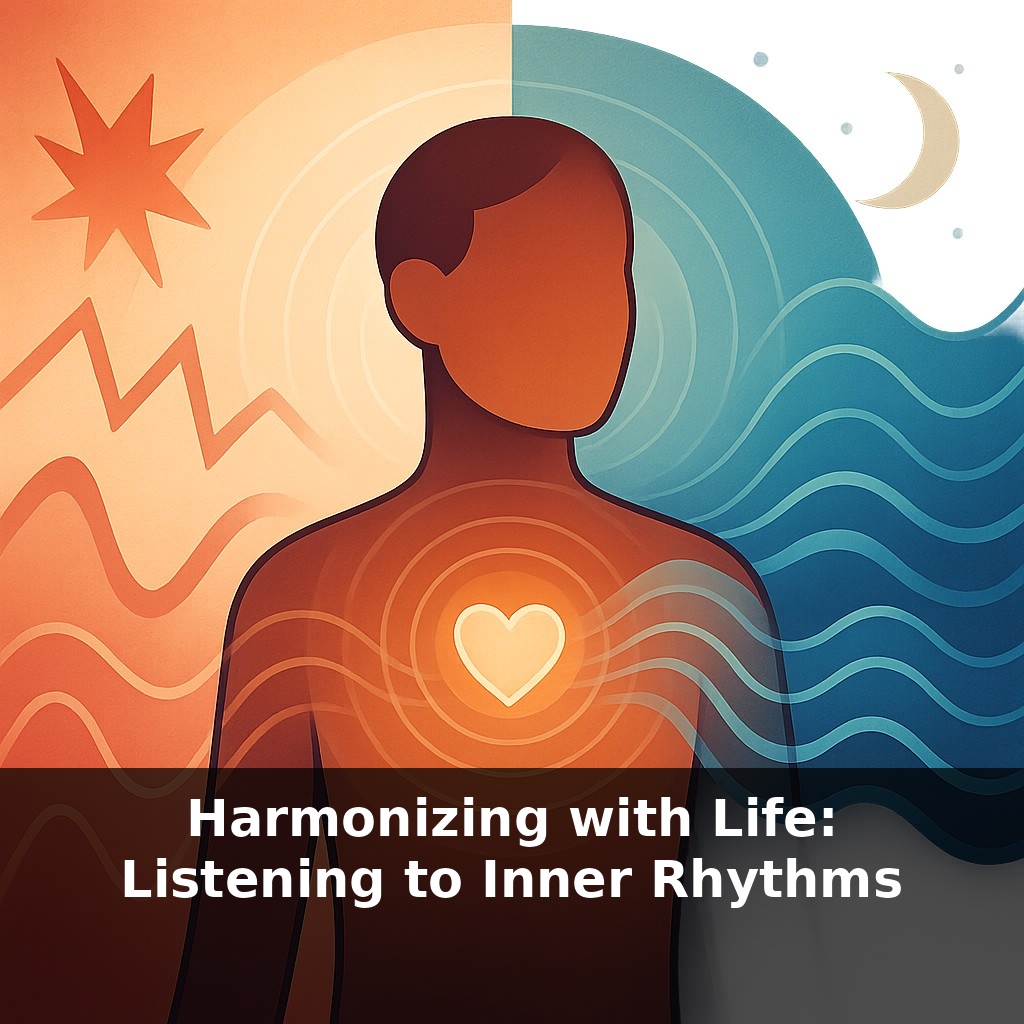
Have you ever been mid-conversation and realized your heartbeats, unbeknownst to you, have begun mirroring the rhythm of the sounds around you? Researchers have witnessed this phenomenon—our hearts unconsciously aligning with external beats. If sound is already steering you subtly, what transformations await if you harness it intentionally?
Think about the shape of your day instead: jolting awake to a harsh alarm, jumping between tabs, scrolling in scattered silence, collapsing at night with a show humming in the background. Most of us move through those scenes without noticing how each sound is nudging the pace of our thoughts and energy. Research on circadian and other body cycles suggests we’re not just “on” or “off”; we’re moving through peaks, dips, and gentle turns. Music can mark those transitions the way streetlights guide traffic: green for focused work, yellow for slowing down, red for full stop and rest. The key isn’t just pressing play—it’s matching your playlists to specific moments: ramping up gently in the morning, stabilizing in the afternoon, and signaling safety at night. Over time, these choices become cues your body recognizes, helping your creative work feel supported rather than forced.
Most of us already use music as background wallpaper: earbuds on the commute, a random playlist during emails, something “chill” at night. But research suggests those casual choices are quietly editing our mood, attention, and even how brave we feel with our ideas. A fast playlist can tip you toward finishing tasks; slower, steadier tempos can make space for reflection and deeper problem‑solving. Some creators treat playlists like a rotating toolkit: one for drafting, one for admin, one for decompression. The twist is noticing that the same song can either sharpen or scatter you, depending on where you are in your own daily arc.
Think of this step as zooming in from “music for the day” to “music for this exact moment, in this exact body.” The research on ultradian and infradian cycles reminds us you’re not a flat line of energy; you’re a series of waves inside bigger waves. That means the same track that helps you crush email at 10 a.m. might make you jittery at 3 p.m. when your system is naturally dipping.
One practical shift: instead of asking, “Is this good music for focus?” ask, “Where am I in my current wave—and what would be a supportive next step?” If you’re already wired and restless, adding high‑intensity tracks is like stomping the gas on a car that’s fishtailing; what you may need is something steady enough to give your attention a lane to follow. If you’re foggy and slow, a slight uptick in tempo can act more like a nudge than a shove.
Tempo is only one lever. Structure matters: repetitive patterns and predictable phrasing tend to quiet the part of your brain that’s scanning for surprises, which can be useful for deep work or winding down. On the other hand, more varied, dynamic tracks can wake up curiosity when you’re brainstorming or sketching new ideas. Tonal color matters too: bright, high‑frequency sounds often feel more activating; darker, warmer timbres can signal safety and exhale.
Crucially, your reactions aren’t generic. Studies on dopamine release show that when you choose the track, your reward system lights up more than when someone else chooses for you. That’s not just “liking” a song; it’s your brain tagging, “This is mine.” For creative work, that sense of ownership can be the difference between forcing yourself through a task and feeling internally recruited to it.
This is where the paradox kicks in: the same algorithm that serves you endless “focus” playlists can also slowly flatten your sensitivity. If you never experiment, you stop noticing subtle shifts—when a piece actually calms you versus merely distracting you. Treat your listening like a living prototype. Shift one variable at a time: tempo, presence or absence of lyrics, acoustic versus electronic textures. Watch what happens to the speed of your thoughts, the tightness in your shoulders, the way your breathing changes.
Over time, you’re not just curating sound; you’re learning a private language of cues. The work isn’t to find the perfect playlist once, but to keep updating your choices as your inner rhythms—and your creative needs—change.
A simple way to start is to treat one part of your day as a test bed. Say you notice you always stall after lunch. For three days, try a 15‑minute “bridge” set: begin with one track that matches your sluggishness—muted, low‑key, maybe even slightly slower than your resting pace—then stack two or three songs that gradually brighten in tempo and texture. Your only job is to notice when your mind feels willing to re‑engage, even if your body still feels a bit heavy. Another experiment: build a “courage cue” playlist for work that scares you—submitting pitches, speaking up, sharing drafts. Choose music that feels like sturdy scaffolding rather than hype: pieces that make your chest feel open, your jaw unclench, your thoughts organize. Press play only when you’re about to cross that edge. Over a week or two, notice whether the first notes start to pre‑signal “I can handle this,” even before you’ve decided you’re ready.
By the time adaptive soundscapes are common, your “music settings” may sit beside brightness and notifications in every app you use. Instead of one static playlist, you’ll have context-aware layers: deep-focus scores that fade in when your calendar shows “writing,” gentle social buffers that surface before hard conversations, even micro-anthems for tiny wins. Think less “DJ in your pocket,” more “subtle operating system for your mood,” quietly shaping how you enter, move through, and exit each part of your day.
Treat this less like “hacking” yourself and more like learning a craft. Composers revise themes across movements; you can revise your sonic habits across weeks. Notice which tracks help you return after setbacks, or soften self‑criticism when you’re stuck. Over time, you’re not just consuming music—you’re quietly co‑writing how your days feel.
To go deeper, here are 3 next steps: 1) Try a 10-minute “inner tempo” meditation with the free Insight Timer app—search for Tara Brach’s “Coming Home to Your Body” and, as you listen, place a hand on your heart and belly to literally feel the rhythm shifts you heard them talk about in the episode. 2) Start syncing your day with your natural energy waves by using the Timeular or Toggl Track app for just today—log when you feel most “in flow” vs. “out of tune,” then adjust one task (like email or creative work) to match your peak rhythm. 3) Deepen your practice of listening to inner rhythms by reading one chapter tonight from “The Power of Rhythm” by Reinhard Flatischler, and then experiment with a simple 4-beat body percussion pattern (tap thighs–chest–snap–clap) while noticing how your breath and mood start to align.