A Harvard study found resilient leaders are about a fifth less likely to burn out—yet most of us train our inboxes more than our nervous systems. You’re in a tense meeting, your heart’s racing… but your voice is steady. How did you get there? That’s the puzzle we’ll unpack today.
That moment in the meeting is just one “stress rep” in a much bigger training plan. Outside the boardroom, your resilience is being shaped in smaller, quieter moments: the curt email that lands wrong, the project that slips, the late-night spiral about a decision you can’t un-make. Most leaders treat these as isolated irritations. In reality, they’re data points in how your emotional system is wired to respond.
Here’s the twist: resilience isn’t just about staying calm when things go wrong; it’s about recovering faster and learning more each time they do. Think of the difference between a leader who snaps back after a setback and one who subtly tightens up for weeks—same event, completely different trajectory for their team.
In this episode, we’ll treat your daily frictions as a lab: specific tools, small experiments, and realistic practices you can actually sustain.
Most leaders try to “feel better” in the moment, but context matters more than any single coping trick. Are you walking into the day already depleted? Are you taking on your team’s emotions without noticing? Is your calendar wired for constant threat—back-to-back reviews, no transition time, feedback always at 4:55 p.m.?
Behind every sharp reaction is usually a predictable pattern: certain people, topics, or times of day that reliably tighten you up. Spotting those patterns is less about judgment and more like debugging code: you’re tracing where the system keeps crashing so you can redesign how it runs, not blame the user.
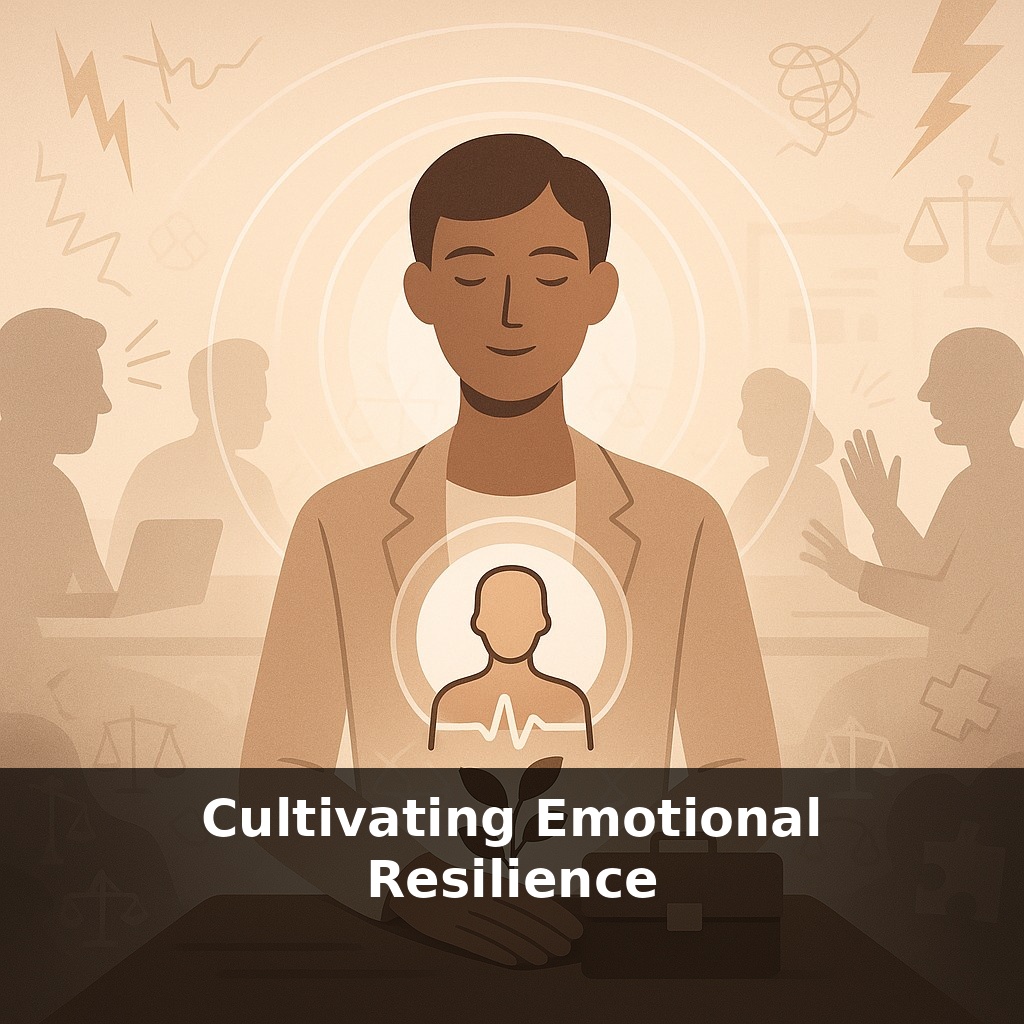
Think of resilience as three interlocking layers: what happens in your body, what happens in your mind, and what happens between you and other people. You don’t “have” resilience in the abstract; it shows up differently in each layer, often at different speeds.
The body layer is the fastest. Long before you “decide” how to respond, your heart rate, breathing, and muscles have already taken a stance: threat or challenge. Leaders who seem grounded aren’t magically calm; they’ve trained the early signals. They notice the jaw clench, the shallow breath, the urge to rush—or shut down—and use simple physical interrupts: a slower exhale, a pause before unmuting, even standing up before answering a hard question.
The mind layer is slower, but more powerful over time. This is where cognitive habits live: how you explain setbacks to yourself. One person gets critical feedback and unconsciously defaults to “I’m failing”; another thinks “this stings, and it’s also a map of what to improve.” Same event, different internal script, radically different energy the next day.
Research on emotional intelligence calls this “emotional self-awareness” and “cognitive reframing,” but in practice it’s more down‑to‑earth: catching the first draft of your story before it hardens into “truth.” Leaders at companies like Microsoft and Salesforce often use a quick mental check:
- What am I assuming right now? - What else could be true? - If my best friend were in this situation, how would I describe it to them?
The social layer is where resilience either multiplies or leaks. Your team reads your micro‑signals faster than your words. When you’re under pressure, do you narrow the circle and go silent, or name that the team is in a tough sprint and set clearer guardrails? During the pandemic, managers whose teams stayed highly engaged tended to do three things consistently: normalized stress (“It makes sense this feels heavy”), made priorities explicit, and modeled boundaries instead of heroics.
Here’s the twist many leaders miss: these layers are bidirectional. Change any one, and the others start to shift. A calmer body makes reframing easier. A more generous story about yourself makes it easier to ask for help. And a psychologically safer team makes your body less reactive in the first place—like upgrading the operating system rather than just closing a few apps.
Think of a difficult 1:1 where a direct report suddenly pushes back hard. Your body goes alert, your thoughts sprint toward worst‑case scenarios, and you notice yourself speaking faster. Instead of powering through, you pause, take one slower breath out, and say, “Let’s slow this down—I want to really understand what’s behind this for you.” That single move shifts all three layers: your physiology, your story about what’s happening, and the tone of the relationship.
Or take a launch that misses its target. Leader A quietly blames themselves, works late all week, and avoids talking about it. Leader B blocks 30 minutes with the team to map “what helped, what hurt, what we’ll change next time,” then ends with, “No late nights this week—recover and we’ll revisit on Monday.” Same miss, but one path compounds stress, the other converts it into shared learning and permission to reset.
Across a quarter, those small, repeated choices start to change what your team expects from you under pressure—and what you expect from yourself.
Stress data won’t stay invisible. Wearables and HRV scores will quietly flag when a “high performer” is actually running on fumes, long before performance reviews catch it. Leaders may soon see resilience graphs beside revenue dashboards, nudging them to schedule recovery the way they schedule launches. Think of it like version‑controlling your emotional habits: you’ll be able to test new ways of responding to pressure, track their impact, and roll back “buggy” patterns before they spread to your team.
You don’t have to overhaul your life to shift this. Think in “micro‑upgrades”: a 90‑second pause after a hard call, a single clarifying question when emotions spike, a brief walk before responding to a thorny email. Your challenge this week: pick one tiny lever and use it daily, like adding one strong password to protect your most important internal account.