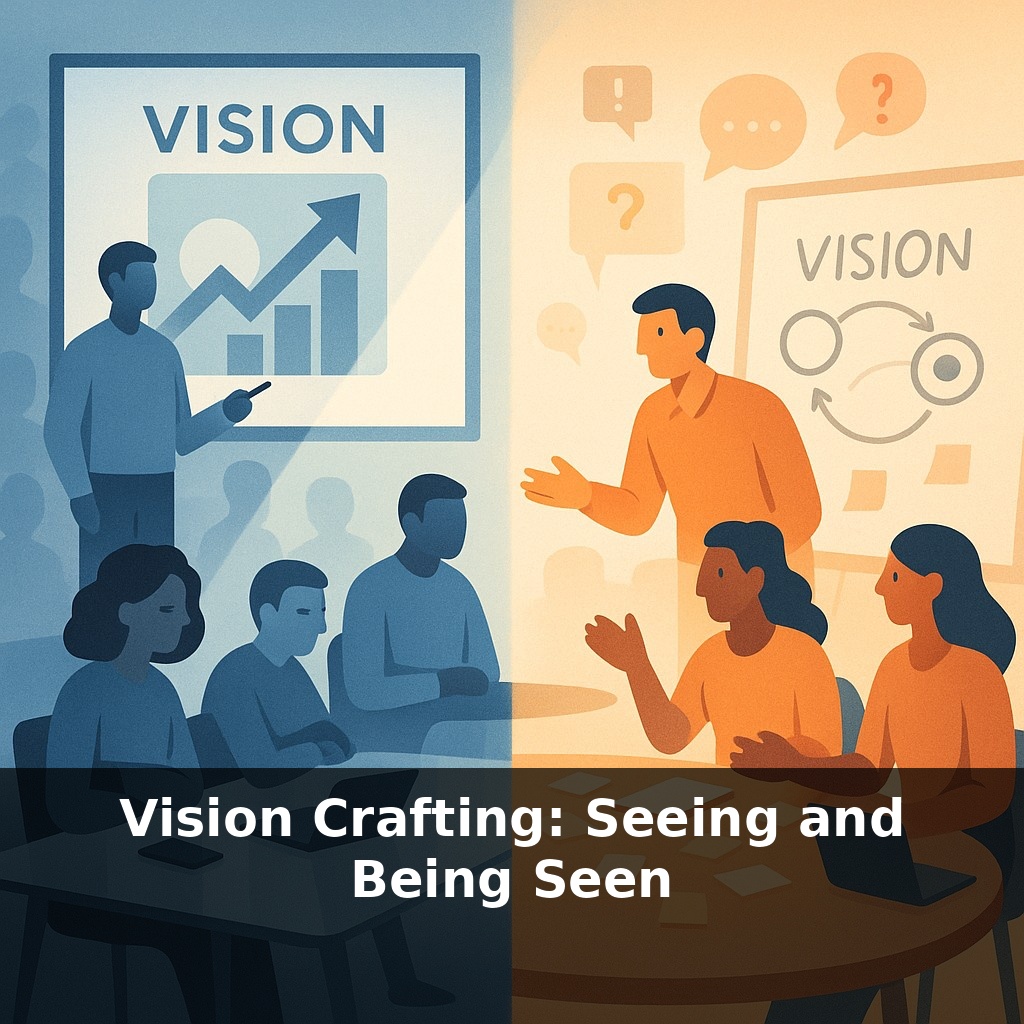
About nine out of ten employees quietly believe their leaders don’t really “get” their day‑to‑day reality. Now, picture two meetings: in one, a leader unveils a polished vision deck; in the other, they show up with a rough sketch and a lot of questions. Which room would you lean in to?
“Leaders don’t understand our reality.” When 91% of people quietly feel this, glossy town halls and clever slogans become background noise. The real turning point isn’t when you unveil a sentence on a slide; it’s when your team starts finishing that sentence in their own words—because they see themselves in it.
This is where vision shifts from broadcast to dialogue. Research shows the strongest visions are short, emotionally charged, and built in spaces where people feel safe to push back, refine, and reimagine. It’s less “Here’s my big idea” and more “Here’s the direction—help me make it real.”
In this episode, we’ll explore how to craft a vision that’s sharp enough to guide decisions, yet open enough for your team to shape. One that feels less like a corporate poster and more like shared ownership of the future.
So where do you start when you’re not the CEO, don’t own the strategy deck, and still feel responsible for the future of your team? You begin closer to the ground. The research is clear: top‑performing teams aren’t just aligned on *what* they’re doing; they share a lived sense of *why it matters next*. That “why next” is your raw material. Think less about wordsmithing a final line and more about noticing the sparks—recurring frustrations, untapped strengths, customer patterns—then turning those into a first draft your team can argue with, improve, and eventually claim as their own.
Here’s the trap many managers fall into: they think “vision work” starts when you sit down to wordsmith a sentence. In reality, the sentence is the *last* 5%. The hard part—and the part most leaders quietly skip—is the seeing and being seen that happens before any words go on a page.
“Seeing” means you deliberately zoom out from the daily firehose. Research on high‑performing teams shows their leaders regularly ask three forward‑tilting questions:
- “What’s becoming unacceptable about how we’re working today?” - “Where are we accidentally winning—what’s working better than it should?” - “If we keep going like this for 18–24 months, what becomes obviously broken?”
You’re not looking for perfect answers; you’re looking for patterns that hint at a direction of travel. That direction becomes the rough sketch of your future picture.
But the vision only becomes *real* when you step into “being seen.” This is where most managers under‑invest. They announce ideas before they’ve truly listened, so the team hears a verdict instead of an invitation. The data is blunt: without structured listening, people conclude you don’t understand their reality—and they’re usually right.
Structured listening isn’t “any questions?” at the end of a meeting. It’s intentional, repeatable mechanisms: short listening circles, anonymous prompts, one‑on‑one future‑focused check‑ins. You’re trying to learn:
- Which parts of your rough sketch energize people? - Where do they flinch or go quiet? - What are they seeing from customers, systems, or partners that you’ve missed?
Then comes the translation layer—turning a messy wall of inputs into a clear, future‑oriented line your team can actually remember and test decisions against. Here the research on brevity matters: when you force yourself under roughly a dozen words, you must choose what you’re *truly* committing to and what you’re willing to drop.
A practical filter: your draft vision should feel slightly uncomfortable—big enough to stretch you—yet specific enough that you could say, in two years, “We’re unmistakably closer” or “We’re off track.” If nobody can tell the difference between progress and drift, you don’t have a vision, you have a slogan.
Think of how you’d redesign a clunky app your team uses every day. You wouldn’t start by writing the tagline on the App Store page; you’d watch how people actually use it, note where they hesitate, and sketch multiple wireframes before landing on a cleaner flow. Vision crafting works similarly in practice: you prototype, test, and iterate.
For example, a support manager noticed tickets spiking every Monday. Instead of declaring, “We need to be more efficient,” she convened a few short huddles asking, “What would ‘Mondays feel lighter’ look like a year from now?” Themes emerged: fewer handoffs, clearer ownership, better tooling. That language slowly condensed into a line the team kept quoting in standups—and using to justify process changes.
Another manager in product shared three rough future statements in a workshop and let the team vote, edit, and merge them. The final line wasn’t his favorite, but it was the one people used in roadmap debates. That usage was the signal it was working.
When vision work becomes continuous, leaders stop treating it as a seasonal “all‑hands event” and start treating it like version releases. Expect more live feedback streams—slack reactions, pulse checks, customer signals—feeding into quarterly “vision sprints” where direction is lightly recoded, not reinvented. The leaders who thrive won’t be the loudest storytellers, but the ones skilled at curating competing futures and helping their teams test them in small, reversible bets.
You won’t nail this in one offsite, and that’s the point. Treat your next version less like a grand reveal and more like a beta release. Notice which words people borrow, bend, or quietly ignore, the way diners tweak a new menu dish. Those micro-edits are clues. Follow them, and your “vision work” becomes a living, evolving contract with reality.
Before next week, ask yourself: 1) “Where in my life am I currently hiding my true vision—who I want to be seen as, or what I really want to build—and what am I afraid people will think if I said it out loud?” 2) “If I let myself ‘try on’ my boldest vision for just one day, how would I show up differently in my conversations, my calendar, and the way I introduce myself?” 3) “Who is one specific person I trust enough to share a rough, unpolished version of my vision with this week, and what do I want them to really understand about me when I share it?”