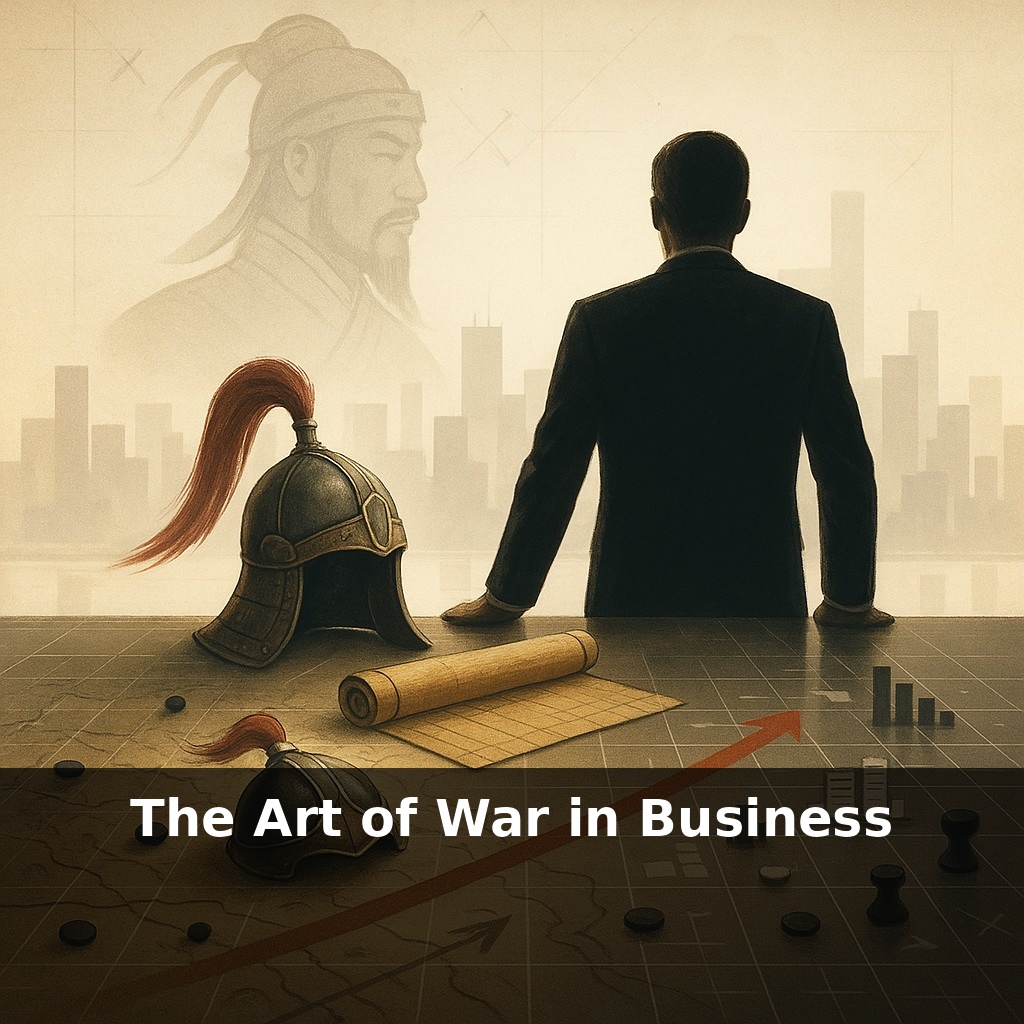
The Art of War in Business
📝 Transcript
A two‑thousand‑year‑old war manual is quietly shaping modern boardrooms. A CEO cancels a product launch at the last minute—not from fear, but because the real battle was won months earlier. Another leader beats rivals by helping them chase the wrong prize. How? That’s where we’re going.
Sun Tzu never mentions quarterly earnings, yet his logic maps uncannily onto modern P&Ls. He starts not with attack, but with clarity: know your own strength and weakness so precisely that your options become obvious. For a startup, that might mean admitting your “innovative culture” is useless without the engineering depth to ship reliably. For an incumbent, it might mean facing that your real asset isn’t brand, but distribution muscle.
Then comes the outside world. Competitors, regulators, shifting customer habits—each forms part of a landscape you can’t control but must read accurately. Most executives skim this terrain like headlines; Sun Tzu demands a weather-forecast level of attention, tracking subtle pressure changes before the storm arrives.
Across this series, we’ll translate those ancient imperatives into concrete moves for modern operators, founder to Fortune 500.
Sun Tzu’s first move in business isn’t aggression; it’s instrumentation. Ancient scouts become dashboards, field reports become customer tickets, and shifting terrain shows up as cost curves and adoption rates. In this view, a P&L is less a scorecard and more like a weather map: pressure fronts of demand, cold snaps in funding, heatwaves of hype. Leaders who treat data this way stop arguing about opinions and start arguing about conditions. That’s where his three imperatives turn practical—when “know yourself” and “know the enemy” are upgraded from slogans into living, continuously refreshed maps of reality.
Sun Tzu’s first imperative—know yourself—sounds philosophical, but in business it’s brutally operational. His question isn’t “What business are we in?” but “Under what conditions do we reliably win?” Not in slogans, in specifics.
Winning conditions live in the messy details: which customer segments close fastest, which channels produce high‑quality leads, which product configurations avoid support tickets, which engineers actually ship on time. Most companies track these fragments. Very few integrate them into a shared, living picture that guides bets.
For Sun Tzu, that picture starts with “measurement, estimation, calculation, comparison, victory.” Modernised: instrument → baseline → model → options → choice.
Instrument means turning fuzzy beliefs into observable signals. If you say you’re “great at enterprise,” where’s the proof? Sales cycle length, win rates by deal size, implementation time, churn by vertical—until these exist, “enterprise strength” is just a story.
Baseline is discovering your true default. When no heroics happen, what’s your organic growth? Your natural hiring pace? Your average defect rate? Many strategies fail not because they’re bad, but because they ask the organization to behave completely out of character.
Model is where you simulate pressure. How do those baselines bend if capital tightens, a platform changes its rules, or a key supplier disappears? This is less about perfect forecasting and more about revealing where you’re brittle. Sun Tzu calls this shaping; in business, it’s scenario design tied directly to resource moves.
Options are the concrete plays that emerge: double down on a channel others can’t copy, exit a product line that quietly consumes your best people, overinvest in a capability that will matter more if a known shift continues.
Choice is discipline: committing resources so your calendar, headcount, and budget all express the same theory of how you win. This is where many firms flinch and spread bets thin. Yet evidence shows those willing to dynamically reallocate—sometimes against internal politics—compound advantage over time.
One useful test: if a sharp outsider shadowed you for a week, could they infer your true strategy from where money and talent are actually flowing? If not, the “self” your decks describe and the self you really are have diverged—and Sun Tzu would treat that gap as your first strategic risk.
A fast-growing SaaS startup once claimed its “secret weapon” was speed. Yet when a new CRO mapped deals by stage and owner, a pattern emerged: the company only closed efficiently when legal, security, and sales ops joined before the proposal. The bottleneck wasn’t sales skill; it was coordination. Their real winning condition was “getting the right quartet in the room early,” not “moving fast” in the abstract.
Contrast that with a consumer brand that thought its edge was design. A cohort analysis showed customers who discovered the product via repair tutorials stayed 2–3x longer than those who came through glossy campaigns. Durability and serviceability—not aesthetics—were doing the heavy lifting. Strategy shifted from new lines to making parts easier to replace, teaching stores repair skills, and telling stories about products that age well.
In both cases, leaders traded identity myths for grounded pattern recognition, then reshaped bets around what quietly worked.
AI is about to stretch Sun Tzu’s ideas in uncomfortable ways. When models can flag weak pricing, surface niche demand, or forecast churn faster than any analyst, “knowing yourself” becomes a moving target. Your edge may hinge less on having data and more on deciding which signals to ignore. Think of it like tuning an orchestra: the tech amplifies every instrument, but leaders still choose the score, the tempo, and when to embrace silence.
Your edge won’t come from quoting Sun Tzu in slide decks, but from treating your company like a living terrain map that’s redrawn each quarter. As markets shift, some hills erode, others rise. The leaders who keep walking the landscape—listening at the front line, updating bets early—turn ancient theory into a quiet, compounding unfair advantage.
Start with this tiny habit: When you open your laptop for work each morning, quietly ask yourself, “Who is my ‘Sun Tzu enemy’ today—confusion, a specific competitor, or wasted effort?” Then type a single, 10-word “battle objective” in the subject line of a blank email to yourself (e.g., “Undercut Competitor X by clarifying our guarantee in proposals”). Don’t send it, don’t make a plan—just define that one strategic objective.
Unlock all episodes
Full access to 5 episodes and everything on OwlUp.
Subscribe — $1.99/monthLess than a coffee ☕ · Cancel anytime