A general once said, “The direct path is rarely the safest one.” Now jump into a tense boardroom: a small startup stares down a giant rival. Instead of copying features, they quietly win over a narrow, overlooked group of customers—and the giant never sees it coming.
McKinsey estimates that “side-door” entrants into a market can outpace direct attackers in revenue growth—precisely because they break the expected pattern of attack. The same logic shows up in neuroscience: Bowden and Jung-Beeman’s work on insight problems suggests our brains literally light up differently when we stop hammering straight at a question and approach it from an oblique angle. In practice, that might look like targeting an unserved use-case instead of a dominant customer segment, or reframing a personal roadblock as a design constraint rather than a dead end. When entrenched forces—whether budgets, habits, or competitors—hold the center, strategy shifts from “How do I break this wall?” to “Where is the seam no one is guarding?” That simple shift is where flanking begins.
So how do you actually spot a flanking move in real life, outside of case studies and war games? Start by noticing where energy is being wasted: meetings that go in circles, product features nobody uses, arguments that repeat weekly. Those are often signs you’re attacking the “front” of a problem. Then look for edges—adjacent users, neighboring processes, or small rules everyone obeys but nobody remembers agreeing to. In many companies, a single outdated approval step or reporting ritual quietly blocks progress more than any official “roadblock” ever could. That is often your real opening.
In practice, flanking starts with a brutally honest admission: “The center is locked. I don’t win by pushing harder—I win by changing where and how I push.”
Military planners do this by mapping not just enemy positions, but also terrain, supply lines, and timing. The “front” is simply where resistance is highest; the flank is where resistance hasn’t organized yet. Translate that to your work: the front is the well-lit path everyone talks about—obvious features, standard career ladders, familiar talking points in a negotiation. The flank is the under-instrumented, under-measured edge where expectations are fuzzy and habits are weak.
Three questions expose those edges:
1. **Where is the power structure *least* interested?** Market leaders obsess over prestige customers and flagship products. They often ignore “annoying” micro-segments or low-status workflows. That’s why many SaaS successes began in “back office” use cases and expanded outward once they were entrenched where nobody was looking too closely.
2. **Where are people already bending the rules?** Shadow spreadsheets, side channels, unofficial scripts—these are live prototypes of a flank. They show where reality has quietly outgrown the official process. A smart flank doesn’t fight that; it formalizes and amplifies it.
3. **Where is precision *not* required yet?** Flanks thrive in zones of ambiguity: early-stage product categories, emerging regulations, undefined roles. In those spaces, you aren’t punished for being different; you’re rewarded for being first to make sense.
This is where cognitive flanking—lateral thinking techniques—earns its keep. Instead of asking, “How do we beat them at X?” you ask, “What would make X irrelevant?” or “What game could we play that they are structurally bad at?” Indirect questions like these unsettle default assumptions and surface options a straight-line analysis never reveals.
The goal is not to wander forever on the margins. Strong flanks loop back toward the center once they’ve gained leverage—using credibility, cash flow, or proof-of-concept from the edge to renegotiate the core. Like wind skirting around a mountain ridge and gaining speed in the valley beyond, your path may be longer on a map, yet faster and safer in reality.
Spotify didn’t win music by out-bidding Apple on star artists; it flanked around ownership altogether with streaming and personalized playlists, starting with users who cared less about collecting albums and more about effortless access. Airbnb didn’t storm the hotel lobby; it slipped in through spare rooms, beginning with hosts who had space but no intention of becoming “hoteliers.” In both cases, the “front” looked impregnable—huge brands, loyal customers, deep pockets—yet the edge was soft: people whose needs didn’t quite fit the standard offer.
Think smaller too: an engineer who can’t get headcount approved quietly automates her own repetitive tasks, freeing 30% of her week; soon, colleagues ask for the same scripts and suddenly she owns an internal platform. Or a nonprofit blocked from big grants starts with hyper-local partnerships, proving outcomes on a shoestring, then uses that data to reset the terms of bigger conversations.
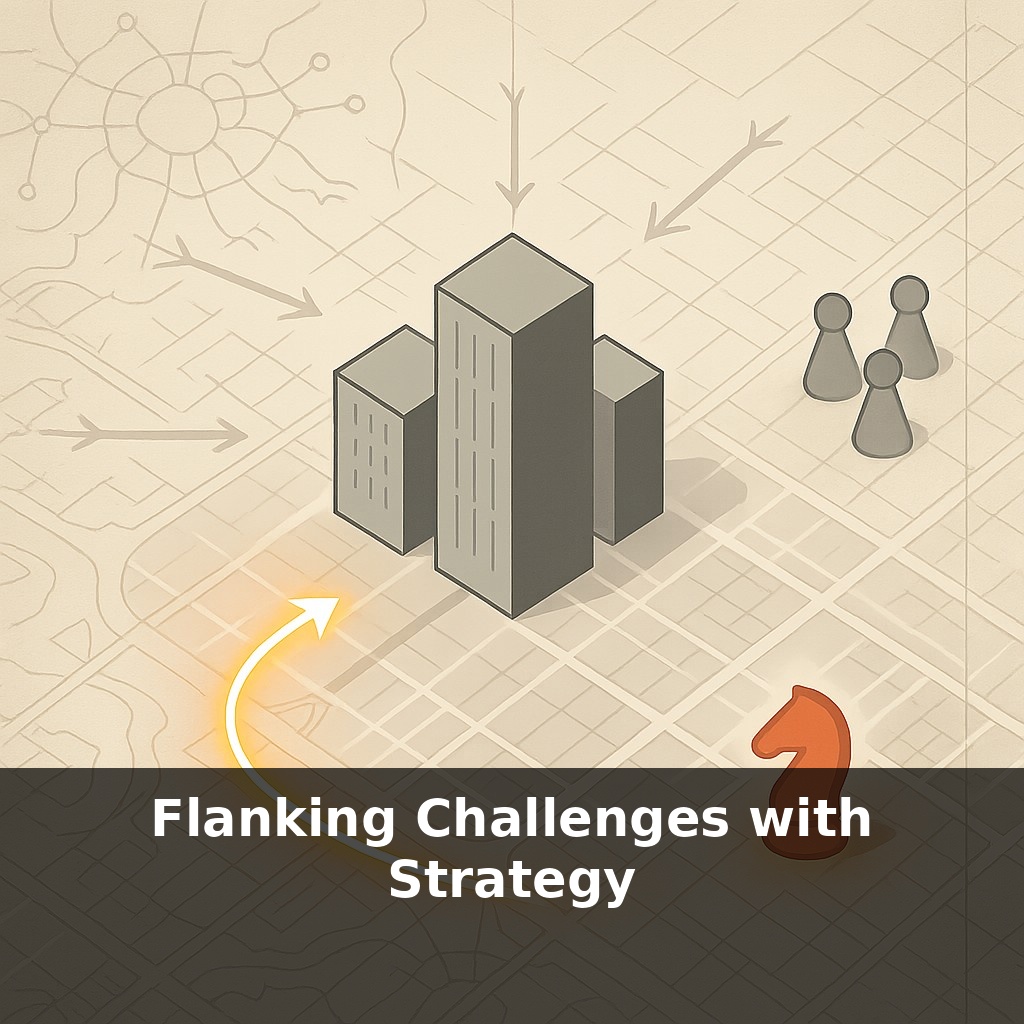
Like wind diverting around a skyscraper and accelerating in the side streets, these moves use the environment’s shape instead of contesting its hardest surface.
Flanking will only get more interesting from here. As sensors, AI, and cheap computing spread, “side doors” won’t just be spotted by clever humans—they’ll be surfaced in real time, like hidden trails lighting up on a dynamic map. Careers will flank too: people weaving skills across domains to bypass rigid ladders, the way a jazz musician slips between keys instead of staying in one scale. The systems that win won’t be the heaviest; they’ll be the ones that can pivot fastest toward the next opening.
Flanking is less about clever tricks and more about training your attention. Start noticing where talk is loud but progress is slow, where people quietly “work around” the official plan, where small bets stay beneath radars. Those are your side streets. Follow a few, map what you learn, and you’ll start seeing options others literally cannot yet see.
To go deeper, here are 3 next steps: (1) Grab Richard Rumelt’s *Good Strategy/Bad Strategy* and read the “Diagnosis” and “Guiding Policy” chapters with your current “stuck” project in mind, highlighting any example that resembles a flanking move (e.g., attacking a neglected customer segment or feature set). (2) Open a free Miro or FigJam board and map your competitive landscape using Porter’s Five Forces, then deliberately circle 1–2 “under-defended” flanks (like a slow, legacy process your competitors still rely on) where you could introduce a lean, tech-enabled alternative. (3) Watch Hamilton Helmer’s talk on the *7 Powers* (search “Hamilton Helmer 7 Powers talk” on YouTube) and pick one power—like “Cornered Resource” or “Scale Economies”—then brainstorm 3 concrete ways to build that power into your flank (for example, using an internal data asset or expert network your rivals don’t have).