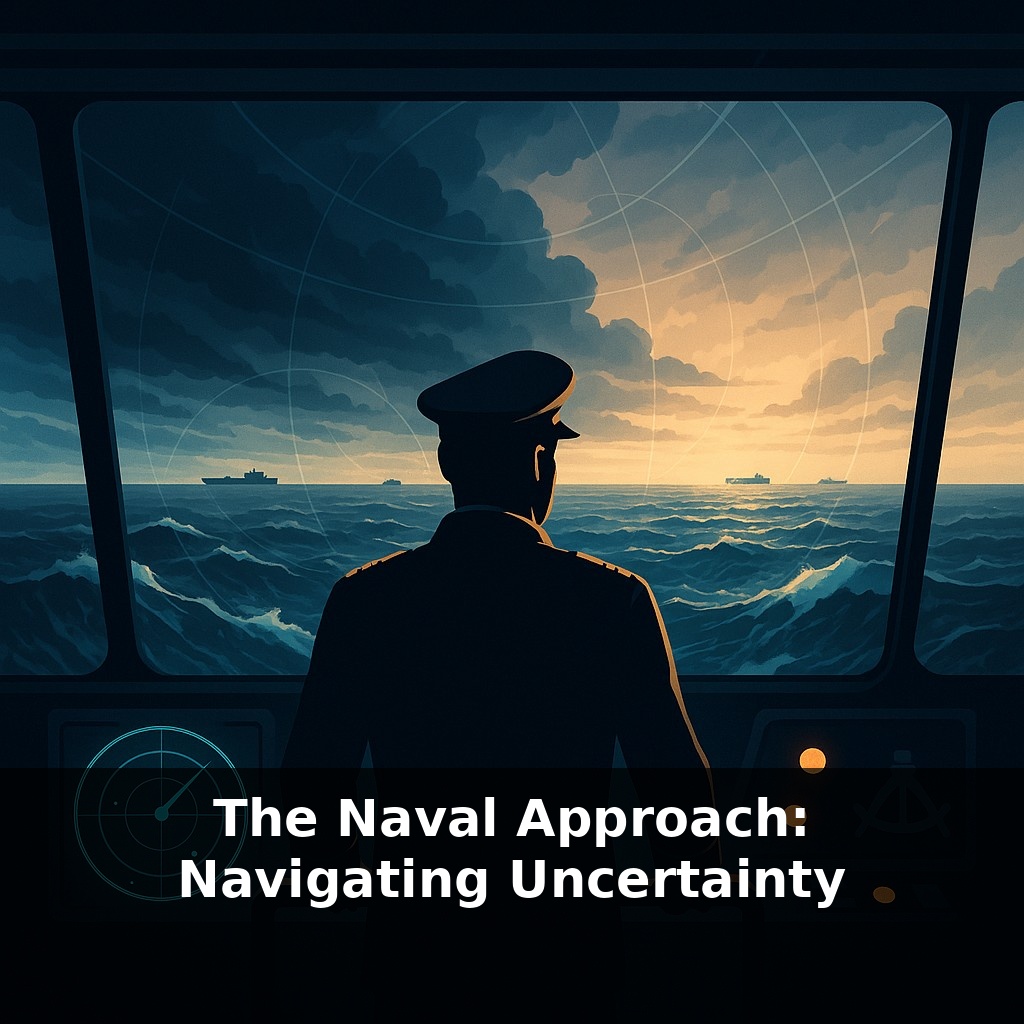
Waves cover most of our planet, yet we plan our careers and companies as if the world were solid ground. A storm front rolls in, radar screens flicker, and a captain has minutes to choose: commit to the plan… or rewrite it mid-ocean. That split-second mindset is our focus today.
Oceans move 90% of global trade, yet most boardrooms still act as if the world runs on fixed timetables and stable maps. Navies don’t have that luxury. For them, uncertainty isn’t an interruption; it’s the operating system. A radar blip might be a glitch, a fishing boat, or the opening move of a war. So they design for “unknowns” from the start: ships that can change roles in days, commanders trusted to act without waiting for permission, intelligence teams updating the picture hour by hour, and war-gamers stress‑testing plans until they break.
In your world, surprises show up as new competitors, sudden regulation, or a key hire leaving. The naval approach asks a simple question: do you treat these as detours… or as normal currents you’ve already prepared to sail? Over the next few minutes, we’ll borrow from sea power to rethink how you build teams, tools, and decisions that stay agile when the map keeps changing.
Commanders don’t just react to surprise; they pre‑wire their world for it. Ship designs assume missions will change. Communications doctrine assumes headquarters might go dark. Even training bakes in the expectation that the carefully scripted plan will fall apart on contact. In business, we rarely do this intentionally. We design org charts, product roadmaps, and budgets as if the next year will vaguely resemble the last, then act shocked when it doesn’t. To apply a more naval mindset, you’ll need to rethink how you structure choices, not just how fast you make them.
Navies start with structure. Before anyone leaves harbor, they decide which parts of the fleet must be fixed and which must stay fluid. Hull dimensions and engineering plants are hard to change; mission packages, sensors, and software are designed to swap. Littoral Combat Ships, for instance, can shift from hunting submarines to sweeping mines in roughly three to four days pierside because weapons, crew skills, and support gear are modular. That’s not an accident—it’s an architectural choice that says, “We don’t know exactly what we’ll face, but we know we’ll need to turn fast.”
Most organizations invert this. Office leases, product architectures, and vendor contracts are oddly flexible, yet roles, priorities, and processes are rigid. A more naval style would flip that: lock in a few deep foundations (values, security standards, core platforms), and keep everything customer‑facing modular. Think product “mission packages” you can reassign: the same engineering squad that ships a feature for Segment A this quarter can be re-tasked to Segment B next quarter, because their tools and interfaces are standardized.
Command philosophy follows the same pattern. Modern fleets practice “mission command”: senior leaders state intent and constraints, then subordinates choose methods. Not chaos—pre‑negotiated freedom. It works because everyone trains on shared playbooks, exercises with neighboring units, and rehearses failure modes. The Battle of Midway’s famous five‑minute turn was possible only because pilots and commanders had internalized a common picture and knew, without asking, when it was time to improvise.
You can replicate this with decision “guardrails” instead of step‑by‑step approvals. Define what absolutely cannot be risked—legal boundaries, brand red lines, safety limits—and where local leaders may maneuver aggressively. Pair that with constant sensing: customer feedback loops, competitive intel, frontline check‑ins that refresh your mental map weekly, not yearly.
Your org chart, tech stack, and leadership norms either trap you in the plan… or let you exploit that fleeting Midway‑like window when the board suddenly tilts in your favor.
A tech company I worked with borrowed this playbook during a volatile product launch. Instead of fixing one “perfect” roadmap, they organized into small cross‑functional “task groups” that could be reassigned every two weeks. Each group had a clear objective, a budget ceiling, and a simple rule: if customer data or competitor moves invalidated their plan, they were obligated—not forbidden—to pivot. Leadership didn’t track tasks; they tracked how quickly teams could credibly change course with new information.
Retail offers another pattern. One global brand built store formats like plug‑and‑play units: shelving, digital signage, and even staffing patterns could be reconfigured in hours. When a local trend spiked—say, a sudden fitness craze—managers didn’t submit lengthy proposals; they snapped in a different “mission set” of products and displays using pre‑approved templates, then fed real‑time results back to HQ.
It’s like jazz: a shared key, loose charts, and players trusted to riff when the mood—and the audience—shifts.
Tomorrow’s fleets won’t just react faster; they’ll rewrite the script in real time. As crewed ships, drone swarms, and AI tools mesh, “plans” start to feel more like living documents than static orders. Arctic routes opening and grey‑zone tactics at chokepoints will reward those who treat every patrol as a live experiment. Think of leaders less as map‑readers and more as gardeners, pruning and re‑shaping their force design as new threats and technologies sprout at the edges.
Treat your plans less like monuments and more like harbors: places ships visit, not where they live. Conditions will change as surely as tides; the question is how quickly you can cast off and re-route. Your challenge this week: pick one project and shorten its “turnaround time” by half—faster briefs, decisions, or deployments—and see what becomes possible.