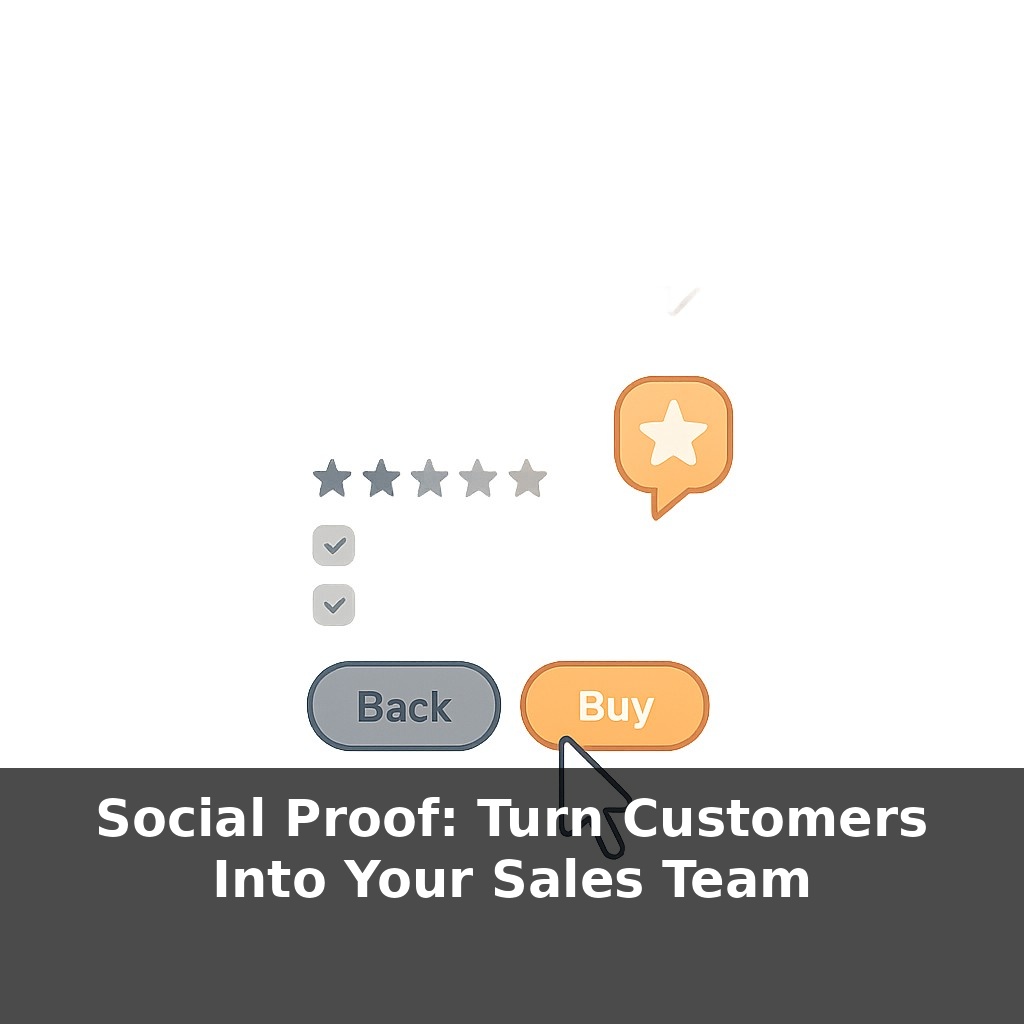
About 7 in 10 people trust a stranger’s review almost as much as a close friend. Now, drop into this moment: a shopper hesitates on your product page, finger hovering over “buy” or “back.” One short sentence from a past customer will quietly decide which way they go.
Here’s where it gets interesting: most businesses treat social proof as decoration—stars under a product, a “Testimonials” page nobody reads. But the smartest brands design it like a system. They don’t wait for reviews to trickle in; they engineer moments that naturally trigger customers to speak up, share, and show their results.
Think of it like fine-tuning a recipe: you don’t just throw ingredients together and hope. You control when to ask for feedback (right after a win), where to show it (exactly where doubt appears), and what format works best (short quote, quick rating, or a detailed story).
You’ll also see that *who* you feature matters as much as *what* they say. Prospects look for people who feel like “them,” solving “their” specific problem. When you line those elements up, your social proof stops being background noise and starts quietly carrying your sales conversations for you.
Now we’ll zoom out from individual reviews and look at your “proof ecosystem.” Think beyond star ratings and quotes: results screenshots, before/after photos, mini case studies, short loom videos, public shout‑outs, even screenshots of DMs all count. Each shows a different angle of “this works.” The goal isn’t to stack praise randomly, but to create a trail of believable evidence across the entire journey—from first discovering you, to comparing options, to post‑purchase doubt. Done well, prospects feel like they’re walking through a gallery of people like them quietly winning with your help.
Think of this step as moving from “collecting nice comments” to building a proof machine. That means getting specific about *which* doubts you’re disarming, and *where* each type of proof belongs.
Start with the questions buyers don’t say out loud:
- “Will this work in *my* situation?” - “Is this worth the price?” - “What if it goes wrong?” - “How long until I see results?” - “Is this company legit?”
Each question deserves its own kind of evidence.
For “Will this work for me?” you want *mirrors*: stories from people who match your prospect’s role, industry, budget, or stage. That might mean separate testimonial collections for beginners vs. advanced users, solo founders vs. teams, or ecommerce vs. B2B. Same product, different proof tracks.
For “Is this worth the price?” lean on *outcomes*: specific numbers, time saved, or headaches avoided. Short, sharp snippets like “Cut onboarding time from 10 days to 3” can sit right next to your pricing buttons, where the money anxiety peaks.
For “What if it goes wrong?” show *recovery stories*: times support stepped in, guarantees were honored, or a mistake was fixed fast. A one‑paragraph case of “We messed up, here’s how we handled it” can be more convincing than five glowing blurbs.
For “How long until I see results?” organize proof by *timeline*: “Day 1,” “Week 1,” “Month 3.” Screenshots, quotes, or mini case studies that map to realistic milestones stop people from expecting magic overnight—and quitting too soon.
For “Is this company legit?” use *credentials*: certifications, media mentions, expert endorsements, user counts, years in business. These belong at high‑level entry points: homepage, about page, social bios, and welcome emails.
Then layer *freshness* and *frequency*. Highlight recent reviews with dates. Rotate in new screenshots. Tag or categorize stories so prospects can filter: by use case, industry, or problem. The more a visitor can “find themselves” in your archive, the less selling you have to do.
Finally, respond publicly. Thoughtful replies to praise and criticism both become part of your proof: they reveal how you behave when nobody’s on a sales call.
Instead of one giant “wall of love,” think in scenes. A SaaS founder I worked with split proof into three galleries: “Switchers” (people who left a competitor), “Skeptics” (people who almost said no), and “Stretch Wins” (people who got outsized results). Same product, same happy customers—completely different impact once each story was labeled and placed where that specific doubt usually showed up.
Concrete example: a DTC skincare brand tagged customer photos by skin type and routine: “Oily · Minimalist,” “Dry · Maximalist,” “Sensitive · Fragrance‑free.” On product pages, they only showed reviews from matching tags. Return tickets dropped, and support emails shifted from “Will this irritate my skin?” to “Which of these two is better for me?”
Think of this less like stacking trophies and more like curating a medical chart: each entry answers a precise question, in the exact moment it matters, for a specific kind of patient.
Stats will stop being the star; *context* will. As platforms surface richer behavior signals—usage streaks, refund patterns, community activity—future proof will look more like a dynamic “health readout” than a static rating. Expect feeds where you can sort by “people who solved X in under 30 days” or “teams like mine that renewed twice.” As this evolves, brands that expose the messy middle—not just wins, but pivots and lessons—will feel less like vendors and more like collaborators.
Treat this like an ongoing lab, not a one‑time campaign. Watch which stories spark replies, saves, or DMs, then refine. Your challenge this week: ship one tiny experiment—a new review prompt, a “before/after” highlight, or a customer quote in your email P.S.—and track what moves. Let curiosity, not perfectionism, run the test.