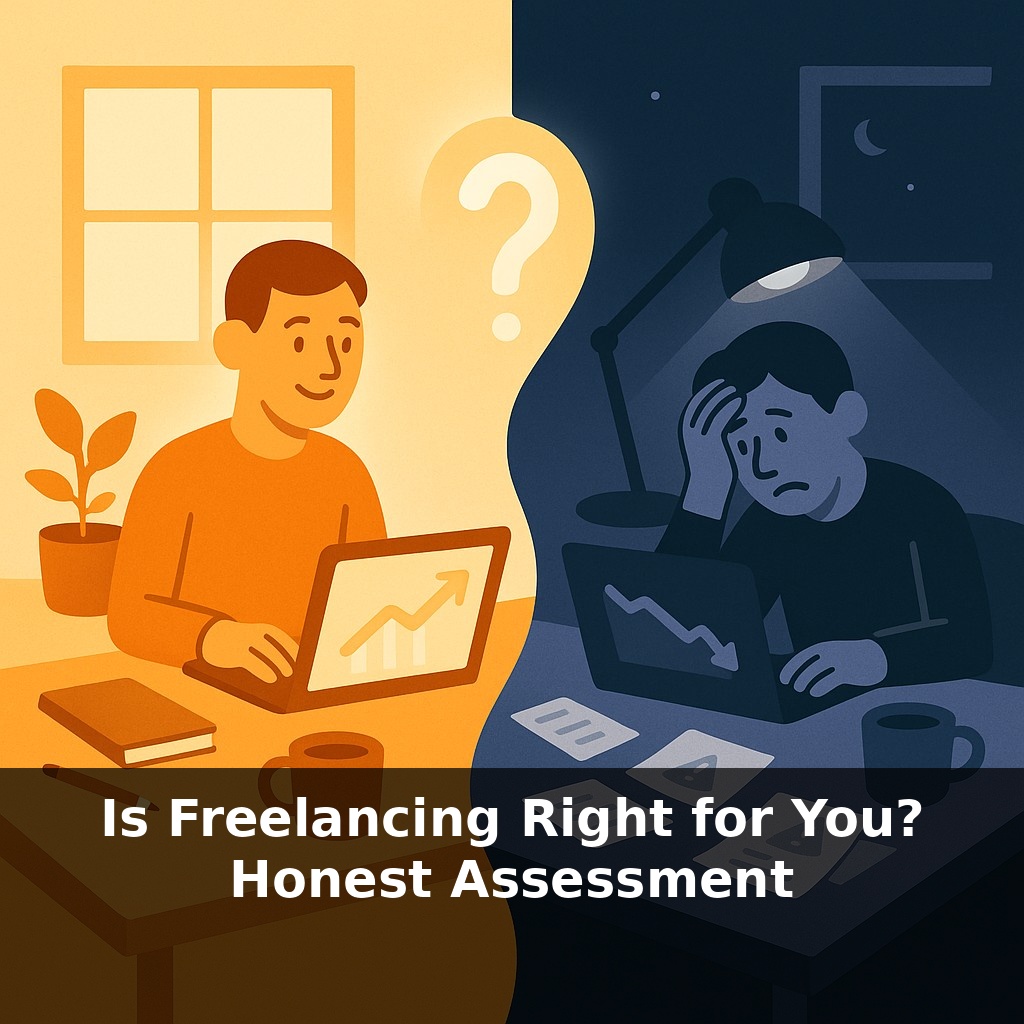
Is Freelancing Right for You? Honest Assessment
📝 Transcript
About half the people who quit to freelance quietly earn less than before—yet many say they’re happier. One designer wakes up thrilled for the freedom; another lies awake worrying about invoices. Same choice, totally different outcome. Why does freelancing fit some personalities and not others?
Forty-six percent of freelancers say remote work is the top benefit—yet the same freedom that feels amazing to some can feel like free‑fall to others. The real question isn’t “Can I freelance?” but “Do I actually want the trade‑offs that come with it?”
Today isn’t about hyping the lifestyle or scaring you away. It’s about an honest stress test: how your habits, money situation, and support system would hold up if the structure of a job disappeared tomorrow.
We’ll look at three pressure points: - How you behave when nobody is watching your work - How your finances handle unstable income - How you cope when you’re stuck, rejected, or isolated
Think of this as checking your “systems” before you fly the plane, not judging your worth as a worker.
Some people cruise through that stress test because they’ve quietly been training for it without realizing it. Maybe you’ve already negotiated deadlines with a tough boss, juggled a side project after hours, or managed a household budget through an uncertain period. Those experiences are like previous “reps” that reveal how you handle ambiguity, responsibility, and money when the guardrails loosen. Instead of asking, “Am I cut out for freelancing?” we’re going to zoom in on what your real‑life behavior already says about how you’d handle leads, lulls, and long stretches of working on your own.
Here’s where we zoom in on three signals your real life is already sending you about fit.
First, your “self‑starting” signal. Look at moments when there *isn’t* a clear script. When you’re given a loosely defined task, do you tend to freeze until someone clarifies it, or do you sketch a plan and move? Think of the last time you had to learn a new tool or workflow on short notice. Did you wait for a formal training, or did you piece it together from docs, YouTube, and trial‑and‑error? Freelance work often arrives undefined. Your default reaction to fuzzy instructions now is a preview of how you’ll feel facing a new client brief or a market you don’t fully understand.
Second, your “money stability” signal. Don’t just ask, “Could I live with variable income?” Ask how you already behave with money. When you get an unexpected expense, do you go straight to panic, or to “OK, what can I adjust?” How often do you actually open your banking app or look at a simple budget? People who do well on their own aren’t fearless; they’re familiar with their numbers. You don’t need a giant cushion to *start* exploring, but you do need the habit of looking reality in the eye instead of guessing.
Third, your “connection and resilience” signal. Freelancing is full of small social frictions: delayed replies, lukewarm feedback, proposals that vanish. Review your response to recent micro‑rejections: ignored job applications, messages left on read, ideas shot down in meetings. Do you spiral into self‑criticism, or can you feel annoyed and still send the next email? Also notice how you maintain relationships now. Do you ever check in with ex‑coworkers, managers, or classmates without needing something? That instinct becomes your future referral engine.
None of these signals are pass/fail. They’re more like vital signs a doctor watches: heart rate, blood pressure, temperature. Off in one area doesn’t mean “never freelance”; it means, “If you want this path, here’s the muscle to build before you lean on it.”
Think of two writers who both leave their jobs. One treats freelancing like a temporary bridge: they line up a part‑time contract, keep living costs lean, and give themselves 6–12 months to test offers. If they don’t hit a minimum income by then, they’re willing to go back to employment without shame. The other burns out fast by betting everything on landing “dream” clients in month one and taking any low‑paid work when that doesn’t happen.
Or take a developer who enjoys their current role but wants more control. Instead of quitting, they start with one client on weekends, using that tiny lab to learn proposals, invoicing, and scope creep while a paycheck still covers rent. Six months in, they know which work they enjoy, what rate the market accepts, and how many hours feel sustainable.
The paradox: people who give themselves a clear exit ramp and fallback plan often end up staying freelance longer—and happier—because they never felt trapped by the decision.
You’re not just choosing a work style; you’re choosing how you’ll respond to a shifting job market. As more companies blend employees and independents, being “freelance‑ready” becomes a kind of career insurance. Treat today like preseason: study how your skills could plug into project‑based teams, learn one AI tool that amplifies your strengths, and note which tasks you’d *still* want to do if titles disappeared and only outcomes mattered. That’s your signal for where to experiment next.
Treat this as a pilot episode, not a life sentence. You can test the waters with a single paid project, a tiny retainer, or a three‑month trial alongside your job. Like turning the heat up slowly on a sauce, you’ll see how your finances, energy, and curiosity respond. The real signal isn’t “Am I ready?” but “What did I learn from this round?”
Before next week, ask yourself: 1) “If I had to replace my current income within 12 months through freelancing, which 1–2 services (e.g., podcast editing, email copy, Notion set‑ups) would I realistically be confident selling, and why those specifically?” 2) “Looking at my last two weeks, where could I have carved out a consistent 5–7 hour ‘client work’ block (early mornings, evenings, weekends), and would I actually be willing to protect that time if I had a paying client?” 3) “Which part of freelancing scares me most right now—pitching myself, inconsistent income, or working alone—and what’s one experiment I’m willing to run this week (like sending one warm email, talking to a current freelancer, or mapping my bare-minimum monthly expenses) to test whether that fear is as big as it feels?”
From this course
Go Freelance: Build a Business Around Your Skills
7 episodesUnlock all episodes
Full access to 7 episodes and everything on OwlUp.
Subscribe — $1.99/monthLess than a coffee ☕ · Cancel anytime