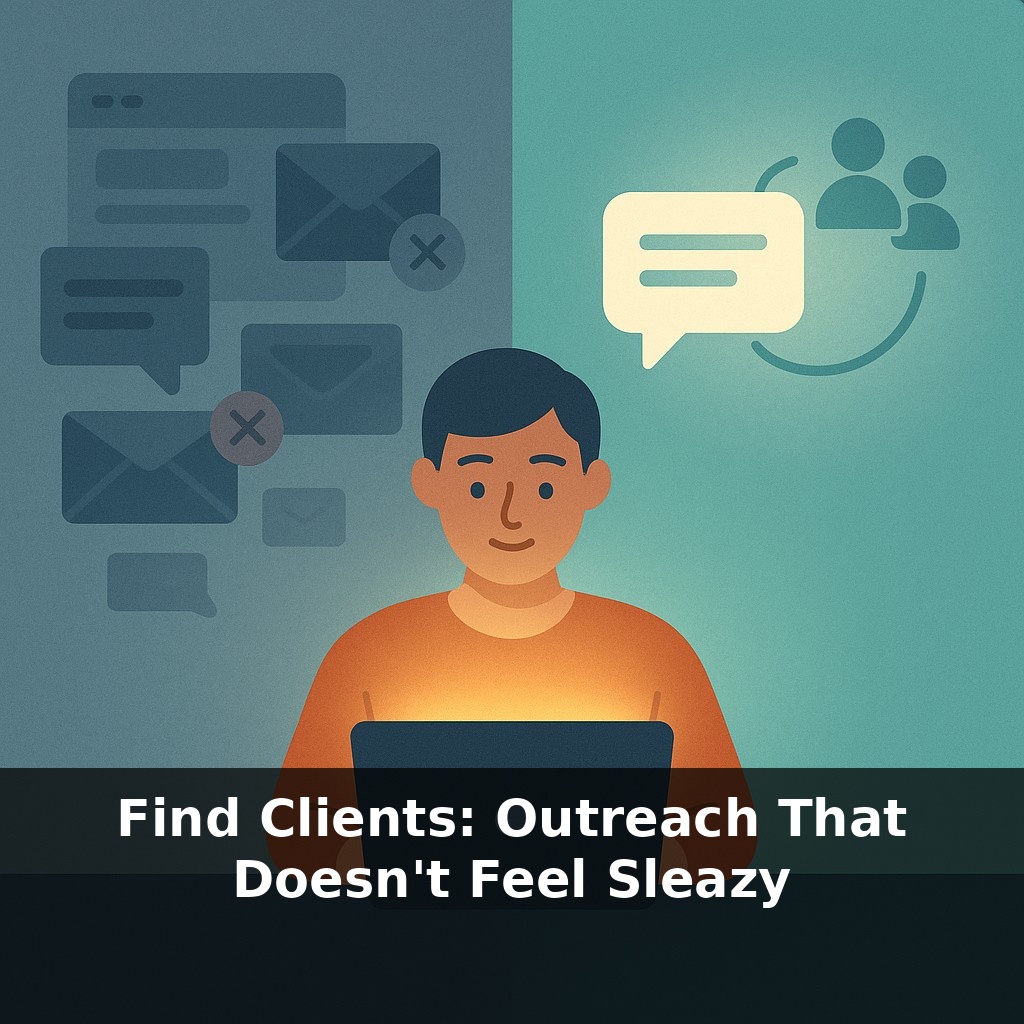
Right now, most of your future clients are quietly deciding who to trust—long before they ever need to hire. One sees a spammy pitch and deletes it. Another gets a short, thoughtful message that actually helps them. Same inbox, same day… totally different reaction.
Most freelancers try to “be brave” and send more messages. More DMs, more cold emails, more proposals. Then they burn out, conclude outreach “doesn’t work,” and quietly hope good clients will just discover them somehow.
The problem usually isn’t courage or even consistency—it’s context.
You’re dropping into people’s inboxes with no shared runway: they don’t know who you are, what you care about, or why you picked them specifically. From their side, your note blends into the blur of other requests tugging at their attention.
What changes everything is treating outreach less like knocking on doors and more like walking into a room where you’re already partially known. Your name has shown up in their feed, a colleague has mentioned you, or they’ve seen something useful you made. Now, a short, specific message feels less like an interruption and more like a continuation of a story they’ve already started reading.
So instead of starting with a cold knock, you’re quietly setting the stage ahead of time. This is where your visible work, your relationships, and your communication style all start doing some lifting before you ever send a note. Think of it like cooking: the marinating happens long before anything hits the pan. When people have already tasted your thinking—in a post, a comment, a referral, a short resource you shared—your eventual message doesn’t arrive alone. It’s backed by tiny prior encounters that say, “This person is thoughtful and relevant,” which lowers defenses and opens real conversation.
Here’s where most freelancers quietly sabotage themselves: they wait until they *need* work to start talking to people.
Then every message carries a subtle “please hire me” weight, even if you never write those words. Prospects can feel that pressure, and it makes even a well‑written note harder to say yes to.
Flip the sequence: start showing up *before* you need anything, and separate “being useful” from “making an ask.”
In practice, you’re doing three things in parallel:
1. **Make it easy to “check you out” in 30 seconds.** Someone clicks your profile or site—what do they see first? Not your life story. They’re scanning for: - Who you help (specific types of clients or industries) - What you help them achieve (outcomes, not just services) - A small number of focused examples or case studies
This doesn’t need to be elaborate. A pinned post, a lean one‑page site, or a tight portfolio page is enough if it clearly answers: *“Is this person relevant to my problems?”*
2. **Give people something to react to.** Clients can’t form an opinion about work they never see. Low‑stakes ways to get your expertise in front of the right eyes: - Short breakdowns of how you’d improve a landing page, onboarding email, or dashboard (with anonymized examples) - “Here’s how I’d approach…” posts that walk through your thinking on a familiar problem in your niche - Commenting with specific, concrete ideas on others’ posts instead of “Nice post!” or generic praise
This is quiet signaling: “Here’s how I think. Here’s the kind of problem I’m good at.”
3. **Use research to make 1:1 messages feel obvious, not intrusive.** Before you reach out, do 3–5 minutes of focused digging: - What are they launching, hiring for, or complaining about publicly? - Where are they already spending money or effort? - What’s one small, sharp improvement you can suggest?
Then your message becomes: - One line that proves you’re paying attention (“I saw you just…”). - One line that frames a specific outcome (“Often that means X and Y slip through the cracks.”) - One line that offers a next step with zero pressure (“If you’d like, I can send over a 2–3 line idea for tightening Z.”)
No hype, no hard sell—just a clear, relevant nudge that builds on what they already know about you from the background work you’ve been doing.
Think of what you’re doing as a series of small tests, not grand gestures. One designer I coached stopped blasting generic “need any design help?” emails and instead started sending tiny, specific ideas to SaaS founders: a 2‑minute Loom walking through one UX tweak, or a one‑slide redesign of a signup flow. About 1 in 5 replied—not always with a project, but with a conversation that later turned into work or a referral.
You can do the same in your own lane. For example: - Developer? Send a brief note flagging a performance issue you noticed on their site and outline one potential fix. - Copywriter? Rewrite a single headline for a sales page and explain the thinking. - Marketer? Sketch a simple 3‑step experiment that could lift an existing campaign.
Keep the “gift” small enough that it’s easy for you to create in under 20 minutes, but concrete enough that they could almost copy‑paste it. You’re not proving you’re a genius; you’re proving you’re paying attention and can make things a little better, fast.
As inbox filters get smarter, your messages will need immediate “nutritional value” or they’ll be pushed aside like junk food in a hospital cafeteria. Expect more tiny, gated communities—Slack groups, private forums, curated newsletters—where being invited in matters more than shouting in public feeds. Short, personal video notes and interactive demos will likely replace long emails, the way sudden storms replace slow drizzles: quick, intense, and impossible to ignore when they hit.
Treat this style of outreach as a long‑running experiment, not a one‑time campaign. Rotate channels like a chef testing recipes: a few DMs, a short video, a quick teardown, a warm intro request. Track which “dishes” get devoured and which come back half‑eaten. Over time, your own data will quietly rewrite the playbook you thought you had to follow.
Start with this tiny habit: When you open Instagram (or LinkedIn) to scroll, DM just one past client or warm contact with a single specific compliment about their recent post or project—no pitch, just, “Hey, I loved how you [specific thing].” When you finish writing a piece of content or hitting “post,” add the names of two people it could genuinely help to a simple “People to Follow Up With” note on your phone. The next time you make tea or coffee, pick just one name from that list and send them your post with a short, helpful note like, “Thought of you when I wrote this because you mentioned [their situation]. No pressure—hope it’s useful!”