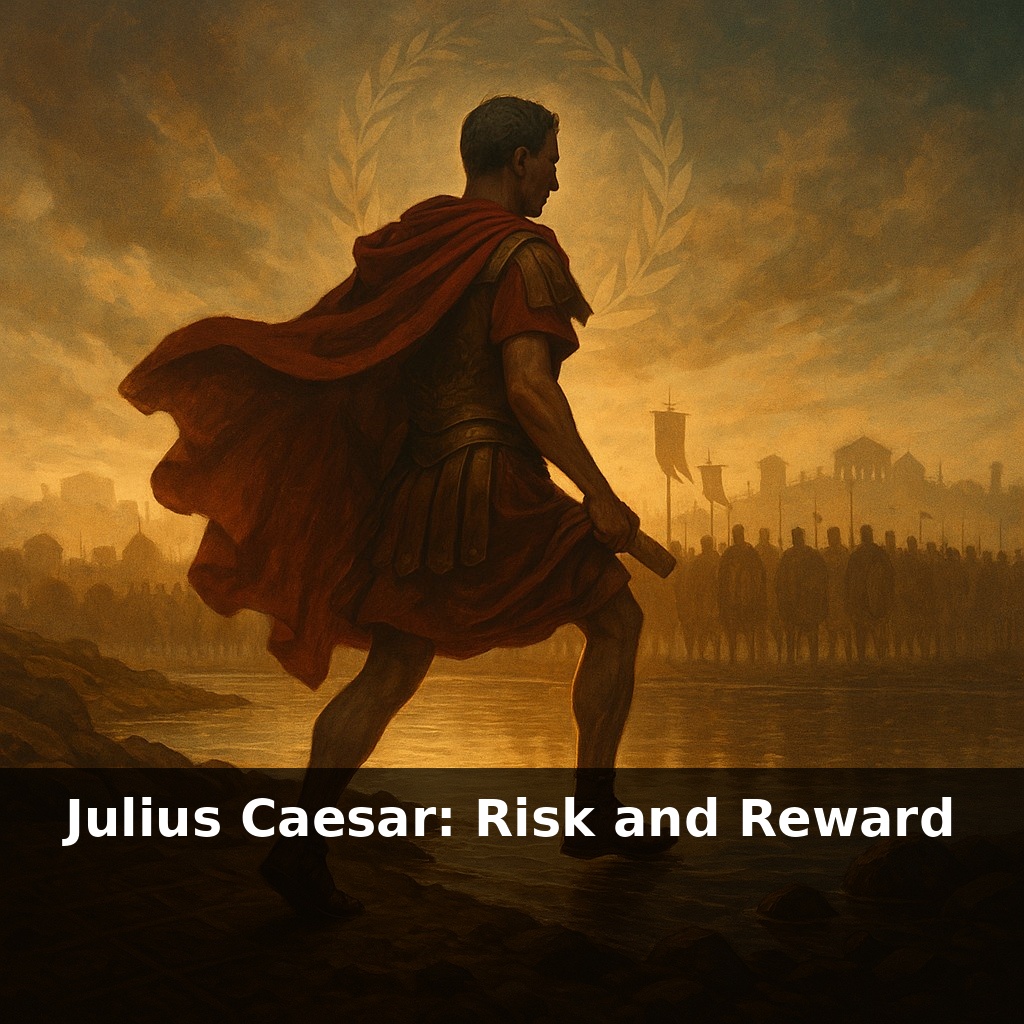
A single step across a shallow Italian river turned a fading politician into the most powerful man in Rome. In this episode, we’re not just asking why Julius Caesar took that step—we’re asking how he made danger work for him, until the day it finally didn’t.
Caesar didn’t succeed because he loved risk; he succeeded because he engineered it. Again and again, he walked toward situations that would terrify most leaders—but only after quietly stacking the deck. Think of a mountaineer who seems fearless on a sheer cliff, until you notice the carefully placed anchors, the tested rope, the rehearsed route. The climb is real, the drop is real, but the danger has been shaped—channeled—into something he can use.
In this episode, we’ll trace three moments where Caesar refined this craft: in the mud and chaos of Gaul, at a provincial river few Romans cared about, and in the marble glare of Rome’s political stage. We’ll see how he turned uncertainty into leverage, and how each success subtly rewired the limits he was willing—or even able—to respect.
To see this clearly, we need to slow Caesar down—almost frame by frame. Not the legend striding across history, but a working operator making choices under pressure: scouts bringing in scraps of news, messengers racing along muddy roads, senators whispering behind columns. Each episode we’ll zoom into a single decision point and ask three questions: What did Caesar actually know at that moment? What safety nets had he already laid down? And how did one decisive move send ripples outward, like a stone dropped into a tightly controlled political pond?
Start in Gaul, not at the Rubicon. Caesar arrived there as a middling politician with debts and enemies, not as an unstoppable legend. What he found was a fractured map: dozens of tribes, shifting alliances, and a Roman Senate far away and poorly informed. That fragmentation became his opening. If Rome could barely grasp what was happening beyond the Alps, he could make himself the primary source of “truth” about the frontier—and shape the story to his advantage.
His pattern there is easiest to see through the way he used information. Caesar pushed reconnaissance aggressively: cavalry screens, allied scouts, interrogation of prisoners, even exploiting tribal rivalries to learn who hated whom, and why. He wanted to know not just where armies were, but what political fractures might crack under pressure. The Commentaries he wrote weren’t just war reports; they were curated dispatches designed to make senators dependent on his version of events. While opponents in Rome relied on rumors, he relied on daily intelligence feeds.
Once he felt he could “see” better than anyone else, he moved to insulation. In Gaul that meant building layers of support and obligation: granting favors to local elites, distributing plunder to soldiers, sending captured wealth back to Rome to buy public goodwill. He negotiated separate deals with individual tribes so that no single coalition could rise against him without others fearing what they might lose. Financially, the campaign started as a way out of personal bankruptcy; structurally, it became a way to make many stakeholders tied to his continued success.
Only then did he attempt operations that looked outrageous from the outside—winter crossings, rapid marches, double lines of fortifications at places like Alesia. From a distance these appear almost reckless; up close they rested on months of prior work: mapped terrain, tested supply lines, drilled troops who knew how quickly he might demand them to move. The apparent gamble at Alesia wasn’t a single bet, but the visible tip of a long series of smaller, earlier decisions that narrowed his uncertainty before the siege ever began.
Watch how this pattern sharpened at Alesia. Caesar faced not just one enemy, but two: the warriors trapped inside the hill-fort and a vast relief force assembling beyond the horizon. Most commanders would pick one problem and hope the other stayed quiet. Caesar refused to choose. He ordered an inward-facing wall to pin Vercingetorix in place, then an outward-facing ring to blunt the coming rescue—two separate systems tuned to different threats, yet feeding the same outcome.
This wasn’t bravado; it was sequencing. First he drilled his legions to build faster than Gallic scouts could measure. Then he placed camps on high ground that could mutually support each other, so a breach in one sector wouldn’t collapse the line. Signal systems, pre-dug fallback trenches, and carefully rationed reserves meant that when the relief army finally struck, he could redeploy units without losing cohesion.
The gamble sat not in one dramatic order, but in trusting that all those staggered preparations would mesh under peak stress.
Caesar’s arc hints at a quieter danger: systems that reward bold moves can start to penalize restraint. In modern terms, a leader who always “wins” by pushing boundaries trains their organization to expect constant escalation. Like a river eating away at its banks, each successful surge makes the next rise less containable. Your challenge this week: spot one process in your world where speed or scale is slowly eroding the rules meant to keep it in check.
Seen this way, the lesson isn’t “be bolder” or “be cautious,” but “know what your wins are training you to do next.” Like a river after a storm, channels cut in crisis can harden into the only path the water remembers. The real craft is periodically reshaping the riverbed—deliberately adding new banks before the current chooses for you.
Try this experiment: Choose one meaningful “Rubicon” in your life this week—a hard conversation, a bold proposal at work, or a creative project you’ve been avoiding—and give yourself 24 hours to cross it, no extensions. Before you act, list (in your head or on your phone) the 3 worst realistic outcomes and what you’d actually do if each happened, the way Caesar weighed the Senate’s wrath, civil war, and exile. Then, like Caesar marching on Rome, commit to a visible, irreversible step (send the email, book the meeting room, publish the draft) that makes backing out awkward or costly. Over the next few days, watch how people actually respond versus the “Senate in your head,” and note whether the upside or downside predictions were closer to reality.