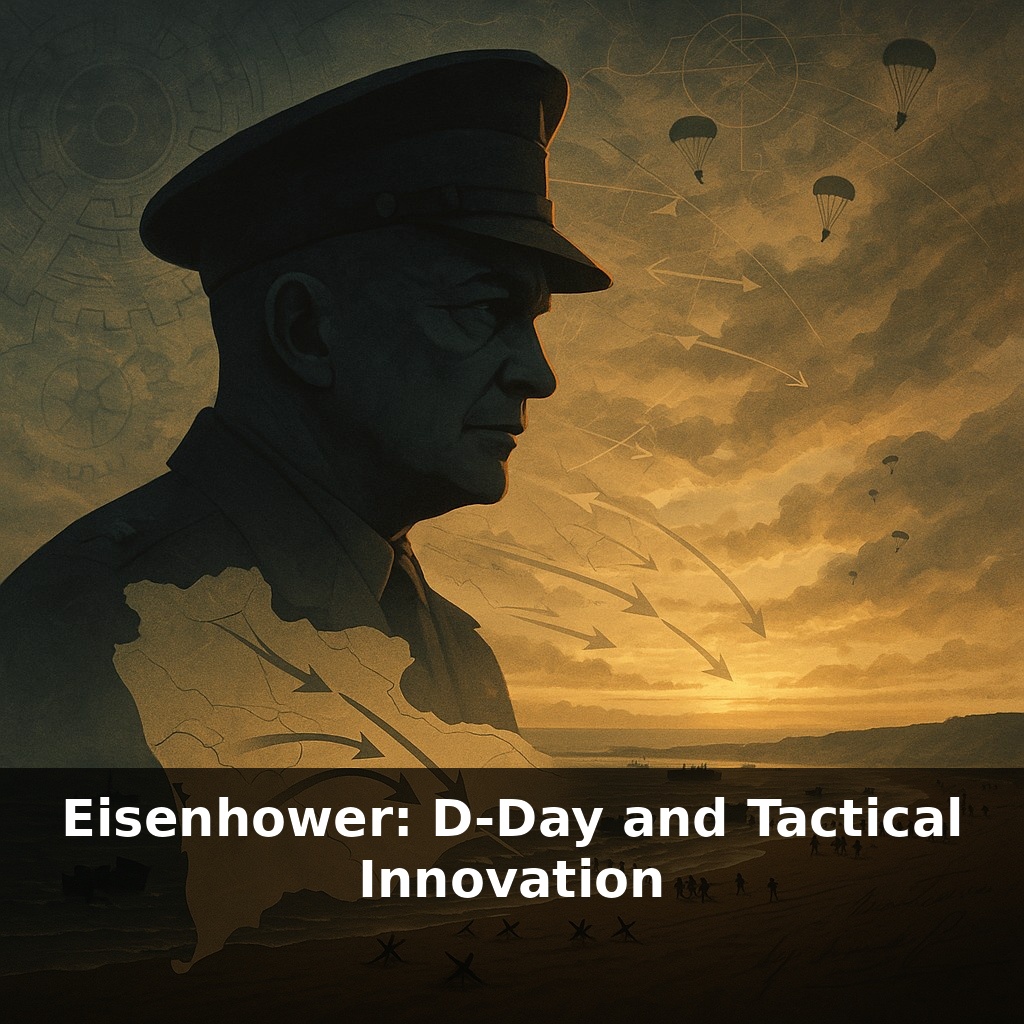
Giant steel harbors that floated, airborne troops dropped in the dark miles from the beaches, and a general who wrote a note accepting blame in case it all failed. D‑Day wasn’t just courage on the sand; it was a risky experiment in logistics, weather, and leadership under pressure.
Eisenhower’s real breakthrough wasn’t just in planning a massive attack—it was in forcing armies and air forces that distrusted each other to fight as a single, synchronized machine. British commanders still scarred by 1914–18, American generals eager to prove their doctrine, naval officers convinced the land guys didn’t “get” the sea, and airmen who wanted independence from everyone else—all had to accept one playbook and one final authority. That meant hard arguments over priorities: smash railways or coastal guns, hit cities or bridges, put scarce landing craft under British or American control. Eisenhower’s innovation was to turn those rivalries into fuel: he demanded ruthless debate before decisions, then absolute obedience after them. Underneath the invasion maps and timing tables was a fragile human pact that could easily have cracked—yet didn’t.
Instead of treating Overlord as a single “big day,” Eisenhower’s team broke it into thousands of interlocking bets. Meteorologists argued over shifting storm fronts; codebreakers read fragments of German signals; photo interpreters studied hedgerows and farm tracks the way a city planner studies traffic flow. Every new patrol report, every reconnaissance image, could nudge the plan—moving a bombing target a few miles, changing which unit landed first, reassigning scarce engineers. The invasion order looked fixed, but beneath its neat arrows was a living document, updated like a constantly patched piece of software.
The real test of Eisenhower’s approach came in how he fused three kinds of innovation: tactical, technical, and psychological.
On the tactical side, he backed ideas that many senior officers considered borderline reckless. Airborne drops behind enemy lines were still controversial; earlier operations in Sicily had gone badly. Yet Eisenhower insisted they were essential to disrupt German reactions. He didn’t tell airborne commanders *how* to seize road junctions or bridges—he set the aim (“block reinforcements, hold key crossings”) and let them solve the puzzle of scattered landings, local counterattacks, and improvisation in the dark. Their job was to turn chaos into a screen that bought the beachheads time.
Technically, Eisenhower pushed for tools that didn’t fit traditional doctrine. Amphibious “DD” tanks, designed to swim ashore, were risky, unproven under real fire, and dependent on sea conditions. Some sank; others arrived late and disorganized. Instead of writing them off as a failure of concept, Eisenhower treated the outcomes as data: where they worked, commanders leaned into the capability; where they didn’t, infantry tactics and naval gunfire had to compensate. The same applied to specialized engineer vehicles that cracked sea walls and minefields. Each beach became a separate laboratory of trial, error, and rapid adjustment.
Psychologically, he understood that the *illusion* of inevitability mattered as much as the plan. He authorized elaborate deception operations—fake armies under Patton, dummy landing craft, false radio traffic—to convince German commanders that the real blow would fall at Pas‑de‑Calais. The point wasn’t only to misdirect enemy divisions; it was to stretch their nerve, to make every Allied feint look like a possible main attack. Even after troops were ashore, this sustained misperception delayed large German formations from pivoting toward Normandy.
Here Eisenhower resembled a conductor handling a difficult score: he couldn’t play the instruments himself, but by deciding where to accept discord—failed gadgets, scattered drops, partial deceptions—and where to demand strict unison, he turned a collection of risky experiments into a coherent offensive that the enemy struggled to read in time.
On the ground, innovation showed up in small, concrete choices. At Omaha, officers pushed scouts and engineers forward in tiny ad‑hoc teams, using gaps no wider than alleyways to slip men through the defenses instead of trying to clear the whole “street” at once. On Gold and Juno, British and Canadian units leaned heavily on specialized armor to punch narrow corridors inland, then fed follow‑on waves through those channels like trains using a freshly repaired single track while the rest of the rail network was still wrecked.
Eisenhower’s staff treated each beach report like a live experiment log. When one sector found a better way to mark exits off the sand or clear a kind of obstacle, that tweak jumped to the day’s priority list and began spreading sideways to neighboring units. The same pattern played out with air support: some divisions discovered that shorter, more frequent bombing runs gave better control than large, infrequent strikes, so air planners began reshaping sortie schedules in near‑real time as feedback came in from field radios.
Eisenhower’s real legacy is a mindset: treat vast operations as evolving ecosystems, not static blueprints. Future coalitions juggling AI, cyber tools, and autonomous swarms will need similar “gardener” habits—pruning what fails, nurturing what adapts, and letting local initiatives spread like fast‑growing vines. Your challenge this week: map one project as a living network—who feeds whom information, where decisions actually occur—and identify a single link to strengthen.
Eisenhower’s quiet gamble was to accept messiness at the edges so the center could hold. He let local commanders redraw lines like a river finding new channels after rain, then watched which currents carved lasting paths. The deeper lesson isn’t about one battle, but about trusting systems that learn faster than the shock trying to break them.
Start with this tiny habit: When you sit down to plan your day, jot a single bullet labeled “D‑Day Move” and list just one decision you’ve been postponing, like Eisenhower finally locking in the invasion date. Then, before you check email or messages, spend exactly 2 minutes choosing your “first wave” action on that decision—one concrete next step, no matter how small. If it feels too big, quickly think “What would I do if the weather were uncertain like on June 5, 1944?” and pick the smallest version that still moves you forward.