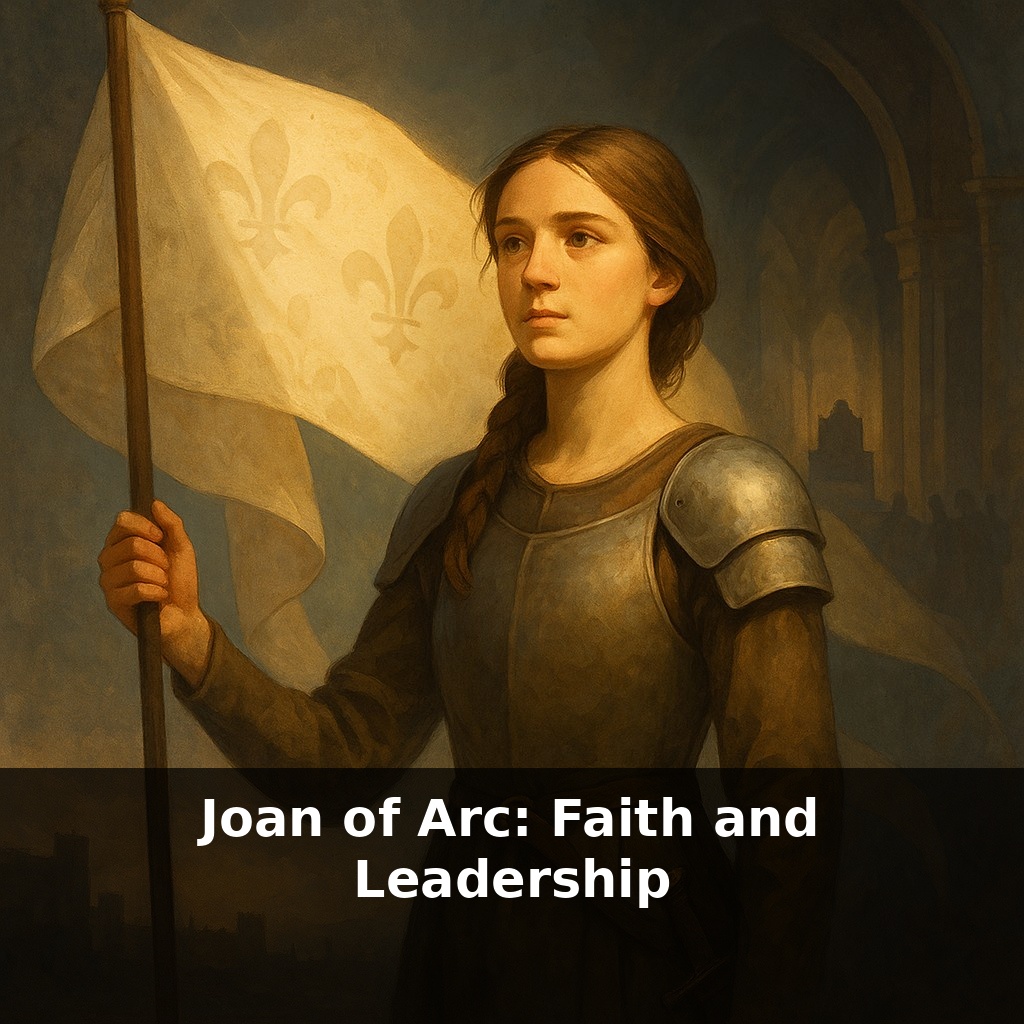
A teenage peasant, carrying a banner instead of a sword, walks into a royal court and calmly tells a prince how to win his war. Within months, hardened generals are taking orders from her. How does someone with no rank, no wealth, and no training pull that off?
Joan doesn’t just walk into history; she collides with it at a moment of near-collapse. France is fracturing, English armies are tightening their grip, and even loyal nobles doubt their own cause. Into that exhaustion she brings something intangible yet electric: a narrative that rethreads scattered fears into a single, shared purpose. Her faith isn’t a private comfort; it’s a public signal, like a lighthouse cutting through coastal fog, giving ships a fixed point to steer toward. Soldiers start fighting not only for pay or survival, but for a story that promises meaning in their sacrifice. Joan’s banner becomes a moving landmark on the battlefield, a visual promise that retreat is no longer the default. Around her, hesitant men discover a bolder version of themselves—not because tactics vanish, but because morale, identity, and destiny suddenly feel negotiable again.
Joan steps into a war already crowded with professionals: veteran captains arguing over fortifications, diplomats trading cities like bargaining chips, clerics measuring each defeat against God’s favor. What she adds isn’t expertise in siegecraft or logistics; it’s the audacity to say, “Act as if victory is possible—and then move.” That conviction rearranges priorities. Hesitations that once felt prudent begin to look like disobedience. Orders that were drafted cautiously in tents are suddenly executed at speed. Like a sudden change in wind at sea, her presence doesn’t alter the ships themselves, but it does reshape which harbors feel reachable.
Out on the walls of Orléans, Joan’s leadership looks strangely practical for someone claiming voices from heaven. She rises early for prayer, yes, but then walks the ramparts, talks with gunners, listens to captains. She insists on coordinated assaults rather than scattered skirmishes, bans looting, and pushes for discipline that makes her force more predictable to itself and less terrifying to the civilians it’s supposed to protect. Her banner is always at the point of action, a moving command post that tells everyone where the effort is concentrated.
What wins people over isn’t abstract piety; it’s the visible alignment between what she says and what she risks. She eats with ordinary soldiers, shares their danger, and keeps confronting senior commanders in blunt, specific terms: attack here, today, not tomorrow. In a culture wary of female authority, this consistency does slow, grinding work. Doubters may not trust her story, but they begin to count on her presence.
Her influence also travels up the chain. Charles VII has been circling the question of his own legitimacy; Joan forces a decision. She frames the march to Reims not as one political option among many, but as the necessary next step. That clarity cuts through the fog of competing advisors. Once crowned, Charles benefits from the aura she has helped construct around him, even as the court grows uneasy with how much symbolic power she holds outside traditional channels.
On the battlefield, her role is closer to conductor than duelist. Chroniclers describe her urging men forward, repositioning ladders, calling for reserves, demanding that wounded be carried off rather than abandoned. Whether or not she ever strikes a decisive blow herself matters less than the pattern: she turns groups of frightened individuals into units that move in time with one another, like sections of an orchestra snapping into the same tempo.
This makes her trial all the more revealing as a leadership case study. The same unwavering alignment between belief and speech that rallied soldiers now alarms church judges. Under pressure, she refuses to recast her experiences into safer language. For them, that persistence marks her as a relapsed heretic; for us, it shows the double edge of charismatic authority. The qualities that can reorder a collapsing system can also threaten institutions tasked with maintaining its boundaries.
Joan’s style shows up today in places far from battlefields. Think of a small hospital on the edge of closing: budgets are tight, senior staff are leaving, and younger nurses are quietly job-hunting. Then a mid-level charge nurse starts volunteering for the hardest shifts, publicly backing a risky reorganization of triage, and refusing to treat “the way we’ve always done it” as a shield against change. She can’t sign checks or rewrite laws, but her visible courage gives others cover to try, too. Or take a startup whose founder has lost nerve after a product flop. A junior engineer stands up in an all-hands meeting and argues—calmly, specifically—for one focused feature, then spends nights building the prototype and days persuading skeptics to test it. In both cases, formal titles lag behind actual influence. The crucial pattern isn’t grand speeches; it’s someone accepting personal exposure so others can move from watching to acting, and institutions being reshaped—briefly or permanently—around that willingness.
Leaders who blend inner conviction with public risk-taking still unsettle systems built for caution. Today that might look like a junior officer backing de-escalation training, or a pastor opening church doors to climate organizers. Their stance works less like a spotlight and more like a weather front: small, persistent shifts that, over time, change what “normal” feels like. As AI tools mine old records and new conflicts, expect more debates over when such disruptive faith should be protected—or contained.
Joan’s story prods a quiet question: where do you place your deepest trust when stakes rise—rules, data, instinct, or something closer to devotion? Modern teams still face that fork, whether in labs, boardrooms, or protests. Your challenge this week: notice who, in your world, moves first when the script fails—and why you find that comforting or unnerving.