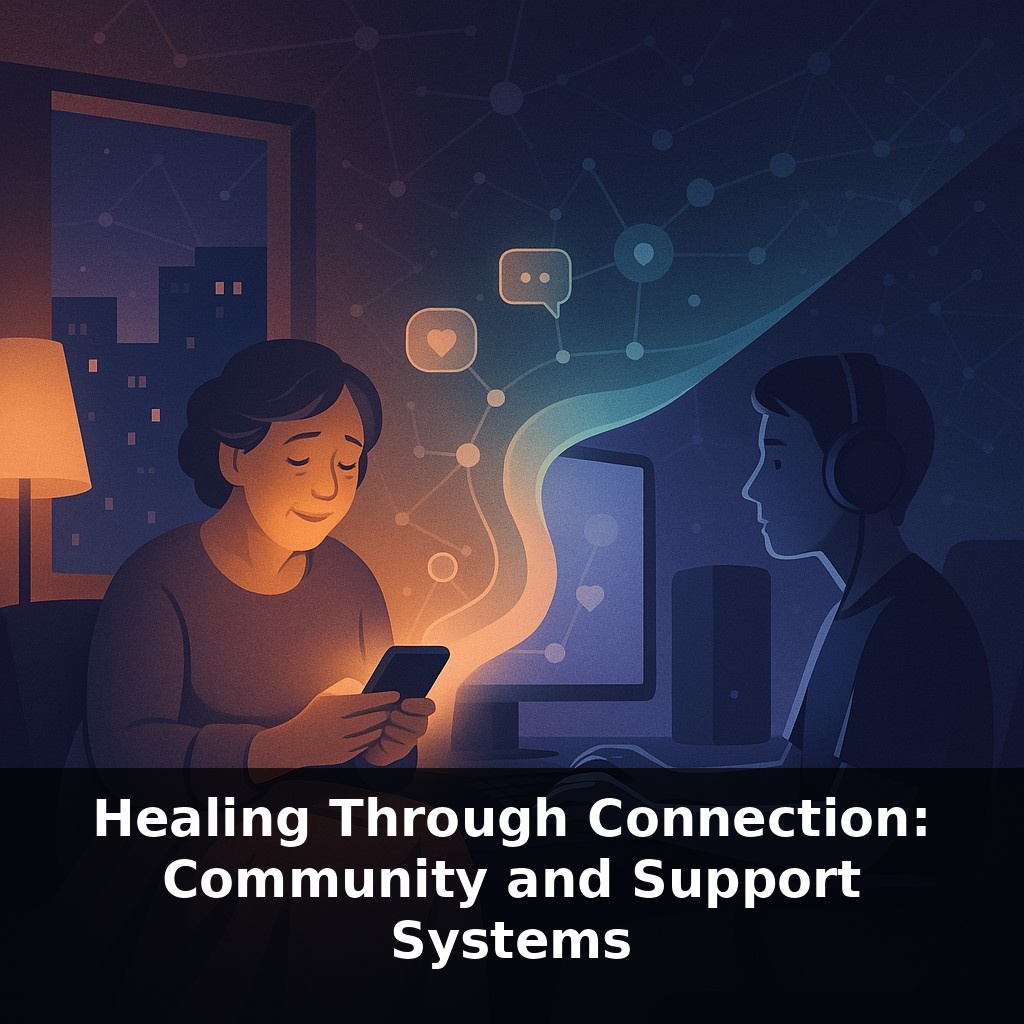
A widow who rarely leaves her apartment and a gamer who spends nights on a grief Discord server might have something crucial in common: one of them is quietly healing. Research shows supportive communities can ease grief dramatically—but not always the ones we expect.
Some of the most powerful “support systems” don’t look like support at all. They’re the coworker who keeps sending you memes at 11 p.m., the neighbor who always “needs help” carrying groceries so you have a reason to step outside, the group chat that suddenly goes quiet when you type, “Today was hard,” and then lights up with replies. These small, ordinary contacts are doing something biologically extraordinary: they’re dialing down the stress chemistry that grief cranks up, and they’re doing it more reliably than any single pep talk ever could. Research now suggests it isn’t just whether you have people, but how and where you connect with them—structured groups, casual friendships, moderated online spaces—that shapes how your nervous system learns to live alongside the absence.
Some people discover that a formal bereavement group feels too intense, while a late‑night text thread or a hobby meetup becomes the place where their grief actually loosens its grip. Others find the opposite: only in a circle of people who “get it” do they finally exhale. The shape of connection matters—how often you touch base, how safe it feels to speak honestly, whether you’re allowed to be both devastated and oddly okay in the same week. Think of your life as a small city: different neighborhoods of connection, each offering its own kind of light, noise, and shelter at different hours.
A surprising thread runs through dozens of studies: it isn’t just *having* people that matters, it’s what those people help you *do* with your grief. Researchers talk about three broad “jobs” that good connection tends to perform—often without anyone realizing it: co‑regulating emotions, co‑creating meaning, and quietly protecting your body.
Co‑regulating emotions sounds technical, but it can look as ordinary as someone staying on a call while you sort laundry, or a friend responding “Of course you still miss them—that makes sense.” In lab studies, heart rate and blood pressure settle more quickly after distress when another human responds with calm, attuned attention. Even text‑based empathy can nudge your system toward steadier ground; the key seems to be feeling *felt*, not just receiving advice.
Co‑creating meaning shows up when you tell the same story for the fifteenth time and someone still says, “Tell me more.” Shared narratives are powerful: groups that invite people to piece together “what this loss means in the story of my life” see steeper drops in grief‑related depression. It’s not about finding a silver lining; it’s about not having to carry the unanswered questions alone. Over time, your story becomes less like a jagged fragment and more like a difficult chapter in a longer book.
The physical side is quieter but just as real. Large population studies show that people who stay woven into some kind of network—religious communities, gaming clans, walking clubs—have lower inflammatory markers and better sleep than similar mourners who stay cut off. The body appears to treat isolation itself as a threat, amplifying the stress response; contact with others dampens that alarm.
Not every space is helpful, though. Some unmoderated online groups drift into cycles of comparison—“my loss is worse”—or spiral around anger without room for anything else. That’s where boundaries matter: muting a chat that leaves you more agitated than before, stepping back from people who only show up to minimize your pain, or limiting time in feeds that flood you with anniversaries and sympathy posts you didn’t ask for.
The most protective networks tend to have three ingredients: emotional safety (you’re not punished for being honest), flexibility (you’re allowed to change), and reciprocity (you give *and* receive, though not always equally). Think of these less as rules and more as signs you’ve wandered into a space that can carry some of the weight with you, instead of adding new kinds of heaviness.
A few concrete portraits might help you notice where similar threads already run through your life. Think of the coworker who never talks about “coping,” but reliably pings you on project days when your house feels the emptiest. Their consistency turns a blank, echoing afternoon into something with edges. Or the book club that quietly shifts genres for a while because certain plots land too hard right now—no big announcement, just a collective tilt toward what you can bear. An online example: a carefully run subreddit that pins resource lists, gently redirects graphic details into private channels, and has a weekly “small wins” post where people share things like “slept through the night” or “went to the pharmacy alone.” Even a local pick‑up soccer game where teammates learn not to joke about hospital dramas around you can function as a kind of low‑key refuge: your body moves, your mind gets a little break, and you’re allowed to just be a player, not “the bereaved one,” for an hour.
As tech and policy catch up, today’s small circles could evolve into wider safety nets. Hybrid spaces might soon feel like walking into a neighborhood center that also lives in your phone—local faces, distant peers, all in one place. AI tools may quietly flag when someone’s posts sound like “I’m not okay,” routing them toward real humans instead of auto‑replies. Workplaces and cities that fund such networks may start to treat communal care less like charity and more like infrastructure.
So the next step isn’t hunting for a perfect circle—it’s noticing where life already tilts toward you. Maybe it’s the late‑shift barista who remembers your order, a raid team that saves you a spot, or neighbors lingering on the sidewalk like streetlights that stay on a little longer than they have to, making it easier to see your own next step.
Here’s your challenge this week: Reach out to three people you already know (a friend, a family member, and someone from a shared space like your gym, class, or spiritual community) and invite each of them to one specific connection moment: a 15-minute phone call, a walk, or a coffee/tea meetup. During each conversation, share one thing you’re genuinely struggling with right now and ask them one question about how they’ve gotten through a hard season. Before the week ends, send one follow-up text to each person thanking them for something specific they said or did that made you feel supported.