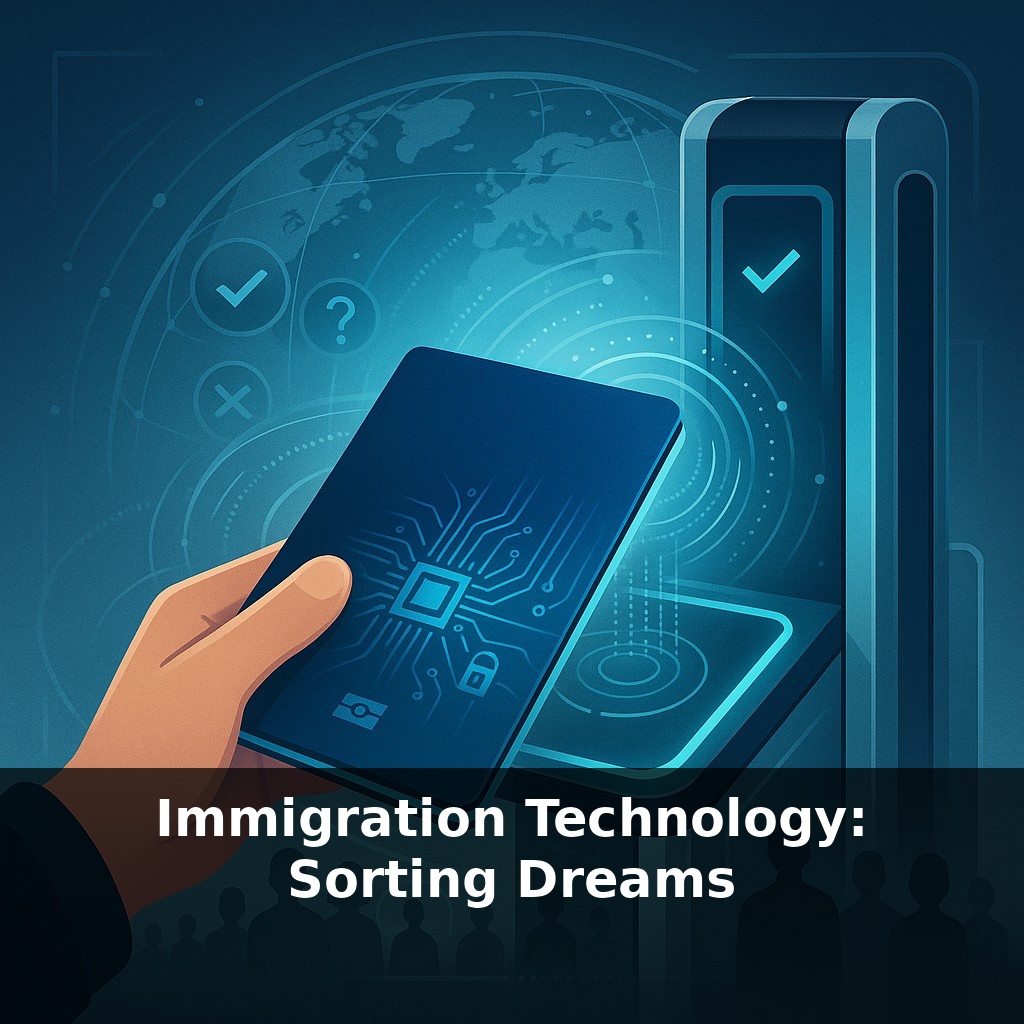
Before you even book a flight, algorithms have started calculating your risk profile, sorting you silently into categories: trusted traveler, question mark, or denial. Over 150 countries use e-passports, intertwining tech with borders before a border guard enters the scene.
Over 150 countries now issue e‑passports, tiny computers in booklet form that quietly talk to machines more than to humans. When you tap one at an airport gate, you’re not just “showing ID”—you’re unlocking a chain of checks that may have started weeks earlier, when your ticket was booked or your visa was requested. Each step adds another puzzle piece: your photo, travel history, fingerprints, even how often you’ve changed flights at the last minute.
In this episode, we’re stepping into that mostly invisible layer of immigration technology: the systems that promise faster lines and fewer fake documents, yet also concentrate power in code few people can audit. We’ll look at how biometrics, AI scoring and digital identities can expand access for some travelers while quietly closing doors for others.
Think of today’s immigration systems as shifting from “lines and stamps” to “accounts and dashboards.” Governments and migrants are both logging in. On one side, cloud platforms let officers pull up a person’s visa history, tax status, even prior overstay decisions in seconds. On the other, migrants upload documents, track cases, and get decisions without ever touching a consulate door. This efficiency can shrink wait times and reduce lost paperwork, but it also raises sharper questions: Who controls the data trails people leave, and what happens when software quietly flags them as a problem?
At the heart of this shift are *three* big moves: pre‑travel screening, continuous data sharing, and self‑service migration.
First, pre‑travel screening. Before you reach a checkpoint, airlines send passenger data to governments, which cross‑reference watchlists, past immigration decisions, and crime databases. Some countries run extra checks for people needing electronic travel authorizations, long before a visa officer ever sees a file. This is where AI‑driven analytics increasingly enter: not just “Is this document valid?” but “Does this pattern of trips, jobs, and connections look like past cases we labeled risky?” The label itself may never be shown to the traveler—only the downstream result: extra questions, a visa refusal, or a boarding denial.
Second, continuous data sharing. Modern systems don’t just verify you once and forget you. Agencies responsible for borders, tax, welfare, and labor inspection increasingly plug into shared platforms, especially in regions like the EU. A work‑permit approval can be visible to labor inspectors; an overstayed visa can trigger an automatic flag the next time you apply for anything. Interoperable databases make it easier to catch forged identities or serial over‑stayers, but also to let a single error—or an old minor offense—echo across decisions for years.
Third, self‑service migration. Online portals and smartphone apps now handle everything from uploading proof of funds to booking mandatory interviews. Estonia’s e‑Residency program is a prominent example: entrepreneurs abroad obtain a secure digital ID, register a company online, and manage it remotely, contributing tax revenue without ever relocating. For refugees and low‑income migrants, pilot projects use digital wallets to store education or vaccination records so they can prove qualifications without carrying fragile paper archives.
All of this expands a quiet hierarchy of mobility. Frequent flyers in “trusted traveler” lanes, remote founders with state‑backed digital IDs, and highly skilled workers sail through streamlined channels, while others face opaque scoring and scarce connectivity. The promise is smoother borders; the risk is a world where opportunity depends not only on your passport, but on which systems recognize—and trust—your data.
A quiet revolution is happening in the paperwork itself. When over 150 countries bake RFID chips into passports, the booklet becomes a traveling dataset that can plug into airport gates, consular systems, and even employer verification tools. U.S. border officials now lean on this infrastructure at scale: since 2018, biometric exit checks have verified hundreds of millions of departures and caught impostors who might once have slipped through with a borrowed document. On the other side of the spectrum, Estonia uses similar building blocks to invite foreigners to become e‑Residents—handing out 100,000 secure digital IDs that let founders from 176 countries open EU‑based companies and pay taxes remotely, generating hundreds of millions in revenue. Yet the same facial recognition benchmarks that boast sub‑0.1% error rates in lab conditions still misfire more often on certain demographics, raising a core tension: the more decisions flow through these pipes, the higher the stakes when they’re wrong—or unevenly accurate.
Digital borders could soon feel as routine as updating a travel app: you change jobs, your status refreshes; a new diploma, and doors in another country unlock. But who writes the rules for those updates, and who audits them? Like credit scores, invisible reputations may follow migrants for life, shaped by old data or foreign misunderstandings. The opportunity is huge: faster refuge, smoother hiring. The risk is a “reputation trap” that’s hard to see, and harder to escape.
Your challenge this week: watch how often daily life already runs on background checks—unlocking a phone, paying online, boarding a train. Then ask: if similar filters silently sorted who may cross borders, rent housing, or get hired abroad, what safeguards would you demand? Treat that list as a draft bill of rights for digital movement.