What Is Money? From Shells to Digital Numbers
📝 Transcript
Right now, most of the money you “have” only exists as changing digits in a bank’s computer—yet those ghostly numbers decide what you eat, where you live, and how you work. A few hundred years ago, your entire net worth might have jingled on your belt in metal coins.
Those glowing numbers in your banking app feel modern, but the logic behind them is ancient. Long before banks and smartphones, people were already solving the same problem: “How do we trade fairly without hauling everything we own to the marketplace?” Different societies hacked together answers using whatever they had in abundance and others wanted—salt bricks in parts of Africa, massive stone disks on the island of Yap, tally sticks notched and split in medieval England.
What changed over time wasn’t the goal, but the *infrastructure* of trust. Rulers stamped metal to certify weight and purity. Merchants accepted paper promises because courts could enforce them. Today, code, regulation, and reputation play that role. Each upgrade made trade smoother, but also more abstract—nudging money further from stuff you can touch, and deeper into systems you have to believe in.
Over time, three questions quietly shaped which objects “won” as money. First: *Is it easy to carry and divide?* Giant stones and sacks of grain failed this test; small metal pieces and later entries in books did better. Second: *Does it last?* Food rots, metals endure, and digital records—when backed up—can outlive buildings. Third: *Can we recognize and verify it quickly?* A coin’s stamp, a watermark, or a secure app interface all answer that. As these questions got solved in new ways, what people *called* money shifted, even when daily life still felt the same.
Think of money’s story as a long sequence of “upgrades” driven by trade getting bigger and messier.
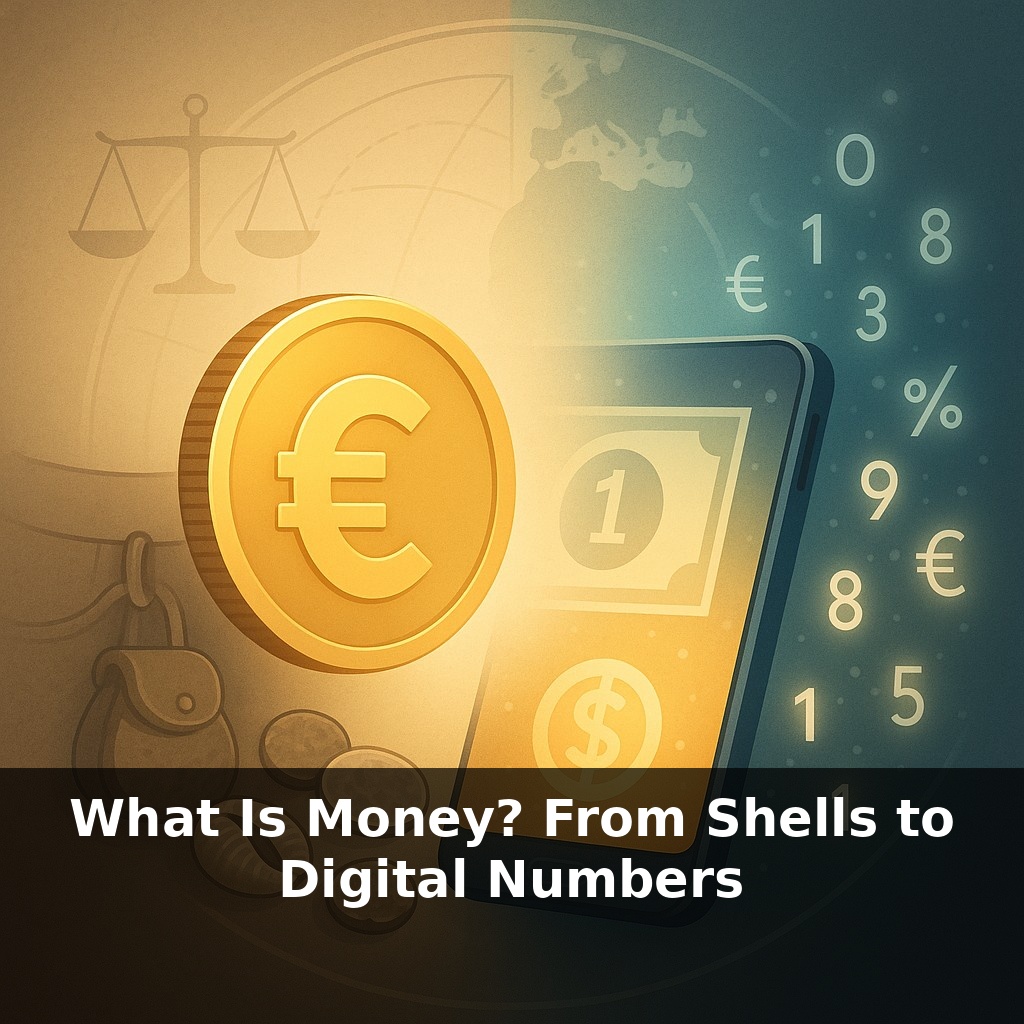
Early on, cowry shells spread across Asia and Africa not because they were pretty, but because traders moving between villages, coasts, and inland markets needed *something* many groups would accept. For over 3,000 years, those shells handled everything from local taxes to long-distance commerce, and in parts of China they stayed official enough to count as legal payment into the late 16th century.
When trade networks thickened again—ports buzzing, caravans crossing empires—shells and weighed lumps of metal started to slow deals down. The Lydians answered with stamped electrum coins, each about 14 grams. That simple mark turned weighing and testing into a quick glance. Prices could be quoted in standard units, and contracts written without pages of “unless this bar turns out to be fake” clauses. Coins didn’t just speed up buying and selling; they made it easier for rulers to collect taxes and for soldiers to be paid on time.
Paper promises were the next jump. In China’s Song dynasty, merchants sick of hauling metal over bandit-filled roads embraced printed notes. The government leaned in so hard that by the 1100s it may have been issuing billions of notes a year. That scale wasn’t about convenience alone—it was about managing a whole economy with tools lighter than bronze.
Today’s upgrade seems invisible. In most advanced economies, only a sliver of the money supply clinks in pockets or changes hands as notes. The vast majority is just numbers on ledgers, updated when you tap a card, send a wire, or schedule an automatic bill. In Kenya, mobile money like M‑Pesa moves value through basic phones on such a scale that its annual transaction volume rivals more than half the country’s GDP.
Across all these phases, what “counts” as money shifts from shells to coins to paper to digits. What stays constant is how societies use those forms to quote prices, settle obligations, and carry value forward in time—even as the stuff doing that job becomes easier to move and harder to see.
Think about how differently three people might “hold” value today. A street vendor in Nairobi may stash most of her earnings on a SIM-card wallet. A freelancer in Berlin might split savings between a bank account and a brokerage app. A crypto enthusiast in Buenos Aires could be tracking balances across multiple chains. None of them are touching gold or bills most of the time, yet each is navigating the same underlying question: “Which system will still let me pay rent next month and fees next year?”
History suggests that what wins in practice is rarely the “purest” or most elegant idea, but the option that enough people, merchants, and institutions can plug into. That’s why loyalty points, in‑game currencies, and ride‑share credits can start to blur into “almost money” when they’re spendable in enough places.
Money is like a software standard: once a critical mass adopts it, compatibility beats perfection. The interesting frontier isn’t just new tokens, but which ones quietly become so convenient that we stop noticing we’re using them.
As value turns into pure code, money can quietly change its *rules* as well as its form. Programmable currencies could auto-split your paycheck—some to savings, some to loan payments—before you even see it. Governments might send crisis aid straight to your wallet, spendable only on essentials. But each upgrade invites trade‑offs: smoother flows vs. tighter tracking, custom features vs. lock‑in, local control vs. global platforms shaping how your future “wallet” must behave.
So the real question isn’t “What is money?” but “Who gets to re‑write its rules next?” As code, corporate platforms, and states all compete to issue the tokens we live by, your future “wallet” may look more like a dashboard of overlapping worlds—each with its own settings, fees, and hidden switches waiting to be discovered.
Here’s your challenge this week: Pretend we just reverted from digital money back to shells and metal coins, and for one full day, track every single thing you “pay” for (rent, coffee, apps, streaming) by writing the exact number of physical objects it would cost you—e.g., “3 months of Netflix = X shells,” “Monthly rent = Y silver coins.” At the end of the day, convert your total into today’s dollars and circle the three biggest “shell sinks” that surprise you most. Before the week ends, cancel, downgrade, or renegotiate at least ONE of those big digital-money drains, and move that exact dollar amount into a separate “store of value” bucket (high-yield savings, Bitcoin, gold, etc.—you choose).
From this course
How Money Actually Works: The Hidden System
7 episodesUnlock all episodes
Full access to 7 episodes and everything on OwlUp.
Subscribe — $1.99/monthLess than a coffee ☕ · Cancel anytime