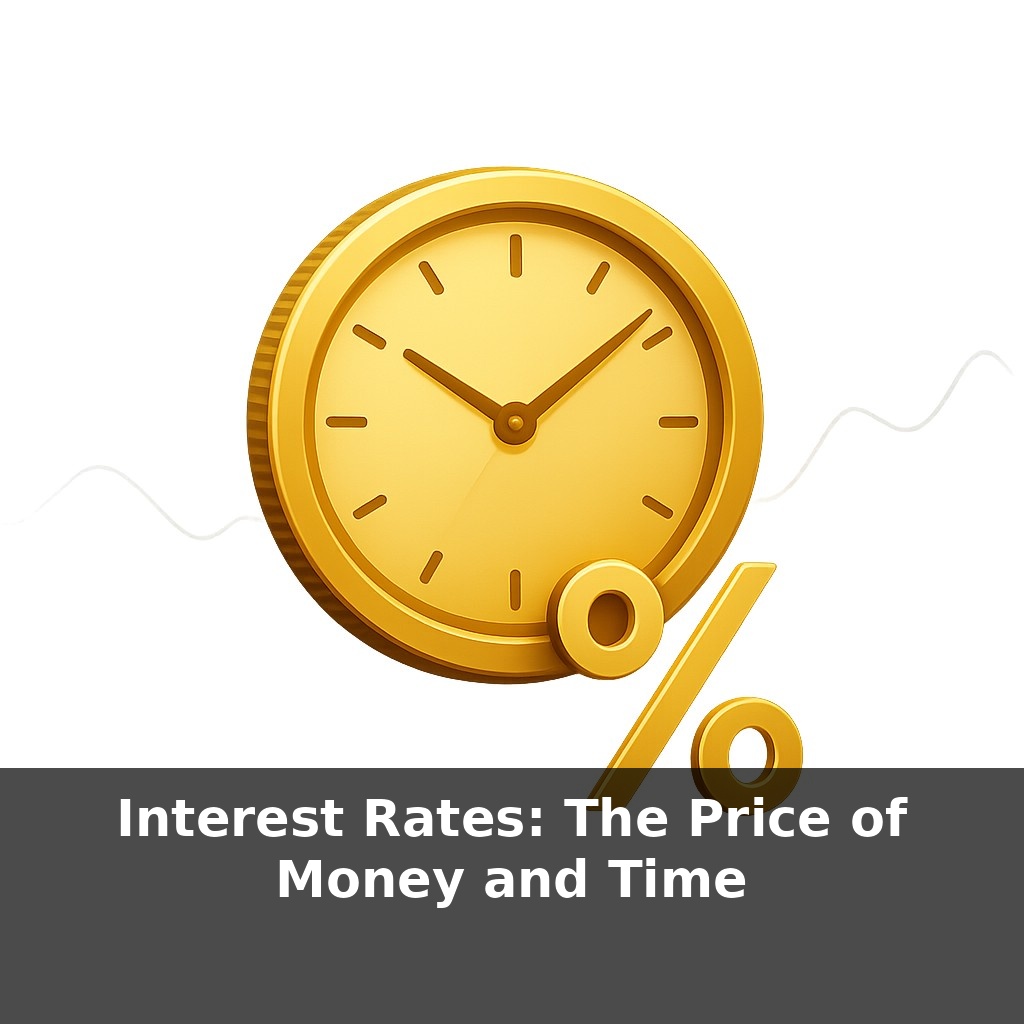
Right now, somewhere in the world, a government is deciding whether it can afford to build a bridge—based on a number you never see. In another town, a family’s rent just jumped because that same kind of number moved a little. This episode is about that hidden price.
In this episode, we zoom in on *who* sets that price and *what* it’s really measuring. When you see an interest rate—on your savings account, a credit card, a student loan—you’re not just looking at a random number a bank invented. You’re looking at a live scorecard of fear, optimism, and policy, all compressed into a single percentage.
Central banks tweak short‑term rates to cool or heat the economy. Lenders add extra points when they’re nervous you won’t pay them back. Investors demand more when they think inflation will quietly shrink the value of tomorrow’s dollars. The result is a shifting landscape of rates that can suddenly make a home affordable—or push it out of reach.
We’ll unpack how these forces interact, why tiny moves in interest rates cause huge waves, and how to read those moves before they hit your wallet.
Here’s where it gets more interesting: every rate you see is part of a much bigger structure. At the top are “risk‑free” benchmarks like U.S. Treasuries, and stacked on top of those are layers of extra yield for taking on more risk, waiting longer, or accepting less flexibility. That’s why a 30‑year mortgage doesn’t move in lockstep with your credit card or savings account. Underneath, huge pools of debt—government bonds, corporate borrowing, household loans—compete for funding, and even a small shift in those benchmark rates can quietly reorder who gets financed and who doesn’t.
Here’s the strange thing about this “price of money”: it’s not one price, it’s a whole menu. The same dollar today has many different “prices” depending on **who** is borrowing, **for how long**, and **under what conditions**.
Start with time. Lending for a week is very different from lending for 30 years. Over longer stretches, more can go wrong: economies stall, governments change, companies fail, and inflation can veer off course. That’s why long‑term borrowing typically costs more than short‑term—investors want to be paid for locking up their choices for years. When that pattern flips and long‑term government yields fall *below* short‑term ones, it’s the market quietly saying: “The future looks rougher than the present.” That flip—the inverted yield curve—has shown up before most U.S. recessions, because investors rush into longer‑term safety, pushing those yields down.
Now add **risk of not being repaid**. A government like the U.S. can tax and print; a startup can only hope to sell more. So the startup must offer a higher rate than a Treasury bond of the same maturity. Within that, there’s a spectrum: solid, profitable companies pay less; shaky, heavily indebted ones pay more. Those gaps are “spreads,” and they widen when fear rises. Watch spreads blow out, and you’re seeing credit markets judge which borrowers might not make it through the storm.
Layer on **policy and expectations**. The overnight rate the central bank targets anchors the very short end of the curve. But the rest of the menu is dominated by expectations: where inflation might go, whether growth will hold, how much debt governments and companies will need to issue. When global debt swells into the hundreds of trillions, even a small change in benchmark yields can add eye‑watering sums to interest bills, forcing hard choices in budgets and boardrooms.
And all this cascades into daily life. A one‑point jump in mortgage rates can mean hundreds more each month on a typical home loan—enough to push buyers out, slow construction, cool hiring, and ripple through local economies. A rate change isn’t just a line on a chart; it’s a reordering of who gets to act now and who has to wait.
Think of two friends both taking out car loans. One has a rock‑steady job and a long history of paying every bill on time; the other just started freelancing and has missed payments before. They might both see the same ad for “5.5% car loans,” but when they sit down with the lender, the offers diverge. The first gets close to the headline rate. The second sees a higher number, plus a stricter contract: maybe a larger down payment or a co‑signer. Same car, same city, different “price of time” attached to each person’s promise.
Scale that up, and you can see why a giant retailer might borrow more cheaply than a small local shop, even if both are profitable. Or why a country with a history of political crises has to offer more attractive yields to convince investors to hold its bonds. Those slivers of percentage points quietly decide who expands, who stalls, and who never gets off the ground.
Higher rates don’t just change monthly bills; they redraw who gets funded and what gets built. As aging savers seek steady income and climate projects chase trillions in capital, money may flow toward “boring but durable” cash‑generators and away from fragile experiments. Digital currencies and AI‑driven underwriting could split borrowers into ultra‑cheap and perpetually expensive tiers, like airports with fast‑track lanes and endless queues, reshaping social mobility along the way.
In the end, learning to read rates is less about predicting headlines and more about decoding trade‑offs. Each percentage point is a quiet vote on whose plans move forward: your future degree, your landlord’s next building, a startup’s risky pivot. Treat those numbers like the seasoning in a recipe—subtle shifts can turn the same ingredients into a feast or a flop.
Before next week, ask yourself: 1) “If the interest rate on my savings or debts suddenly rose by 2%, which specific loan, credit card, or investment in my life would hurt or help me the most—and what could I change this week to be less exposed?” 2) “Looking at one real decision in front of me (e.g., buying a car on finance, refinancing a mortgage, choosing between paying off debt or investing), how does ‘the price of money over time’ actually show up in the numbers—what does it cost or earn me over 1, 5, and 10 years?” 3) “Where am I currently treating future money as if it’s equal to today’s money—for instance, in a buy-now-pay-later plan or a long-term subscription—and how would my choice change if I honestly priced in the time value of that money?”