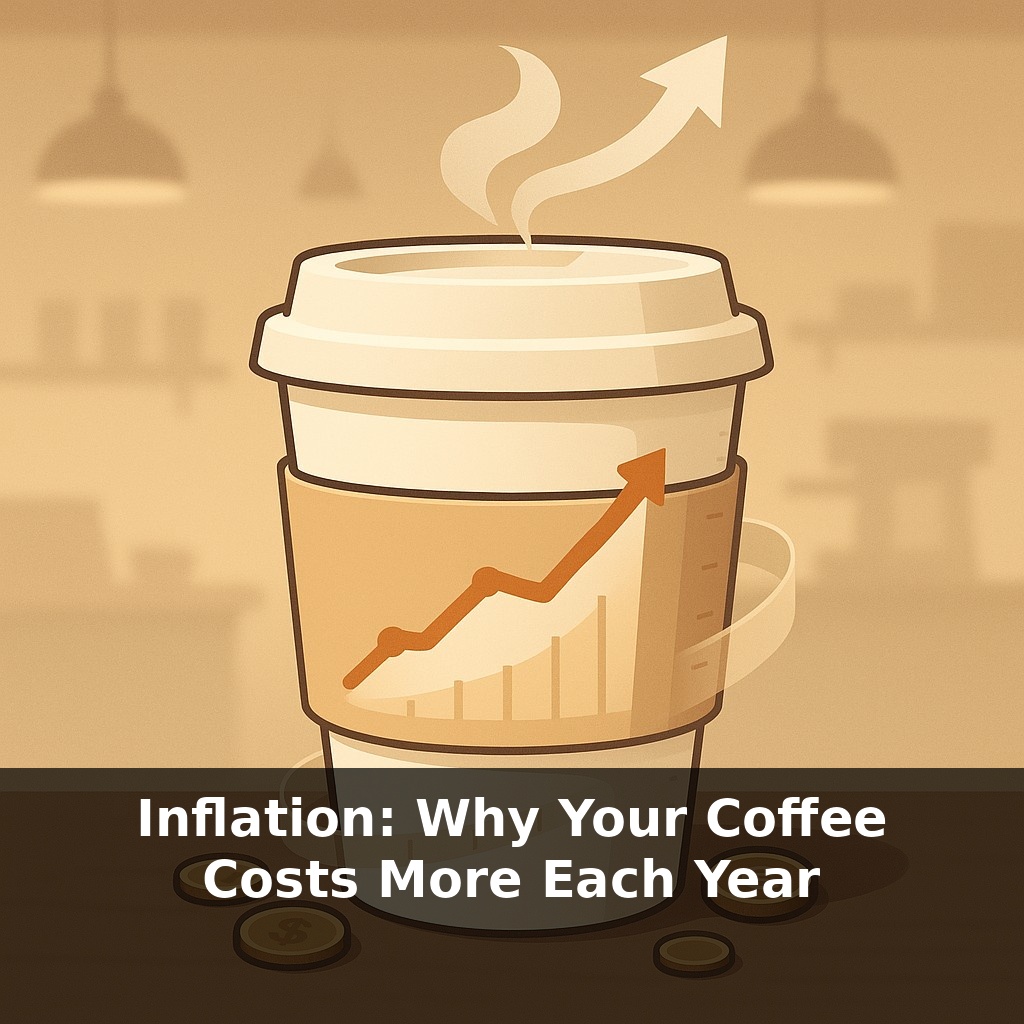
Your morning coffee has quietly become one of the best inflation trackers in your life. One year it’s a typical three‑dollar treat, a few years later it’s closer to five. Same cup, same café, same you. So where did the “extra” money on the price tag actually come from?
That higher price on your latte isn’t just your café “being greedy.” It’s the visible end of a long chain of quiet changes you never see. The beans were grown in Brazil or Colombia, where droughts, fuel prices, and local wages all shifted. Those beans were shipped on containers whose costs spiked, roasted by a company paying more for energy and labor, then delivered by trucks whose fuel and insurance are pricier than a few years ago. Your barista’s rent went up, the café’s lease renewal cost more, card-processing fees crept higher, and the minimum wage in your city may have changed. Each step adds a few cents, like layers in a pastry. By the time the cup hits your hand, those tiny increases have stacked into a new “normal” price that almost no single person decided—but everyone helped create.
Step back and zoom out from the café and you’ll notice something bigger: your coffee is just one tile in a massive economic mosaic. The same invisible forces nudging that price upward are also working on rent, streaming subscriptions, groceries, concert tickets, even haircuts. Some change faster, some slower, but they’re all linked by the value of the money in your wallet. Central banks, like the Federal Reserve or the European Central Bank, constantly tweak interest rates and money supply, trying to keep this broad rise in prices steady rather than spiraling, like adjusting a thermostat in a drafty house.
If you only looked at your café’s menu, you might think inflation lives in that one chalkboard. In reality, economists care less about any single price and more about how *thousands* of prices move together. That’s what “broad‑based” really means: rent, healthcare, used cars, movie tickets, groceries, gym memberships—some jumping, some drifting, some even falling, but on average, trending up.
To keep score, governments build price indexes like the CPI or PCE. They’re basically giant shopping baskets filled with what households actually buy. Coffee might be a tiny slice; housing and transport are huge. When the basket’s total cost rises persistently, you’ve got inflation. When it rises faster than your paycheck, you *feel* inflation.
Now add money to the picture. Most modern money is created when banks issue loans. After COVID‑19, central banks cut rates and bought financial assets, while governments sent out support payments. More money and credit flowed through the system just as factories, ports, and workers were disrupted. That mix—strong spending capacity plus constrained production—meant more dollars, euros, or pesos lining up for fewer goods and services.
Not all episodes are the same. Economists separate: - **Demand‑pull episodes**: people and firms are eager to spend—think stimulus checks, low rates, booming stock markets. - **Cost‑push episodes**: key inputs jump—oil, freight, key crops like coffee beans. - **Expectation‑driven spirals**: workers and firms *plan* on higher inflation and bake it into wages and contracts, which can keep the process going.
This is why central banks obsess over “anchoring expectations” at around 2 %. They want you, your employer, and the café owner to assume that’s the normal pace—so contracts, price lists, and wage demands don’t start racing ahead.
Left alone, even modest inflation compounds quietly. At 3 % a year, your currency’s purchasing power is cut in half roughly every 24 years. That’s the same math that makes savings grow with interest—just running in reverse on what your money can buy. Over a working lifetime, that gap between the number on your paycheck and what it actually *gets* you is where inflation really changes your standard of living.
A good way to *see* all this is to compare three everyday “inflation stories” side by side.
At your café, the owner might quietly shrink the size of the pastry instead of raising the sticker price—a classic “shrinkflation” move. You’re paying the same, but getting a little less. Supermarkets do this with cereal boxes and chocolate bars all the time.
Streaming services play a different game: they may hold the basic price for a while, then add a “premium” tier or extra fees. On paper, you still have a cheap option. In practice, the version that feels normal creeps upward.
Landlords often nudge rents up right when leases renew, bunching several years of rising costs into one jump. It feels sudden, but often reflects a slow build‑up in taxes, maintenance, and financing costs.
One analogy: inflation is like software updates on your phone—each small change seems harmless, but after a few years the device barely resembles what you first bought, and old apps (prices) don’t quite work the same way anymore.
Your coffee today is also a preview of tomorrow’s economy. As climate stress hits crops, beans may feel more like vintage wine: harvest quality, weather patterns, and region suddenly matter much more for price. Digital forms of money could let governments nudge spending the way apps send push notifications—highly targeted, sometimes intrusive. For you, inflation awareness may become as routine as checking the weather: a quick scan before choosing savings, debts, and even when to ask for a raise.
Your coffee budget can be a tiny personal lab for testing how the money world shifts. Keep an eye on how portions, recipes, or loyalty perks change over time—these tweaks often speak louder than price tags. Like learning a city by its side streets, noticing these small detours in your daily purchases can quietly train you to navigate a rising‑price world.
Before next week, ask yourself: How would my monthly budget change if I treated my daily coffee (or similar small treats) as a “mini subscription” and multiplied its true yearly cost—does that still feel worth it to me? If the price of my usual coffee went up another 15–20% tomorrow, what specific swap (brew at home, smaller size, fewer days, different café) would I actually be willing to make, and why that one? Looking at the last three price increases I’ve noticed (coffee, groceries, streaming, etc.), which one bothers me most—and what does that reveal about where I might need to build more buffer or flexibility into my finances right now?