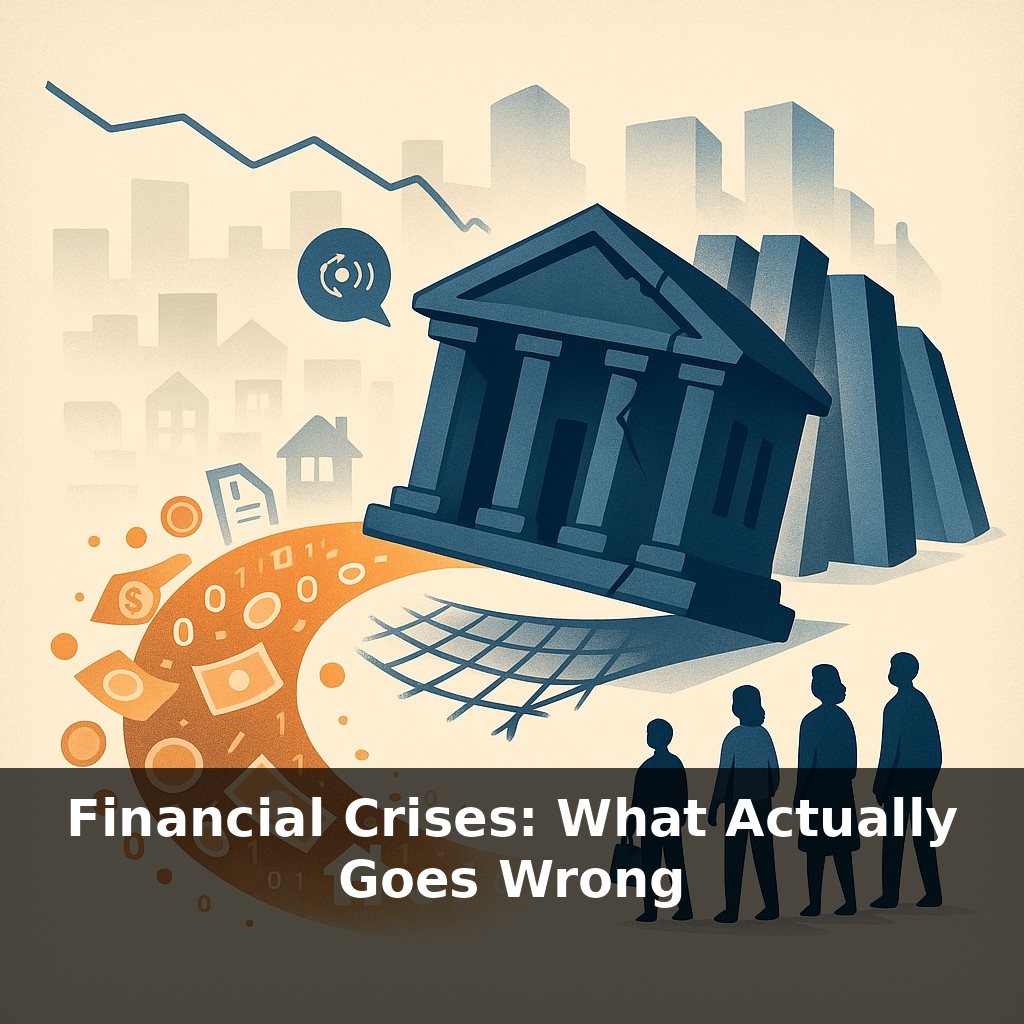
One bad rumor at a midsize bank can erase billions in deposits in a single day—long before regulators finish their morning coffee. In this episode, we’ll walk through how ordinary loans, quiet fears, and missing safety nets combine to flip a wobble into a full-blown crisis.
Sometimes, what breaks isn’t the “bad” part of finance at all—it’s the normal, everyday stuff pushed just a bit too far. A mortgage that looked safe when prices only went up. A currency peg that worked as long as dollars kept flowing in. A business line that was profitable until everyone tried to exit at once.
In this episode, we’ll zoom out from one shaky bank and look at what actually goes wrong in full‑blown crises. Why does leverage inside big institutions make tiny losses lethal? How can a small policy change or rate hike flip investor expectations worldwide? And why do safeguards that look solid on paper suddenly fail when it matters?
Think of this as tracing the fault lines: we’ll follow how pressure builds, where it snaps first, and how that break travels through balance sheets, markets, and, finally, into jobs and incomes.
When historians study past panics—from tulips to tech stocks—they keep finding the same underlying script. The characters change, the setting moves from Amsterdam canals to Silicon Valley campuses, but the plot beats are eerily familiar. Risk quietly shifts into places no one’s watching. Short‑term funding props up long‑term bets. Rules built for the last war miss the next weak spot. Then a shock hits—maybe rates jump, a currency stumbles, or a big player wobbles—and what looked like a contained problem starts leaking into money markets, trade flows, and, eventually, payrolls. In this episode, we’ll unpack that script piece by piece.
Start with what builds up in the background. In calm years, banks and shadow banks stretch: they borrow more relative to their capital and lean increasingly on funding that can disappear overnight. Before 2008, big U.S. investment banks ran leverage ratios around 33:1. That made them look impressively profitable in good times—but also meant a loss of just over 3% on their assets could mathematically erase their equity. Similar quiet stretching showed up in Asia in the 1990s and in European banks before the euro‑area crisis: short‑term foreign funding, long‑term local bets.
Next comes the jolt. It doesn’t have to be dramatic on its own. Sometimes it’s a central bank raising rates faster than markets assumed. Sometimes a currency that had been informally “guaranteed” starts to wobble. Thailand in 1997 didn’t default on everything at once; it burned through reserves—falling from about US$37 billion to just US$2 billion—trying to defend its exchange rate. The signal to investors wasn’t “we’re doomed” so much as “the old assumptions no longer hold.” That’s enough to trigger questions: Who’s exposed? Who funded this in dollars? Who rolled their debts yesterday and might not be able to tomorrow?
Once those questions start, everyone tries to shorten risk at the same time. Lenders refuse to roll short‑term funding. Derivatives that looked like boring hedges suddenly matter a lot because no one trusts the counterparties. Balance sheets that were thinly capitalized become suspect on rumor alone. Because modern finance is tightly interconnected, a problem in one corner—say, subprime mortgages or Thai real estate—forces selling elsewhere as investors hunt for cash. Prices fall not just where the trouble started, but wherever assets can be sold quickly.
This is where missing or mis‑aimed defenses show. Deposit insurance such as the FDIC’s US$250,000 guarantee is meant to stop runs from small savers, but in 2023 regulators had to extend protection to all of Silicon Valley Bank’s roughly US$175 billion in deposits to halt wider panic. Capital rules like Basel III’s higher minimum Common Equity Tier 1 requirements push large banks to absorb bigger shocks, but risk migrates: into non‑banks, offshore vehicles, and newer instruments regulators understand less well.
Across episodes—from the Great Depression’s roughly 29% GDP collapse to the euro crisis—the pattern is the same: tightening credit and forced asset sales feed back into the real economy. Companies cut investment, then jobs; falling incomes make more loans go bad, which hits balance sheets again. The numbers and players change, but the loop—fragile structures, shifting expectations, incomplete firebreaks—stays remarkably consistent.
Your challenge this week: pick one past crisis—the Great Depression, the Asian Financial Crisis, or 2008—and trace that loop for yourself. Start with: Where did the risky structure sit? Then: What was the specific shock that changed beliefs? Finally: Which safeguards worked, which failed, and how did that shape the damage to jobs and incomes? Write it out as a three‑step chain, not a full history. By the end, you’ll see how much of the drama comes from the *connections* between steps, not any single villain.
Think about how restaurants handle a busy night. A cautious owner keeps some dishes simple, holds extra ingredients in the fridge, and limits how many reservations overlap. A more aggressive owner preps just enough, overbooks tables, and relies on a single supplier for key items. Both look fine until a delivery truck breaks down. The careful place shrinks the menu and survives; the stretched one runs out of food, refunds customers, and gets slammed online.
Crises often look like that second kitchen at scale: small design choices that trade resilience for efficiency. Before 2008, some money market funds quietly promised “always‑safe” cash while chasing slightly higher yields. When one “broke the buck,” firms that treated those funds like checking accounts suddenly faced gaps in payroll. During the euro‑area turmoil, exporters who’d borrowed cheaply in a shared currency discovered that falling domestic demand hit twice—sales dropped, and refinancing rolled over on tougher terms. In both cases, the real damage came from plans built on best‑case assumptions.
Future crises may grow from slow, creeping shifts rather than sudden shocks. As coastlines erode and carbon‑heavy firms face stricter rules, balance sheets can weaken quietly, like metal rusting under paint. At the same time, DeFi platforms and CBDCs could move money with the speed of a group chat—making panics faster but also more measurable. If regulators use real‑time data to spot strains early, policy might evolve from calling the fire brigade to enforcing better building codes.
Crises, in the end, are less like earthquakes and more like overworked bridges: they fail where too many loads have been silently crossing for too long. The practical takeaway isn’t to avoid risk altogether, but to notice where weights are piling up. The more you can read balance sheets and policies this way, the less “random” the next shock will seem.
Here’s your challenge this week: Run a “mini stress test” on your personal finances as if a 2008-style shock hit tomorrow—assume you lose your job for 3 months and your investments drop 30%. Open your actual accounts and calculate (in dollars) how long your current cash reserves would cover rent/mortgage, food, insurance, and loan payments under that scenario. Then, before the end of today, set up one concrete buffer action inspired by the episode—either automate an extra transfer into savings, lower the limit on one discretionary category (like dining out) by a specific amount, or increase your minimum debt payment by a fixed dollar figure.