Your rent, your streaming subscription, the rate you’re paid for a gig—none of these prices are set by accident or by “greedy” or “generous” people alone. They all come from one quiet tug‑of‑war: how badly buyers want something, and how badly sellers want to get rid of it.
A cup of coffee that costs an extra dollar, a ride-share fare fluctuating mid-week, or concert tickets doubling on sale day – these price shifts aren't just random changes. They're signals. It probably felt random or blamed on a single culprit: “inflation,” “greedy corporations,” or “supply chain issues.” But underneath the headlines, there’s a consistent engine humming along: the way entire crowds of buyers and sellers quietly respond to each other’s moves.
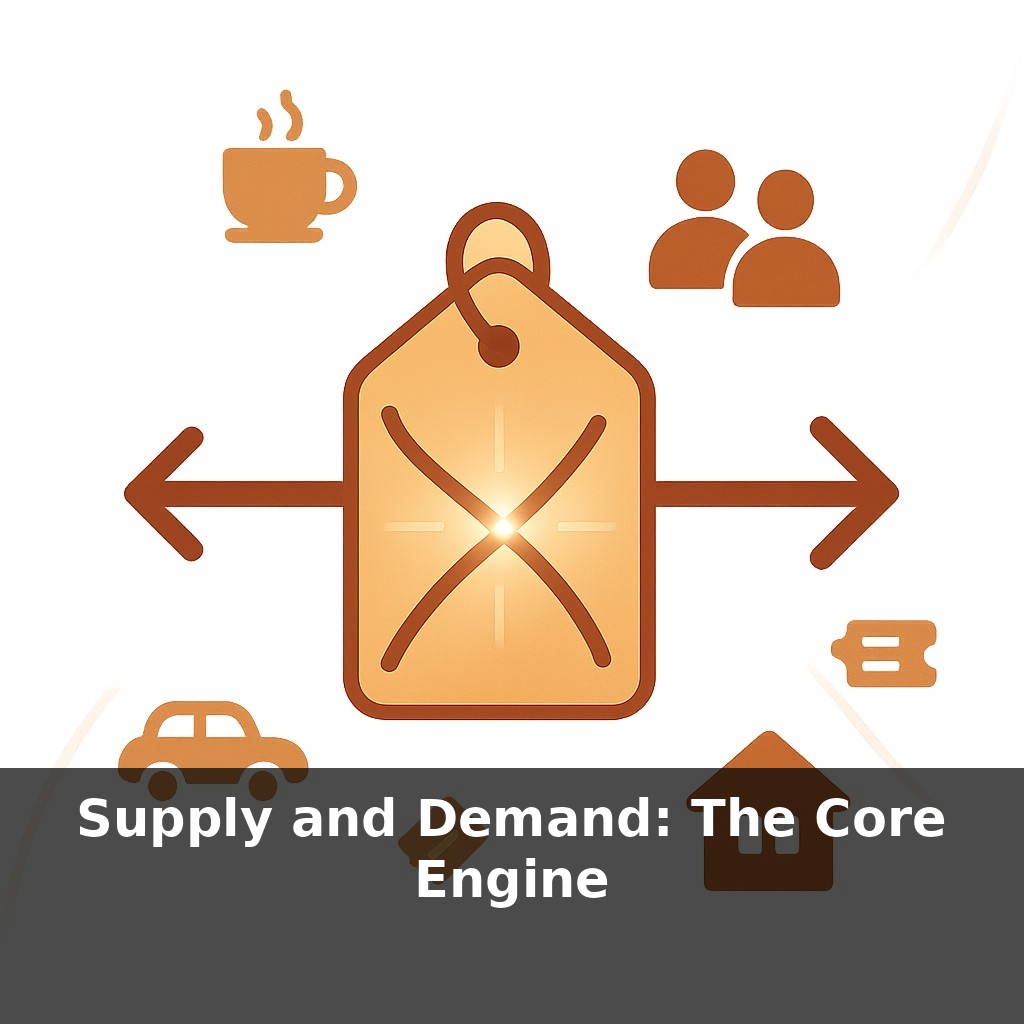
In this episode, we’re going to zoom out from individual decisions and look at the full pattern: how *many* people want something at different prices, and how *many* units producers are willing to offer at those same prices. Put those responses together, and you don’t just get a story—you get actual curves that economists can draw, compare, and test against real data. Those curves don’t just predict prices; they reveal who gains, who loses, and why some markets feel stable while others whiplash overnight.
Now we’ll zoom in on what those curves are actually *doing* in your daily life. For every good or service you care about—coffee, childcare, cloud storage—there’s a whole schedule of “yes” and “no” decisions stacked behind each price tag. Some goods barely respond when prices move (gasoline, insulin), while others swing wildly (luxury handbags, vacation flights). And because different markets react at different speeds, today’s “annoying price spike” might be tomorrow’s new normal—or a brief storm that passes once people and firms finish adjusting.
Here’s where the “curves” stop being abstract and start explaining the headlines.
Take gasoline. In the short run, a 1% drop in the price only raises the quantity demanded by about 0.2%. That tiny response tells you drivers are mostly locked in: they still have to commute, still have the same car, same job, same school run. Even a noticeable change at the pump barely nudges behavior. Contrast that with a luxury brand raising prices: a 10% bump might shrink its sales by more than 10%, because many buyers can simply walk away without changing their lives.
On the supply side, think about used cars during the 2021 chip shortage. New car production stalled, so the supply curve for new vehicles shifted left. That shock cascaded into the used market: rental companies held onto fleets longer, fewer cars were auctioned, and the Manheim Index logged roughly a 45% year‑over‑year price jump. No single dealer “caused” it; the entire feasible quantity sellers were willing to release at each price shrank, and the new intersection with demand landed at a much higher price and lower availability.
Digital platforms make the demand side move in the opposite direction. Amazon’s internal analyses have credited recommendation algorithms with a huge share of sales because they reveal products people were willing to buy but hadn’t discovered yet. In curve language, that’s a rightward shift in demand: at every price, more units get snapped up. The item didn’t change; information did.
Notice something deeper: equilibrium isn’t a target we “hit” once. It slides constantly as technology changes costs, as incomes rise or fall, as tastes drift, as expectations about the future harden or crumble. A tax on soda, a subsidy for solar panels, a viral TikTok review of a no‑name skin‑care brand—all of these redraw either the willingness to pay or the willingness to sell.
Think of it like adjusting a recipe: tweak the heat, alter one ingredient, or change the size of the pan, and the whole dish turns out differently. Markets are that recipe, rewritten every day by millions of small changes in what people want and what firms can do.
At a neighborhood food truck festival, each stand quietly runs its own experiment. The taco truck posts a menu, glances at the growing line, and decides whether to prep more meat or switch to cheaper fillings. The vegan bowl stand watches how fast its special sells out and tweaks tomorrow’s batch size. No one coordinates, yet by the end of the night, you see patterns: the longest lines, the first stalls to run out, the ones discounting leftovers. That patchwork of small adjustments is what you’re seeing every time a platform like Uber raises fares on rainy evenings or a streaming service quietly adds a cheaper ad‑tier. It’s why a trendy café might accept lower margins to stay “must‑visit,” while a corner diner raises prices a bit to survive. The same logic shows up in labor: when remote roles explode, companies bid differently for your time, reshaping when and how much work gets done—long before any headline catches up.
As climate, tech, and politics keep reshaping who can make what, where, and when, you’ll see everyday life reorganize itself around new “sweet spots.” Think of work shifts moving like tides: gig pay surging on stormy nights, off‑peak discounts nudging you toward Tuesday grocery runs, real‑time wage offers popping up on your phone. Your challenge this week: notice one price that changes often and ask, “What just moved in the world to push this number here?”
So the next time a headline blames “the economy,” zoom in: ask which side quietly shifted, and who quietly adapted. This lens won’t make groceries cheaper or rent lower, but it will make the pattern less mysterious. Like learning the basics of a new language, once you catch the grammar of these moves, you’ll start hearing it everywhere you spend or earn.
Before next week, ask yourself: Where in my own life or work do I keep “buying” something that’s clearly in low supply (my time, energy, attention) as if it were unlimited, and what would change if I treated it like a scarce, high-value resource instead? When I feel frustrated about a result I’m not getting, am I expecting different outcomes without changing either the “price” I’m willing to pay (effort, focus, trade-offs) or the “offer” I’m putting into the world (skills, quality, value) — and which of those will I experiment with adjusting this week? Looking at one concrete situation (a project, relationship, or habit), what would it look like to intentionally lower the “price” for the other side (make it easier, clearer, more attractive) so that their natural demand to engage with me or my work actually rises?