Right now, there’s more money in bank accounts and digital wallets than there are actual notes and coins by a huge margin. You’re buying coffee, paying rent, tapping your phone—and almost none of that “money” exists physically. So what is it, really, that keeps all this moving?
In this episode, we zoom out from your personal balance to the system that makes everyone’s balances work together. Behind every tap and transfer sits a web of promises: your bank promises to honor your deposit, other banks promise to trust that promise, and the state promises to backstop the whole thing. Money, in this sense, is less a “thing” and more a shared story about who owes what to whom—and how quickly that IOU can be turned into something you actually want.
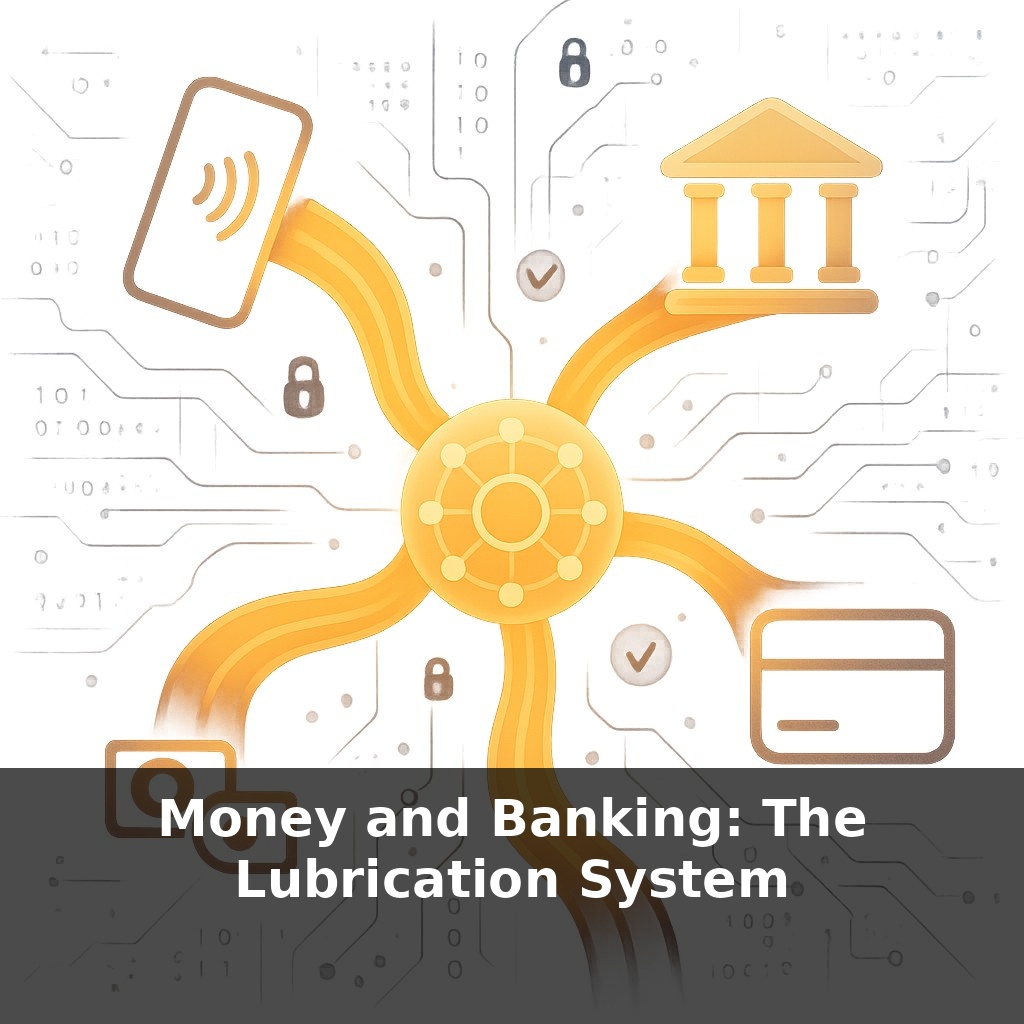
But stories alone don’t move salaries, pay suppliers, or fund new shops on your street. Banks and payment networks take those IOUs and route them at high speed between millions of strangers who never meet and never check each other’s creditworthiness. When that routing works, trade feels effortless. When it doesn’t—when credit tightens or payments jam—you discover how dependent everyday life is on this hidden circulation system.
Behind that circulation is a more basic question: why does anyone accept money in the first place? You can’t eat it, live in it, or wear it, yet it unlocks food, rent, and clothes. Economists call it a “universal IOU,” but in practice it’s more like a multi-use ticket you can hand to almost anyone, confident they’ll pass it on again. That confidence lets us skip endless haggling over “your tomatoes for my coding skills” and go straight to getting things done. Banking’s real trick is not just shuffling balances, but stretching those tickets further by extending credit where it’s most productive.
Start with how large this “universal IOU” system actually is: by 2023, broad money worldwide—mostly numbers in databases—had passed US$105 trillion. That’s not a pile of notes; it’s a dense mesh of claims and counterclaims linking households, firms, banks, and governments. What keeps that mesh usable is not its size, but how easily pieces of it can be swapped, netted out, and reshaped as people’s plans change.
This is where modern banking quietly does two big jobs at once.
First, it cuts the hassle out of matching savers with borrowers. A bakery in Nairobi doesn’t need to find 300 locals willing to lend $100 each for a new oven. A bank aggregates scattered deposits, studies the bakery’s business, and turns many small, liquid claims (deposits you can pull any time) into a few longer, riskier claims (a multi‑year loan). The bank absorbs the headache of figuring out who is trustworthy, and deposit insurance plus regulation make it plausible for you to leave your cash there without constantly checking its books.
Second, it expands the usable money stock far beyond what any government budget could sustain. When a bank in London approves a mortgage, it doesn’t wait for someone else to move their savings; it marks up your account and records your debt. Across the system, thousands of these decisions every day decide which projects get funded and which don’t. A 2014 Bank of England study estimated that roughly 90% of the money we use emerges from this sort of deposit creation.
Who gets access to that mechanism shapes the real economy. The World Bank regularly finds that small and medium‑sized firms put “access to finance” among their top constraints. They often have customers, ideas, and local knowledge, but can’t tap the web of IOUs at reasonable terms. Closing that SME credit gap, the Bank estimates, could add around US$1 trillion to global GDP—essentially by letting more people swap future income for present investment.
The same logic shows up in newer systems. In Kenya, M‑Pesa lets users store and send value via basic phones, and now processes mobile payments each year worth more than half the country’s GDP. That doesn’t magically create new factories overnight, but it slashes the time and risk of paying suppliers, school fees, or wages across distance. The lower the friction in turning promises into settled payments, the easier it is for productive activity to scale.
Consider three very different days. In one, a farmer in Vietnam gets a small loan to buy a better rice dryer. Her harvest spoils less, she earns more, and suddenly she’s spending extra income at local shops. In another, a freelance designer in São Paulo gets paid instantly through a platform and can cover rent the same afternoon, instead of juggling late invoices. In a third, a factory in Poland taps a credit line to buy new machinery, boosting output for years.
Each case looks small, but together they show how the “universal IOU” scales: a tiny upgrade here, a smoother payment there, a bet on future production somewhere else. When this scaling breaks—say, a credit crunch hits construction firms, or a glitch freezes payroll files—real plans stall: projects pause, deliveries slip, and even tax receipts fall.
Think of it a bit like blood circulation in medicine: you rarely notice it when it’s healthy, but when flow is blocked to even one limb, the whole body has to adapt, quickly and painfully.
Central banks now experiment with digital currencies that could reshuffle who controls the “pipes” of everyday transactions. Open‑banking rules and AI‑driven scoring might feel like switching on stadium floodlights: more players visible, but every move recorded. Climate policies will nudge banks to treat carbon‑heavy projects like aging machinery—still running, but less attractive to maintain—redirecting finance toward cleaner, longer‑lived assets.
So the real question becomes: who designs the next layer of this system—and for whose benefit? As fintechs, big tech, and states compete to move value faster, expect new “shortcuts” and new bottlenecks. Like a city adding bike lanes and toll roads at once, the rules we choose will decide who glides through and who stays stuck at the lights.
To go deeper, here are 3 next steps: 1) Open a free account at FRED (Federal Reserve Economic Data) and favorite these three charts so you can watch “the lubrication system” in real time: M2 Money Stock (M2SL), Effective Federal Funds Rate (FEDFUNDS), and Total Consumer Credit (TOTALSL). 2) Read Chapters 1–3 of “Money, Bank, and Financial Market” by Stephen Cecchetti & Kermit Schoenholtz, then pause to compare their explanation of how banks create money with what you heard in the episode—specifically how deposits, loans, and reserves circulate like oil in an engine. 3) Use the free online simulator “Monetary Policy Game” from the Federal Reserve Bank of San Francisco (or the Bank of England’s “MMT and Monetary Policy” interactive, if available in your region) and run at least two scenarios—one where you tighten and one where you loosen policy—to see how changing the “flow of lubrication” affects inflation, unemployment, and credit conditions.