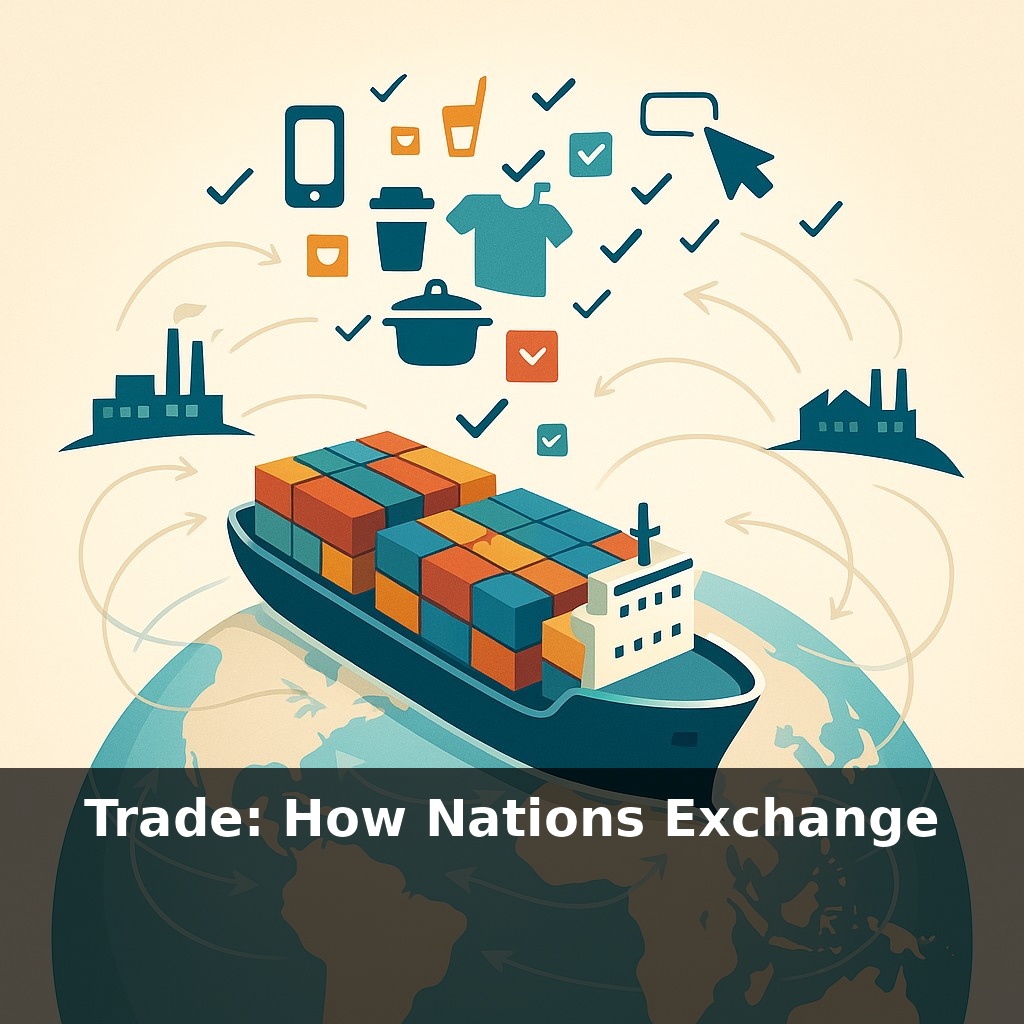
Right now, ships carry goods worth tens of trillions of dollars each year, yet no single country makes even a simple smartphone from start to finish. On your desk, in your kitchen, in your closet—almost everything around you is the result of dozens of quiet cross‑border trades.
Every time you tap “buy now,” you quietly vote in a global election about what the world should produce, and where. Those votes add up. They help decide whether a factory expands in Vietnam or closes in Ohio, whether a farmer in Kenya plants coffee or avocados, whether a coder in Poland works on banking apps or video games.
International trade is the system that turns all those tiny decisions into giant supply chains, export booms, and—sometimes—painful job losses. It doesn’t just move products; it reshapes whole economies, from port cities to small inland towns.
This flow of goods and services also carries rules: trade agreements, safety standards, tariffs, digital regulations. Together, they determine who benefits from openness, who gets left behind, and what kind of growth the world actually builds.
Trade used to mean spices on ships and crates of steel; today it’s also code moving across borders in milliseconds and components zig‑zagging between countries before becoming a “finished” product. A T‑shirt’s cotton might be picked in one nation, spun in another, sewn in a third, and sold in a fourth—each step shaped by wages, skills, and rules set far away from the factory floor. As costs of shipping and communication have plunged, production has splintered into global value chains, making local jobs, prices, and even politics tightly linked to distant decisions you’ll never see.
Stand back from the container ships and policy debates, and trade looks like a simple question: what should we *not* try to do ourselves?
Economists call the answer comparative advantage. It’s not about who’s best at everything; it’s about where you give up *least* by focusing. A high‑wage country might be able to assemble sneakers and design medical devices, but the real gain comes from concentrating scarce engineers on the devices and buying sneakers from places where labor is cheaper and skills match that task better.
This logic scales. China didn’t start as “the world’s factory” by doing everything; it began with labor‑intensive assembly, then climbed into electronics and machinery. Germany leans into complex manufacturing; the U.S. into advanced services, tech, and high‑end goods. Small economies like Singapore and the Netherlands punch above their weight by acting as logistics and trading hubs rather than trying to grow all their own food or make all their own consumer products.
When it works well, the payoff is huge. World trade relative to GDP has more than doubled since 1960, and in that same era, hundreds of millions in East Asia alone moved from rural poverty into urban, export‑linked jobs. Cheaper imported essentials—food, clothing, electronics—quietly raise real incomes, especially for lower‑income households that spend a bigger share of their budgets on those goods.
But the benefits arrive packaged with harsh local shocks. A town built around one factory that suddenly faces tough foreign competition can see wages fall and jobs vanish, even as national consumers gain from lower prices. The classic win‑win story is *true on average*, yet those averages can hide concentrated pain, often in specific regions and industries that struggle to adapt.
That’s why modern debates aren’t really “trade or no trade.” They’re about *how* to trade: what rules protect workers without freezing opportunity, how to cushion people and places knocked over by import surges or offshoring, and how to manage security risks when critical supplies—like semiconductors or medicines—depend heavily on a few foreign producers.
When you zoom in, the story gets very concrete. Take coffee. Brazil, Vietnam, and Colombia mostly ship green beans; the highest margins often go to brands in rich countries that roast, package, market, and run the café chains. Or look at Bangladesh, where clothing factories employ millions—mostly women—feeding retailers like H&M and Zara. A tweak in European labor rules or a sudden drop in U.S. demand can mean canceled orders and overnight layoffs in Dhaka.
On the other end, advanced economies increasingly export invisible things: legal advice over Zoom, cloud computing, streaming content, design and engineering services embedded in physical exports. Ireland’s GDP swings wildly when a big tech firm shifts where it books intellectual property; that’s trade too, just harder to see.
And resilience is now a major concern: after COVID‑era shortages, firms started “friend‑shoring” and keeping extra inventory, trading a bit of efficiency for backup options when one supplier—or one country—runs into trouble.
Trade’s next chapter may feel less like shipyards and more like app stores. Code, design, and even virtual “skins” in games already cross borders as quietly as emails. Firms are testing “China+1” production maps, spreading orders to Vietnam, India, or Mexico the way investors rebalance portfolios. At the same time, green rules and carbon pricing will nudge factories to clean up—or lose access to key markets—turning climate policy into a new axis of competitiveness and conflict.
Trade’s next moves will be less about “more or less” and more about *which* links we trust. Data routes can be blocked like roads in a storm; rare minerals can become bargaining chips. Your weekly grocery mix, the apps you rely on, even how quickly vaccines arrive in a crisis will reflect choices governments and firms now make about who to lean on—and who to keep at arm’s length.
To go deeper, here are 3 next steps: (1) Open the World Bank’s World Integrated Trade Solution (WITS) dashboard and pull up your country’s top 5 export and import partners, then compare those with the trade patterns discussed in the episode to see where your country fits in the global web of exchange. (2) Read one chapter of Paul Krugman’s “International Economics: Theory and Policy” (or his more accessible “Pop Internationalism”) focusing on comparative advantage, and pause to test the examples against the episode’s stories about why nations specialize. (3) Visit the Observatory of Economic Complexity (oec.world), pick one product mentioned in the episode (like semiconductors, wheat, or rare earths), and trace its major exporters/importers to visualize how that single good ties multiple nations together in trade.