What Is the Internet? Not What You Think
📝 Transcript
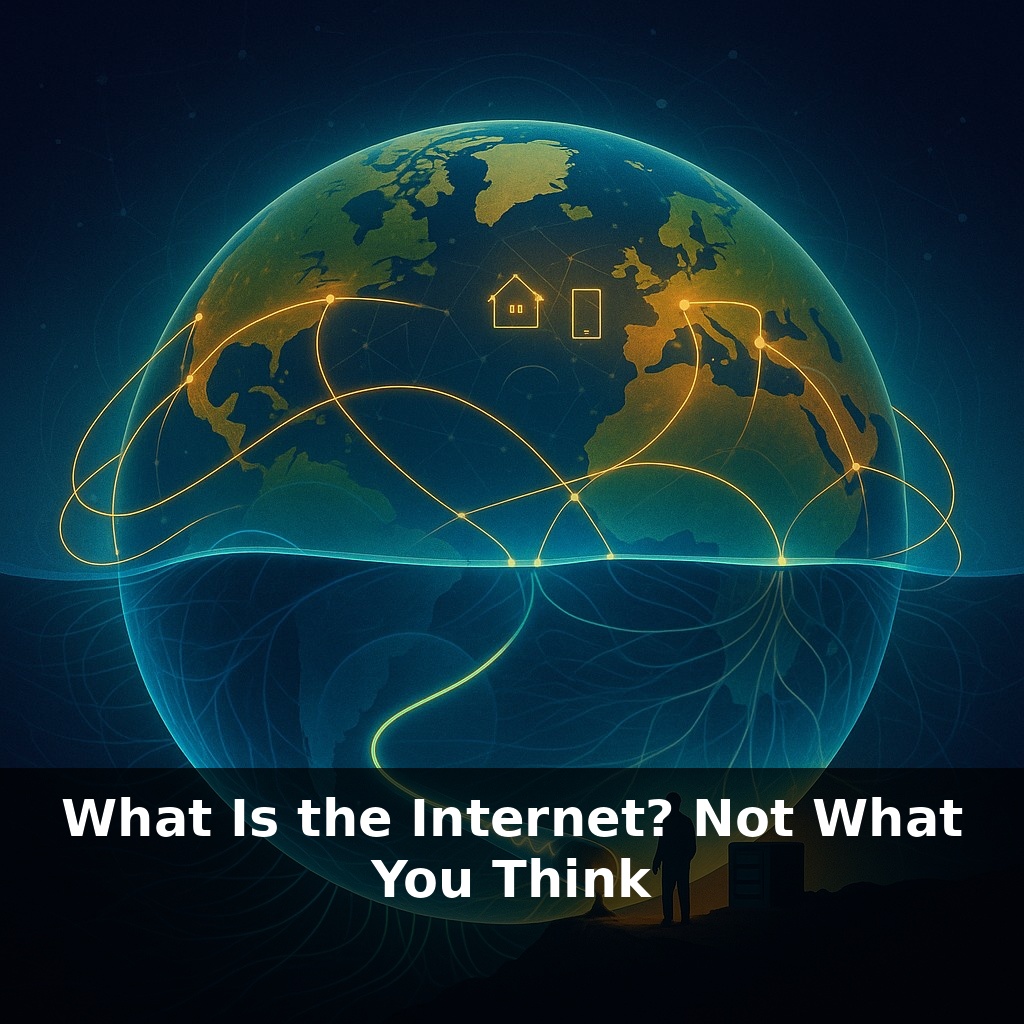
Right now, as you listen, your voice could be bouncing through the ocean. Not in a poetic way—literally racing along glass-thin threads under the sea. Here’s the twist: no one owns “the Internet” that carries it… because there is no single thing to own.
You interact with this thing every few seconds—scrolling, streaming, sending—but almost never meet the people who actually make it possible. Not “tech CEOs,” but the quiet cast in the background: the engineer deciding where a cable should surface on a remote beach, the local provider arguing for a new link to a rural town, the standards nerd debating one tiny rule that changes how fast a video loads worldwide.
Behind every “Wi‑Fi is down” moment is a chain of decisions, contracts, and physical repairs. Storms knock out sea cables; operators reroute traffic in minutes. Governments push for more control; others fight to keep connections open across borders.
In this episode, we’ll zoom out from your screen and into that messy, human layer: who shapes the network you rely on, why their incentives matter, and how those hidden choices decide which futures stay possible—and which quietly disappear.
Think of the network like a city that never finished its master plan: new “districts” get bolted on wherever land, money, and politics allow. Some neighborhoods are brightly lit with blazing-fast links; others are cul‑de‑sacs where a single broken line strands everyone. Quiet agreements decide whose traffic gets a fast lane and whose crawls during peak hours. Standards bodies meet for years to tweak one rule; a single telecom merger can reshape what routes are profitable overnight. In between, activists, regulators, and start‑ups keep trying to reopen doors that quietly slid shut.
Most people first meet “the Internet” through a glowing rectangle: a browser tab, a streaming app, a chat window. It feels like one seamless place because the seams are deliberately hidden. Underneath, what actually holds everything together are a few shared rules—protocols—that every participating network agrees to follow, even while competing fiercely on everything else.
That’s the strange paradox: coordination without central command. Your device doesn’t negotiate separately with every company between you and a server in another country. It speaks a common language (like TCP/IP and friends) that says: “Here’s how to label information, break it into chunks, and put it back together.” As long as other systems respect the same grammar, your messages can hop across hostile borders, corporate rivalries, and wildly different technologies.
This “rules, not rulers” approach has consequences. When the rules are open and interoperable, a tiny startup can plug into the same global fabric as a trillion‑dollar firm. That’s how the Web itself emerged on top of existing infrastructure: nobody had to ask 10,000 operators for permission. But when rules get extended, bent, or quietly replaced—by proprietary apps, private app stores, or locked‑down devices—the pathway for new ideas narrows.
You can see this tension in small design decisions. Does a messaging app use open standards so others can interconnect, or does it build its own silo? Does a video service optimize only for its own traffic, or cooperate on shared protocols that benefit everyone? These choices sound abstract, yet they decide whether your future online life feels more like walking through a city of many streets or being funneled through a handful of private malls.
A subtle shift is happening: more of what you do online happens inside tightly controlled platforms that simulate the wider network while quietly redefining the rules. It’s like a hospital cafeteria that looks public but only accepts one company’s health card. You’re still “online,” but fewer actors get to shape what that means—and fewer alternatives can even reach you.
Understanding that difference—between the open rulebook and the closed replicas—is key to seeing what’s at stake as the next generation of services, devices, and laws arrives.
A concrete example: in 2010, a small company launching video calls had to rent capacity from larger carriers, but it didn’t need to beg each one for a custom hookup. Using standard protocols, it could send its packets through whoever offered decent terms that month. When one carrier raised prices, traffic shifted to others almost invisibly. That flexibility is why new players can appear quickly—and vanish just as fast if they ignore those shared rules.
Contrast that with a big messaging app that keeps everything inside its own walls. It may still traverse many networks underneath, but it doesn’t let other services plug in. A local nonprofit building a crisis‑helpline app can’t automatically reach those users, even if both run on the same phones in the same town.
In medicine terms, it’s the gap between a vaccine formula anyone can manufacture and a treatment locked behind a single supplier: both save lives, but only one lets many actors respond when demand suddenly spikes.
As more everyday objects quietly gain connections—cars, door locks, medical implants—the stakes of subtle rule changes grow. A tweak that once only shaped which videos load faster could now decide whose ambulance data arrives on time. Think of it less like rearranging apps on a phone, more like redrawing road priorities in a city at night: most people won’t see the blueprints, but they’ll feel the effects when something suddenly can’t get through.
Your challenge this week: whenever something “just loads,” pause and ask yourself, “Whose rules decided that?” Trace one step deeper than the app—look up the company, the country, the terms of service. Over time, a pattern appears, like seeing which chefs quietly control the menu in a city where you thought every kitchen cooked freely.
Unlock all episodes
Full access to 7 episodes and everything on OwlUp.
Subscribe — $1.99/monthLess than a coffee ☕ · Cancel anytime

