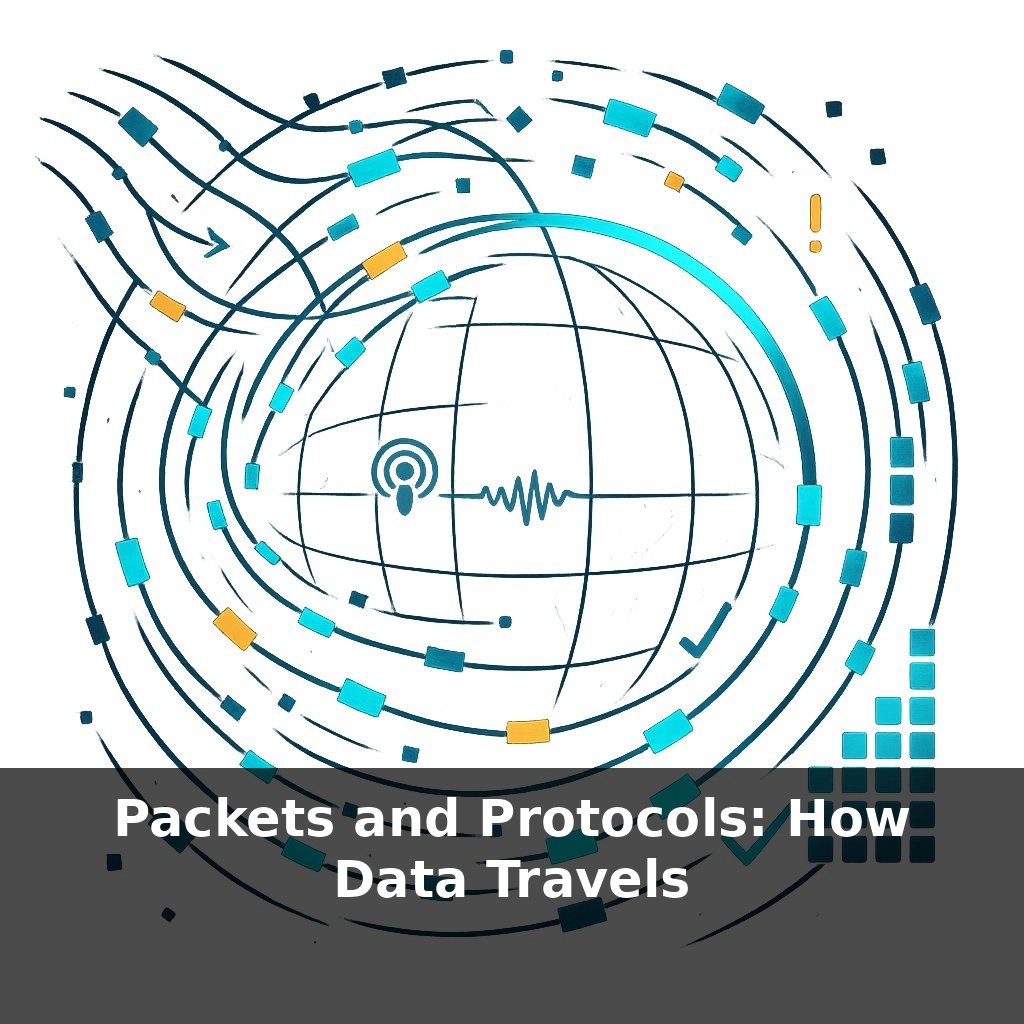
Right now, as you listen, the internet is quietly slicing every message, song, and video into tiny fragments and flinging them across the planet—often along completely different paths—then reassembling them so perfectly you never notice the chaos underneath.
Every one of those tiny chunks is following strict “travel rules” that most of us never see. These rules—protocols—decide who speaks first, how loudly, and what happens if someone mumbles or doesn’t answer at all. Some prioritize reliability, others raw speed, others secrecy. And while they quietly cooperate, they’re also constantly negotiating: Is this a video call that can’t afford delays? A bank login that must be encrypted? A game that cares more about responsiveness than perfection?
Behind the scenes, routers and servers act less like dumb pipes and more like busy air-traffic controllers, juggling billions of routes per second. As congestion, failures, and attacks flare up, the rules adapt on the fly, often rerouting your data mid-journey so you never notice the turbulence.
Some of those rules sit very close to your device, deciding how big each chunk can be before it’s launched onto the wire. Others operate only between distant endpoints, quietly agreeing on things like error checks, congestion behavior, and whether to wrap everything in encryption. Instead of a single “internet rulebook,” there’s a stack of specialized layers, each focused on a narrow job: addressing, delivery, ordering, security, presentation. The surprising part is how modular it all is—swap Wi‑Fi for 5G, copper for fiber—and the higher layers barely notice anything changed.
At the bottom of this stack sit the physical limits: how much you can cram into a single packet before it’s likely to get dropped, delayed, or chopped up again. On a typical Ethernet link, that ceiling—the MTU, or maximum transmission unit—is about 1,500 bytes. That’s why a single 5‑MB photo silently turns into thousands of separate packets, each with just enough extra markings for the network to know where it came from and where it’s going next.
Above that, things get more opinionated. Transport layers like TCP, UDP, and QUIC don’t just hand off packets; they decide *behavior*. TCP behaves like a careful conversationalist: it waits for acknowledgments, slows down when it senses congestion, and retransmits when something goes missing. UDP skips the small talk and just fires packets, useful when timeliness matters more than perfection—live sports streams, voice calls, game state updates. QUIC, running over UDP, mixes in modern tricks like built‑in encryption and faster recovery when paths change.
Security layers such as TLS then wrap these flows so that eavesdroppers see only ciphertext, not the contents or the higher‑level details. On top, application protocols like HTTP and DNS give structure and meaning: a web page request, an API call, a name lookup. Swap out one transport or security choice for another, and those upper layers usually don’t care—as long as their expectations (ordered delivery, confidentiality, low latency) are honored.
All of this is happening at astonishing scale. Cisco once estimated more than 360 billion packets crossing the global internet every second, and that number keeps climbing as more devices come online. The addressing system has had to evolve too: IPv6, with its vastly larger address space, now serves nearly half of all Google users worldwide, quietly coexisting with older IPv4 addresses and translation gateways.
Underneath the wireless access points and “cloud” icons we see, these packets mostly travel through undersea fiber‑optic cables and terrestrial backbones—glass threads carrying bursts of light, where milliseconds of delay can determine which route a flow takes and which protocol strategy wins.
Think of protocols like layers in a kitchen: the stove doesn’t care whether you’re making soup or pasta; it just provides heat. The pan focuses on even contact. The recipe layer decides seasoning and timing. Change from gas to induction, or from a steel pan to cast iron, and most recipes still work with only minor tweaks. In networks, that same decoupling lets Wi‑Fi, 5G, or fiber swap underneath while apps keep behaving predictably.
Concrete example: when you tap “join” on a video meeting, several protocol “recipes” start in parallel. One set negotiates encryption keys so only invited devices can decode. Another hunts for a path with low delay, sometimes shifting routes mid‑call as congestion shifts. A third adjusts bitrate on the fly, trimming quality slightly if loss or delay spike, then ramping back up as conditions improve—often many times per minute.
QUIC accelerates this dance by collapsing handshakes and keeping connections alive as you roam between networks, which is why some modern apps feel less “glitchy” when you walk out the door and onto mobile data. Meanwhile, IPv6 quietly simplifies path selection and reduces the need for address‑sharing workarounds that can complicate routing and security policies at scale.
Your challenge this week: pick one online activity you use daily—maybe messaging, streaming, or gaming—and *actively break* its path once per day in a controlled way. Turn Wi‑Fi off mid‑use, switch to airplane mode briefly, or move from one access point to another. Each time, notice three things: how quickly the app recovers (if at all), whether it resumes exactly where it left off, and whether quality steps down before stabilizing. By the end of the week, you’ll have a felt sense of which apps lean on “careful” transports, which bet on speed and resilience, and where new protocols like QUIC are silently smoothing over those sudden route changes.
As new layers emerge, the path your data takes starts to look less like fixed highways and more like shifting air currents. QUIC and HTTP/3 treat distance as a nuisance, not a barrier, trimming lag so tightly that remote surgery or AR overlays can feel local. IPv6 lets cities sprinkle sensors like weather stations on every block, but each extra “thermometer” is another lock to manage. Above it all, satellite constellations add moving rungs to the ladder, nudging engineers toward protocols that can tolerate long, uneven pauses.
Those packets don’t just serve screens; they’re increasingly steering streets, hospital devices, even factory robots. As more of the physical world hangs on timing and integrity, tiny shifts in how flows are prioritized can echo as smoother traffic, safer care, fewer breakdowns. We’re quietly tuning a global nervous system—one update, one header field at a time.
Here’s your challenge this week: Open your browser’s dev tools, load three different websites you actually use, and inspect the Network tab to watch the individual packets/HTTP requests as the pages load. For each site, note which protocol versions you see in use (HTTP/1.1 vs HTTP/2 vs HTTP/3/QUIC) and how many separate requests each page makes. Then, run a packet capture with Wireshark or tcpdump for 5 minutes while you browse, and label at least three visible protocols (e.g., DNS, TCP handshake, TLS) by matching what you see to what was described in the episode. Finally, take a screenshot of one captured flow (from SYN to FIN) and annotate each step with what’s happening in the protocol conversation in your own words.