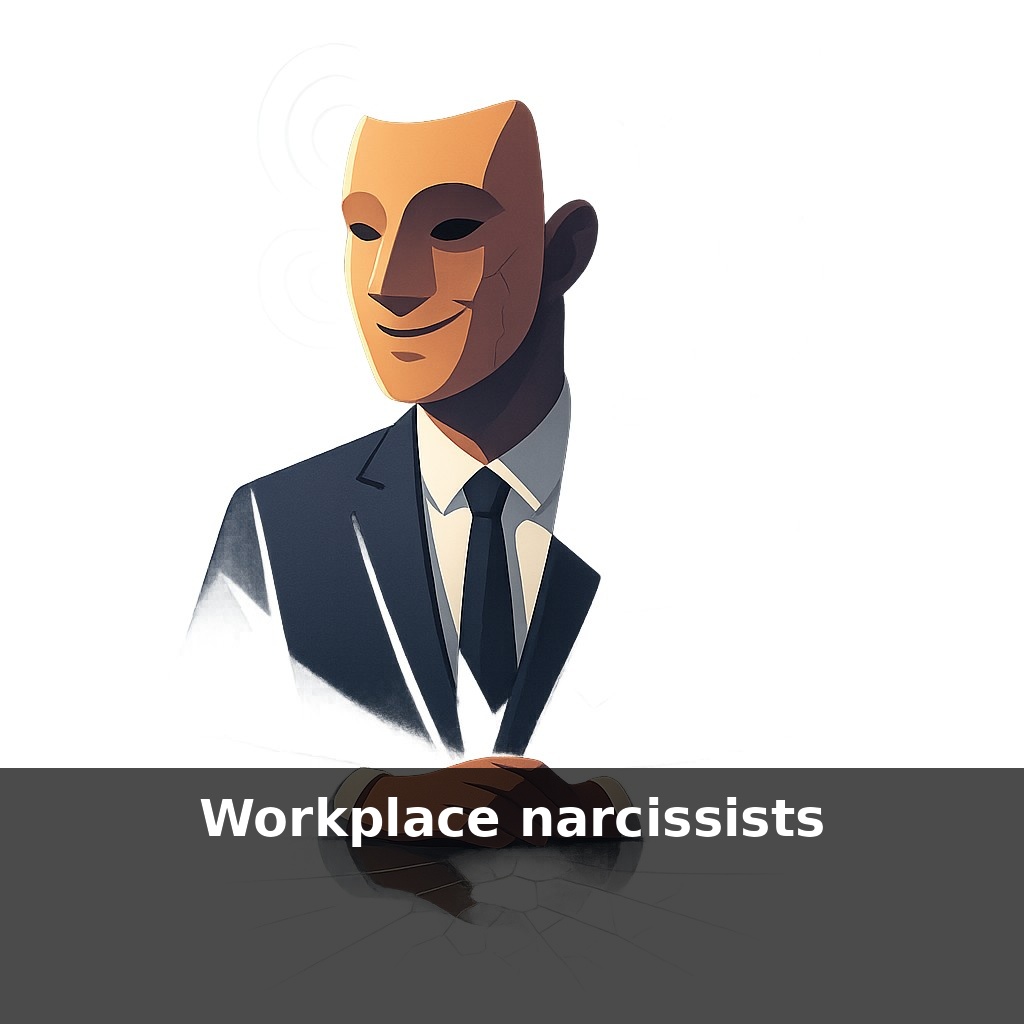
“Some of the highest‑paid people in your company may quietly be its biggest liability. In one study, narcissistic CEOs talked up social responsibility while barely changing how the company behaved. Today, we’re stepping into that gap between the story they tell—and what actually happens.”
Roughly 1 in 20 people may score high on narcissistic traits—yet most workplaces still confuse “loud confidence” with “leadership potential.” That confusion is where real damage starts. Narcissists often rise fastest in environments that reward sharp elbows, performative passion, and “hero” narratives: the person who swoops in at the last minute, dominates the meeting, then vanishes when follow‑through is needed. Colleagues might feel a subtle pressure to orbit around their opinions, schedules, and moods, while quieter experts get sidelined. Over time, small distortions add up: projects selected because they’re flashy, risks taken because they offer applause, feedback ignored because it threatens ego. In this episode, we’ll look at how these patterns show up in everyday team life—and how to notice them before they harden into culture.
Rough edges become easier to spot when you know where to look. In many tech teams, the warning signs don’t appear in performance reviews—they surface in code reviews, product roadmaps, and who gets invited to which Slack channels. You might notice one person steadily steering projects toward high‑visibility launches, then disappearing when bugs or ethics questions arise. In stand‑ups, they subtly reframe collective wins as personal genius, while failures become “misalignment” by others. Over time, riskier bets get greenlit because they *look* bold, not because they’re grounded in data or user needs.
A leader who blames “communication issues” after every failed launch might not have a messaging problem—they might have an ego problem. To spot it, shift your lens from *how* they talk to *what repeatedly happens* around them.
Start with decision patterns. Narcissistic personalities tend to: - Push for bets that generate headlines or internal glory, even when data or user research says “not yet.” - Treat pushback as disloyalty rather than as signal. - Shift criteria mid‑stream so that, somehow, their idea always “wins” the comparison.
You’ll see this in product councils where tradeoffs magically tilt toward whatever makes them look visionary. The slide deck emphasizes future valuations, not reliability, safety, or maintainability. When results are good, the story is “my conviction.” When they’re bad, the story is “the team didn’t execute.”
Next, watch how credit and blame move through the system. In healthy teams, praise and responsibility flow in roughly the same direction: the people doing the work are visible when things go right *and* are at the table when lessons are learned. Around a workplace narcissist, that symmetry breaks: - They show up at the tail end of a project and quickly become its public face. - They retell history in reviews—subtly erasing key contributors, exaggerating their own role, or rebranding others’ ideas as their “guidance.” - When bugs, outages, or ethical flags emerge, they position themselves as the one who “raised concerns early” or was “misled by incomplete information.”
Communication channels are another clue. Do important decisions: - Move into private DMs or invite‑only threads just before they’re finalized? - Get reframed after side conversations you weren’t part of? - Depend on having “face time” with one specific person for anything to move?
That pattern suggests less a collaborative process and more a loyalty test: those who keep the narcissist supplied with admiration and deference get access; others slowly lose context and influence.
Finally, pay attention to psychological safety over time. Are retros getting quieter even as incidents rise? Do smart people stop volunteering dissent, not because arguments are strong, but because the *cost* of disagreeing with one person keeps going up? That divergence—between what your processes say (“we value candor”) and what your people actually do—is often where narcissism leaves its clearest fingerprints.
A useful stress test is to watch what happens when the spotlight *shouldn’t* be on someone. Think of a sprint where a junior engineer quietly shipped a tricky refactor. In a healthy team, the demo stays centered on that work. With a narcissistic lead nearby, the story drifts: suddenly the focus is on the “strategic framing” they provided, or the “vision” that allegedly made it all possible. The more technical the achievement, the more it gets translated into vague abstractions only they can claim.
Another pattern shows up when priorities shift. A new compliance requirement lands that’s tedious but important. Does this person: - Vanish toward a sexier initiative, or - React as if being asked to share status updates is an insult?
Watch incident channels during outages. Do they: - Ask clarifying questions and own tradeoffs, or - Hijack the thread with performative outrage, then later retell the event as if they personally “stabilized everything”?
Over multiple cycles, these micro‑edits to reality become a kind of unauthorized fork of your team’s history—one that always compiles to their advantage.
Bold prediction: within a decade, “personality risk” could sit next to “credit risk” in board reports. As AI starts flagging patterns in emails, commits, and meetings, subtle ego‑driven distortions may become as trackable as missed SLAs. The paradox: tools that can surface hidden damage can also be misused by narcissists to label critics as “toxic.” Your real leverage may be cultural: who’s allowed to question the story—and what happens when they do?
The real test isn’t spotting one difficult personality; it’s noticing how your systems respond. Do budgets, promotions, and roadmaps bend toward whoever shouts loudest, or toward stable value? Treat each planning cycle like a code review for power: where are incentives misaligned, who can safely say “no,” and whose version of events never gets questioned?
Before next week, ask yourself: 1) “In the last month, where have I seen someone at work rewrite reality (e.g., denying a conversation, minimizing my contribution, or shifting blame) and how did I react in that exact moment?” 2) “If that same narcissistic pattern shows up again tomorrow, what specific boundary sentence could I calmly use (for example, ‘That’s not how I remember it’ or ‘Let’s stick to the facts from the meeting notes’)?” 3) “Which one relationship at work feels most emotionally draining right now, and what is one concrete way I can reduce that person’s access to my time or information this week (such as shortening meetings, moving requests into email, or looping in a third party)?”