Why Wars Happen: The Causes of Conflict
📝 Transcript
Right now, more people are fleeing war than the population of many big countries. A border guard hesitates for a second, a leader misreads a message, a convoy takes a wrong turn. Are these accidents, or the final sparks of deeper forces pushing nations toward war?
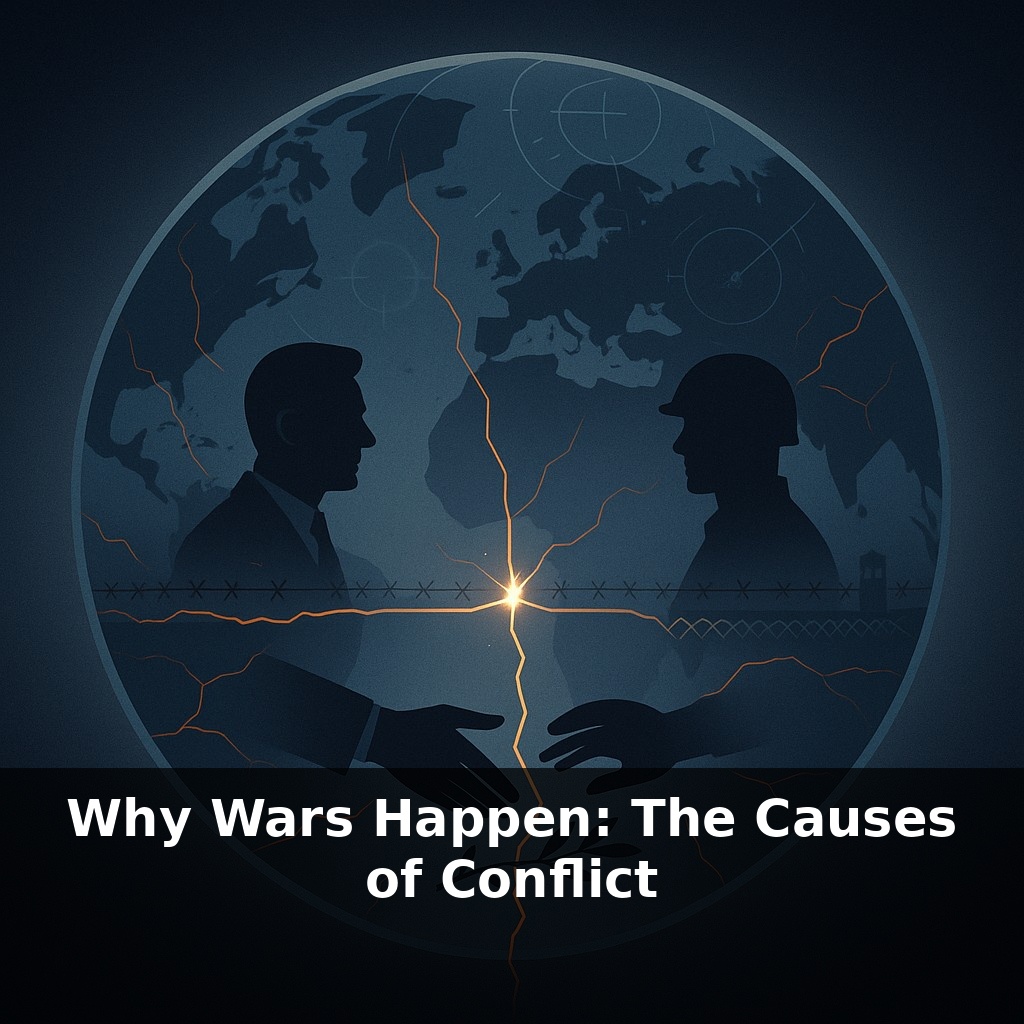
Those tiny moments only matter because the world is already wired in risky ways. Leaders make choices inside a system that has no world government, where every state ultimately relies on itself for survival. That creates a constant background hum of fear: If I don’t strengthen my position, will someone else exploit my weakness? Layer on top of that domestic struggles for power, economic interests, and stories nations tell themselves about who “we” are and who “they” are. It’s less like a single villain plotting war and more like a crowded kitchen where too many cooks are grabbing for the same limited ingredients under bad lighting. Someone bumps an elbow, a pot spills, tempers flare—and suddenly, people reach for knives instead of towels. To understand why wars happen, we have to untangle each of those hands in the kitchen, not just the final spill.
To see those forces clearly, it helps to separate them into layers. At the broadest level are structural conditions: unequal power, arms races, and the simple fact that no referee can force rivals to back down. Closer in are tangible stakes—oil fields, trade routes, fertile land—that states fear losing. Then come domestic pressures: elections, protests, coups, and lobby groups that reward leaders for looking “tough.” Finally, there’s perception: leaders guessing at each other’s intentions through speeches, troop movements, and cryptic cables, often as hurriedly as a doctor reading a scan in a crowded ER.
Peel back those layers and patterns start to emerge.
At the structural level, the absence of a referee doesn’t just create unease; it generates concrete incentives to strike first or arm faster. When two rivals fear each other’s potential, they often drift into what scholars call a “security dilemma”: one side’s defensive move—new missiles, joint exercises, a base near a border—looks offensive to the other. Each reacts, not wanting to fall behind. No one may want war, but both end up closer to it. Nuclear standoffs in the Cold War, or regional missile races today, grew less from hot tempers than from this cold arithmetic of worst‑case assumptions.
Resources sit on top of that structure like high‑value targets on a map. Oil fields, rare earth minerals, river systems, even fishing grounds become flashpoints when states fear scarcity or dependency. Since 1946, a large share of disputes has involved such assets, and not only because they are profitable. Control over them can mean leverage: the ability to pressure neighbors, fund militaries, or shield economies from sanctions. Leaders weighing whether to back down or escalate often ask not just “What is this worth now?” but “What leverage am I giving up forever?”
Inside states, domestic politics can push in directions that look irrational from the outside. A leader facing an election, a corruption scandal, or a coup threat may see foreign crises as distractions or rallying tools. Some stoke external enemies to unify divided societies; others fear being labeled weak by media, opposition parties, or generals. In fragile states, armed groups, warlords, or regional bosses have their own incentives, turning local feuds into national or international conflicts when they drag in patrons and rivals.
Then there are identities and ideas. Stories about historical injustice, sacred lands, or superior civilizations turn policy disagreements into existential struggles. When leaders frame concessions as betrayal of “who we are,” compromise becomes politically toxic. That’s one reason ethnic or sectarian tensions, once militarized, are so hard to unwind.
Overlaying all this is perception. Information in crises is late, noisy, and biased. Leaders lean on analogies from past wars, stereotypes about opponents, and selective intelligence. Misreading another state’s red lines, resolve, or alliances can turn cautious probing into a spiral. Kaiser Wilhelm II’s mistaken belief that Britain would sit out a continental conflict is only one dramatic example of how a single wrong assumption, layered atop structural pressures and combustible domestic politics, can close off peaceful exits just when they’re most needed.
Look at a few concrete patterns. On the economic side, consider when a government quietly subsidizes a key industry, then notices a neighbor negotiating exclusive access to the same export market. What begins as routine trade policy slowly morphs into a contest over shipping lanes, port rights, and “friendly” regimes along those routes. Generals who once focused on borders start presenting maps of distant straits and Building on our exploration of how leadership, technology, and climate shifts impact conflict, consider canals as 'vital arteries' that must be protected, or, if necessary, seized.
At the domestic level, think of leaders whose approval ratings are sliding. A tense standoff abroad can feel like political adrenaline: televised speeches, flag‑waving rallies, pundits praising “firmness.” The incentives to de‑escalate shrink if doing so risks looking indecisive just before an election.
Meanwhile, security officials pore over satellite images and intercepted chatter, trying to guess whether a rival’s exercise is routine or cover for a strike. In that fog, a routine troop rotation can be misread as a prelude to invasion—and planned as if it were.
Think about how new technologies and climate shifts change the stakes. AI‑driven warning systems might flag threats faster than humans can debate them, like a smoke alarm that triggers sprinklers before anyone smells burning. Melting glaciers, shifting rivers, and salt‑poisoned farmland can turn once‑stable borders and trade routes into contested ground. As cities swell and coastlines erode, leaders may see pre‑emptive deals—or pre‑emptive force—as the only way to secure a livable future.
If conflict grows from many small incentives, peace has to grow the same way. Scholars find that trade, shared institutions, and dense communication networks lower the odds that crises turn violent—like extra shock absorbers on a rough road. Your challenge this week: notice where trust is quietly built across borders, not just where it is loudly broken.
From this course
How Wars Shape History: Understanding Conflict
7 episodesUnlock all episodes
Full access to 7 episodes and everything on OwlUp.
Subscribe — $1.99/monthLess than a coffee ☕ · Cancel anytime