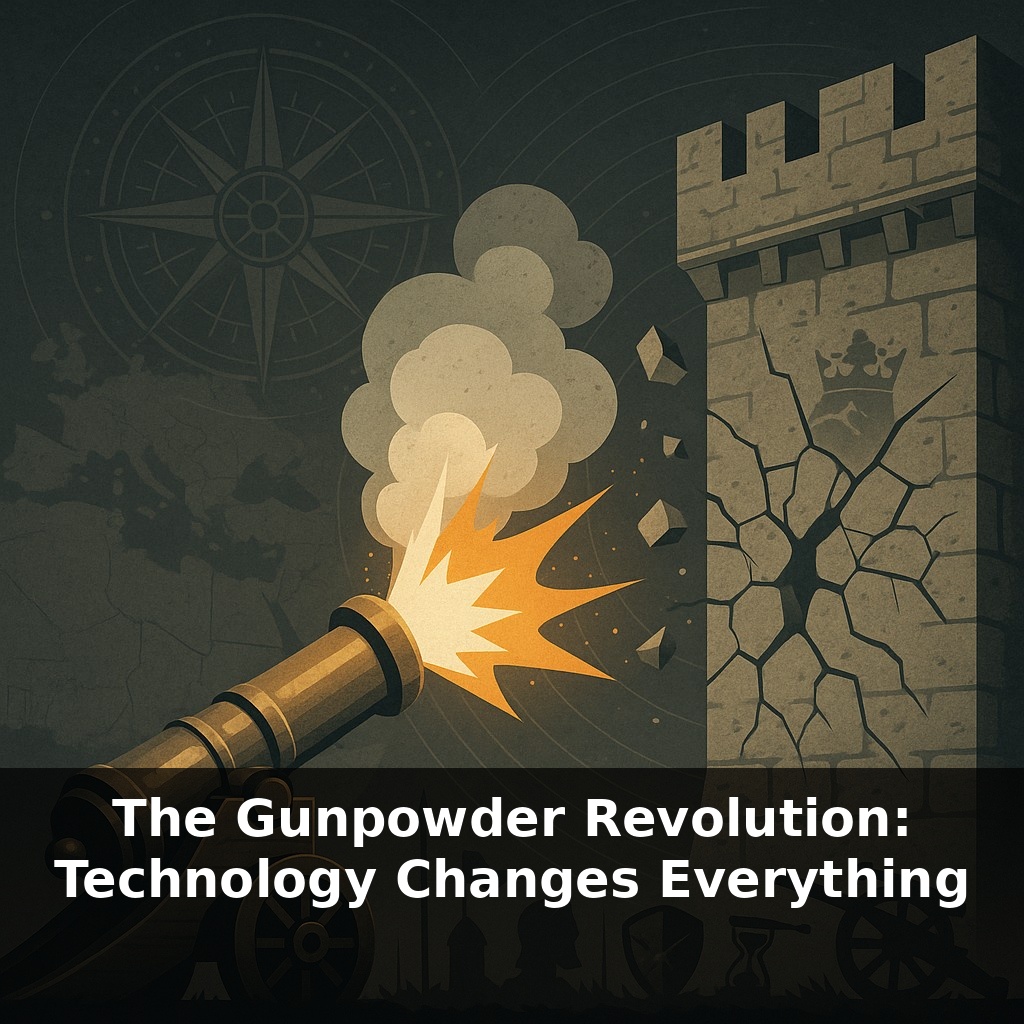
Gunpowder began as a Chinese alchemy experiment—and ended up deciding who ruled continents. A stone wall that once stood for centuries could fall in a single afternoon. In this episode, we step onto battlefields where a simple powder quietly rewired the entire map of power.
By the 1400s, rulers were discovering that this strange, noisy powder did more than punch holes in walls—it punched holes in budgets, traditions, and old certainties. Hiring a few elite knights in shining armor suddenly wasn’t enough. You now needed foundries to cast cannon, mills to grind powder, roads sturdy enough to haul siege guns, and clerks to count every coin that paid for it. Warfare turned into a sprawling industrial project long before factories filled with steam. Kings who adapted—centralizing taxes, standardizing weapons, training permanent gun-using troops—grew stronger. Those who clung to heroic charges and castle pride risked becoming quaint, then conquered. In this episode, we’ll trace how a noisy chemical mixture quietly built modern states.
Cannons and handguns did more than change how armies fought; they changed who could fight at all. Suddenly, a peasant drilled for weeks with a firearm could threaten an armored noble trained from childhood. That shift scared elites and tempted rulers: if loyalty could be mass-produced faster than knightly honor, why not raise bigger armies? Cities, sensing danger and opportunity, bargained hard—trading cash and access to workshops for royal protection. Think of each new fortress or gun foundry like a knot in a growing web, pulling towns, monarchs, and merchants into tighter, riskier dependency.
Gunpowder’s real disruption lay in how it forced people to redraw the blueprint of war from the ground up. As metal projectiles flew faster and farther, old habits—charging in tight blocks, clustering officers on hills, ringing cities with high walls—became invitations to disaster.
On the battlefield, the key problem was timing. Slow‑loading firearms fired in “salvos” left terrifying gaps when no one was shooting. Commanders answered with drill: files of soldiers learning to fire, step back, reload, and rotate so that some part of the line was always sending lead downrange. In places like 17th‑century Sweden and Prussia, this turned battle into a choreographed routine. Precision marching wasn’t just for show; it was a tool to keep powder, shot, and nerve synchronized under fire.
Gunpowder also reshaped distance. Once weapons could kill reliably at hundreds of meters, the space between armies thickened into a lethal zone. Officers spread out units, staggered lines, and dug in. By the 19th century, with rifled muskets and then machine guns, ditches, earthworks, and barbed wire replaced the clean, colorful fields of earlier paintings. The more energy crammed into each cartridge, the more soldiers had to hug the ground.
Cities adapted too. As artillery grew stronger, defenses flattened and thickened. Engineers in Italy, France, and the Low Countries cut angular bastions into the earth, creating overlapping fields of fire that forced attackers into narrow killing corridors. These fortification projects swallowed money and labor, turning quiet border towns into huge worksites for years on end. Whoever controlled the engineers and the payroll controlled the frontier.
Supply lines became as decisive as bravery. Powder needed dry storage, standardized grain size, and secure transport; metal barrels required careful maintenance. That pushed rulers to map roads, regulate weights and measures, and police corruption more aggressively. In many realms, the office that counted powder kegs sat near the office that counted taxes for a reason.
One subtle effect came in knowledge itself. States built arsenals, schools for artillery officers, and permanent staffs to calculate ranges and design siege plans. Warfare began to rely on tables, diagrams, and mathematics as much as raw courage. Like a careful cook adjusting oven temperature and timing to get repeatable results, generals and bureaucrats tried to make violence predictable—something you could budget, schedule, and refine.
Early firearms also rewired everyday life far from sieges and drill fields. In workshop districts, the demand for uniform barrels and reliable locks nudged craftsmen toward early mass production: interchangeable screws, gauges to test bore size, written standards pinned above benches. City councils debated where to store powder safely, pushing magazines to the outskirts and banning open flames nearby—public safety policy born from explosive risk. Merchants learned that contracts for saltpeter and charcoal could be as lucrative as spice routes; some Indian and European trading firms quietly financed wars by cornering nitrates. Universities and observatories found patrons in artillery offices, since better tables for gravity and wind meant more accurate fire. Even timekeeping changed: gun salutes regulated harbor schedules, and noon‑day cannon helped set city clocks. Like a new medical drug whose side effects reshape diets, laws, and insurance, this propellant’s “side effects” leaked into law codes, city plans, and scientific budgets.
Your challenge this week: treat any big technology headline—drones, AI targeting, hypersonic missiles—as if you’re a 15th‑century town council hearing rumors about cannon. Don’t focus on the gadget’s raw power. Instead, ask three specific questions: Whose skills become more valuable if this spreads? Whose status quietly erodes? And what new kinds of specialists—engineers, accountants, regulators—will have to appear to keep it all running? For each headline you see, jot a one‑sentence guess for each question. By the end of the week, look back and see whether you’re imagining only louder “bangs,” or also the slow, structural changes that technologies like gunpowder always drag behind them.
In the long run, propellants behave less like a single invention and more like a climate system: small chemical tweaks upstream create storms or droughts of power decades later. As cheaper, lighter, more stable powders spread, the real struggle may be over who controls the “weather stations”—the labs, factories, and shipping routes that decide who actually gets reliable ammunition when supply chains are stressed or sanctions bite hardest.
Today’s propellants sit beside satellites, sensors, and code, each tweak like adding a new spice to a simmering stew of power. The next shift may come less from louder guns than from smarter shells and tighter logistics, where software decides which depots stay stocked—and which armies, or cities, discover too late that the barrel has quietly run dry.
Start with this tiny habit: When you finish brushing your teeth at night, whisper one “what if gunpowder never existed?” question to yourself and answer it in a single sentence out loud. For example: “What if cannons had never replaced castle walls—how would cities look different?” Then, tap your phone’s notes app and type just the name of one historical figure from the episode (like the Ming artillery engineers or Ottoman janissaries) you want to Google tomorrow. Keep it playful and curious—no research rabbit holes yet, just one question and one name each night.