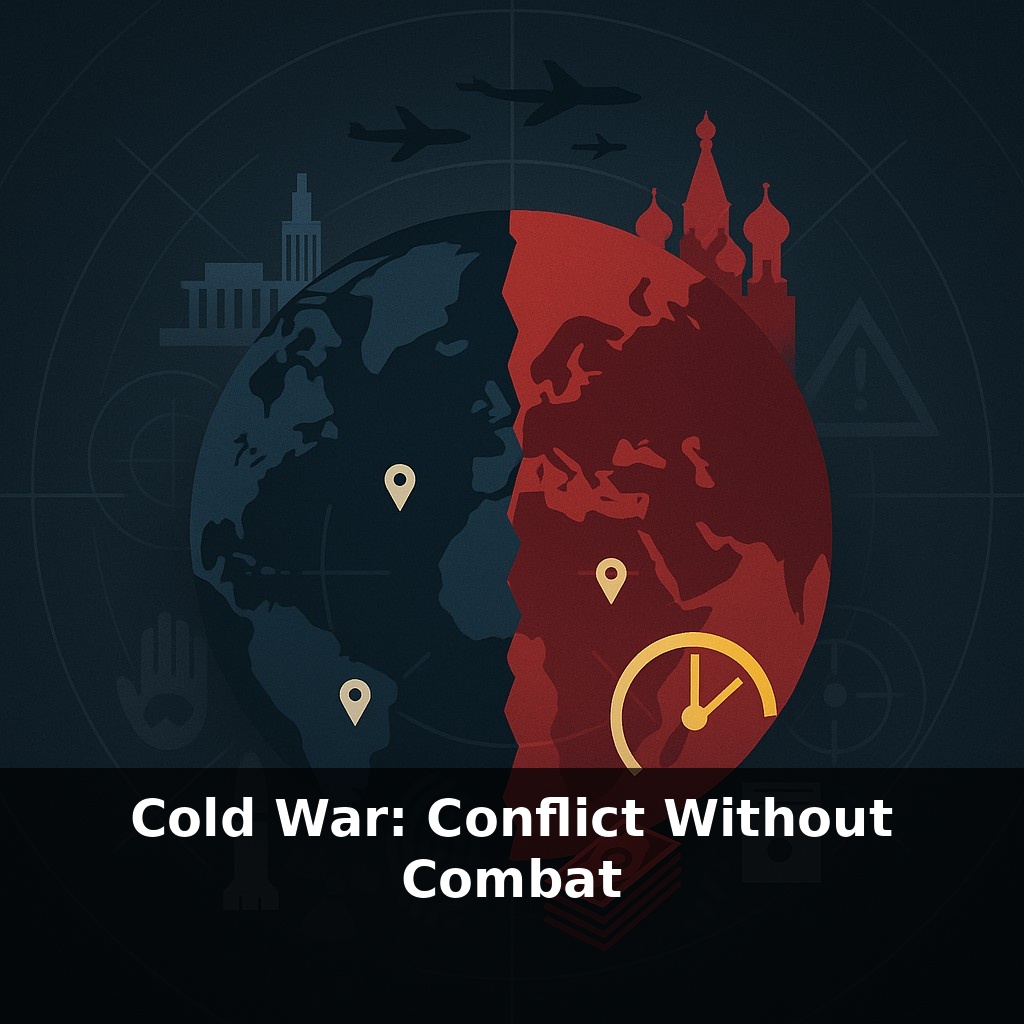
One October morning, the world woke up only two steps from all‑out nuclear war—and most people had no idea. In this episode, we drop into those tense days, follow the silent duels in the skies, and ask: how did a war with no battles still leave scars everywhere?
Seemingly local conflicts, from Korea to Angola, suddenly look different once you notice the same two fingerprints on the weapons, the money, and the training manuals. That’s the strange logic of the Cold War: a schoolyard fight in a distant town could quietly be funded by Washington and Moscow, each trying to tug the world an inch closer to their side. Some countries tried to stay “non‑aligned,” like diners at a crowded restaurant insisting they were just there for coffee while two loud groups argued over the menu. In this episode, we’ll trace how those arguments shaped borders, governments, and everyday life—why a crisis in Berlin could rattle Latin America, or a war in Southeast Asia could shift politics in Europe—and how that web of tensions still shapes today’s headlines, long after the superpower standoff officially ended.
Factories, film studios, and classrooms all became front lines of a different kind. In Washington and Moscow, budgets quietly shifted: more into missiles and spies, less into housing and consumer goods. History textbooks were rewritten so that children absorbed not just dates, but loyalties. Jazz tours, Olympic teams, and aid projects doubled as sales pitches for entire ways of life. Even maps were political: the same border might be labeled “liberation” on one side and “aggression” on the other. To understand this era, we have to zoom out from battlefields and study these everyday arenas of influence.
Factories that once turned out refrigerators or tractors in peacetime found themselves bidding—openly or quietly—for defense contracts. In the United States, entire towns grew up around aerospace plants and nuclear laboratories; in the Soviet bloc, secret “closed cities” were built where maps showed only blank space. The same engineers who perfected missile guidance systems later adapted those skills to navigation tools that would, decades on, help airplanes land safely and farmers track weather patterns with uncanny precision.
On city streets, the conflict seeped into everyday choices. Joining a trade union, publishing a poem, or hosting a foreign visitor could be read as a political signal. In Washington, congressional hearings probed actors and screenwriters for hints of disloyalty; in Eastern Europe, security services opened mail and built thick files on students who read banned books or tuned in to foreign radio. People learned to speak in code or not at all. Silence, in many places, was its own defensive language.
Far from the superpowers’ capitals, newly independent countries discovered that every development loan or military training program came wrapped in expectations. Egypt bought Soviet weapons but took American wheat. India accepted aid from both sides while fiercely guarding its autonomy. Leaders from Ghana to Indonesia played a long, careful game—accepting dams, factories, and scholarships while trying not to become anyone’s client. Some succeeded; others found that “friendly advisors” soon wanted bases, vetoes, or guaranteed access to raw materials.
Inside the military establishments, war planners treated spreadsheets almost like weather charts, constantly updating estimates of how many bombers, ships, or missiles the other side possessed. A tiny change in one column could trigger a vast response in steel orders, draft calls, or research funds. This logic filtered down into school drills, civil defense pamphlets, and bunker construction, giving everyday life a faint but constant hum of contingency planning.
Meanwhile, international organizations became arenas where this quiet struggle played out in votes, resolutions, and aid packages. A seat at the United Nations, a role in the Olympics committee, or leadership in a regional bloc could translate into leverage far beyond its symbolic weight. Each new ambassador, treaty, or trade deal added another thread to a dense, often invisible net of commitments and fears that spanned the globe.
At a village clinic in Chile or Tanzania, a vaccine refrigerator stamped “USAID” or “Made in USSR” quietly advertised whose orbit you lived in. Medical teams arrived with syringes and also with pamphlets, films, and scholarships. A new hospital wing might depend less on local needs than on which ambassador had the minister’s ear that month. In universities, physics departments ballooned, not only to chase prestige but to train minds that could handle advanced reactors, satellites, or cryptography. Scholarships shuttled students to Moscow, Prague, Boston, and London; some returned as leaders, others stayed and subtly shifted the politics of their adopted homes. Even weather forecasts and radio relays carried traces of this contest: satellites that tracked monsoons or relayed Olympic broadcasts were often launched to prove a point about rocket reliability. Like a doctor prescribing an impressive new drug, each superpower wrapped genuine help together with side effects—long‑term dependence, voting alignment, and quiet access to strategic decisions.
Today’s security puzzles still echo that earlier rivalry, but the pieces have changed shape. Instead of two giants, several nuclear‑armed states now eye one another like campers sharing a dry forest, each guarding its own sparks. Cyber tools can slip past borders the way smoke finds cracks, turning power grids or hospitals into potential targets. As storms of climate stress and pandemics gather, states must decide whether to keep building higher walls, or learn the slower craft of shared firebreaks.
The real test now is whether we can treat that era less like a script to copy and more like an old medical chart—useful, but describing a different patient. Algorithms, rare minerals, and orbital clutter are today’s pressure points. How we share, hoard, or weaponize them will decide if future rivals compete like cautious surgeons or reckless storm‑chasers.
To go deeper, here are 3 next steps: 1) Watch the free documentary series “Cold War” (CNN/BBC, 24 episodes—start with Episode 1: “Comrades”) on YouTube or DVD, and keep a parallel map open (like the Cold War overlay on Google Earth or the interactive map at nuclearsecrecy.com) to visualize where each crisis actually unfolded. 2) Read one core overview—either *The Cold War: A World History* by Odd Arne Westad or *The Cold War* by John Lewis Gaddis—then compare one chapter on the Cuban Missile Crisis with the declassified documents in the Wilson Center’s Digital Archive (search “Cuban Missile Crisis” there) to see how leaders actually thought and spoke at the time. 3) Pick one arena of “conflict without combat” from the episode (space race, proxy wars, or nuclear deterrence) and explore it through a dedicated resource—for example, NASA’s “Sputnik and the Dawn of the Space Age” page, the RAND report archive on nuclear deterrence, or the book *Proxy Wars: Suppressing Violence through Local Agents*—and jot a few bullet points on how that same pattern shows up in today’s US–China or NATO–Russia tensions.