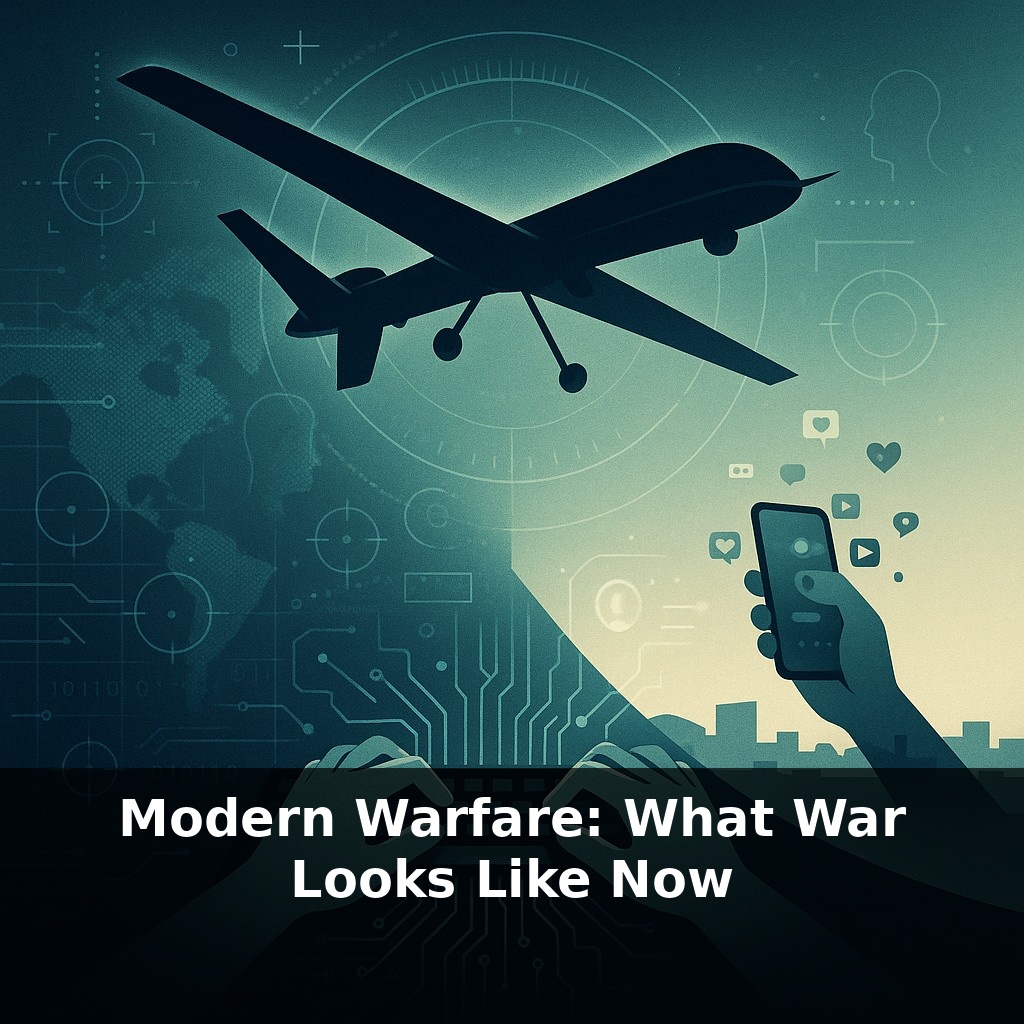
Some of the most important weapons on today’s battlefields never leave a keyboard. A drone operator in one country, a hacker in another, and a teenager scrolling social media all shape the same war—sometimes without realizing who’s really directing the fight.
Over 90 countries now fly military drones, and some of the most effective models are cheaper than a luxury apartment in a major city. That price drop matters: it means firepower once reserved for superpowers can now fit into the budget of a small state—or a well-funded militia. At the same time, governments quietly pour billions into AI and autonomy, training algorithms to spot targets faster than any human eye and to sift through oceans of data for patterns a normal analyst would miss. Add in cyber tools that can shut down power grids, scramble logistics, or quietly corrupt battlefield communications, and you get a very different kind of frontline—one where code can set the tempo before a single tank even moves.
Many of the most decisive moves in modern wars now happen before anyone fires a shot. States plant backdoors in foreign networks years in advance, like slipping a spare key under someone else’s doormat and waiting for the right moment to use it. Online, troll farms, botnets, and paid influencers test narratives the way chefs taste dishes, adjusting the recipe until it spreads on its own. Meanwhile, cheap commercial satellites and open-source maps let journalists and hobbyists track troop movements, shrinking the space where governments can operate in the dark. Wars no longer “begin”; they slowly sharpen into focus.
Modern warfare now unfolds across three tightly linked layers: what happens on the ground, what happens in networks, and what happens in people’s heads.
On the ground, classic hardware is being quietly rewired. Artillery units receive precise coordinates from small surveillance aircraft, cheap quadcopters, and commercial satellites. Armored columns avoid certain roads not because scouts saw an ambush, but because pattern‑recognition systems flagged unusual activity in traffic cameras and cellphone signals. Logistics officers no longer just count fuel drums; they monitor whether digital tracking tags have been spoofed, sending a shipment in circles or straight into danger.
In the network layer, attacks often look less like explosions and more like “glitches.” Trains stop because signaling systems crash. Hospitals revert to paper because records are locked and ransomed. Financial transactions slow or fail, straining public patience at exactly the moment a government needs calm. Some of these operations are military, some criminal, and some a murky mix: syndicates lease tools to states; states quietly tolerate gangs that hit the “right” targets abroad.
The psychological layer is where these effects are stitched into a story. A power outage can be framed as government incompetence, enemy sabotage, or even a “necessary” emergency measure. Carefully timed leaks of genuine documents sit beside forged ones, forcing journalists and citizens to guess which is which. This is less about persuasion in the old propaganda sense and more about exhaustion—flooding the information space until people stop believing anything.
These layers rarely move in isolation. A missile strike might follow a brief cyber intrusion that disables radar, announced online by a flood of accounts pushing a ready‑made narrative. A single event becomes three simultaneous battles: to control territory, to control systems, and to control meaning. Like a doctor treating a complex illness, modern commanders and policymakers must track how interventions in one part of the “body” of society can trigger symptoms in another—sometimes far from the original point of impact.
A front‑line unit today might look less like a row of foxholes and more like a pop‑up tech lab. One team launches a cheap quadcopter for a ten‑minute peek over the next hill; another team watches a tablet that fuses its live feed with satellite snapshots and radio intercepts; a third quietly monitors for odd spikes in nearby Wi‑Fi and Bluetooth signals that could hint at booby‑trapped devices. In Ukraine, both sides have learned to move artillery the way city kitchens move food deliveries—constantly, in small batches, to avoid becoming predictable targets. On the home front, defense planners worry less about bombers over capital cities and more about a steady drizzle of network “accidents” hitting ports, stock exchanges, or air‑traffic control during a crisis, like a slow‑moving storm system that never fully clears. Citizens become unwitting participants: a viral video from a smartphone at a border crossing can give away force locations faster than any spy. Your challenge this week: when you see breaking news about conflict, try to spot all three layers—ground, networks, minds—at work.
Borders start to feel porous when disruption can flow through code, satellites, or outsourced “patriotic volunteers.” Future conflicts may look less like a single storm and more like a long, shifting monsoon: trade bans here, GPS spoofing there, a sudden blackout during an election. As quantum‑safe tools spread, some doors will slam while new windows open for intrusion. The hardest task for societies may be agreeing on when such pressure quietly crosses the line into war.
Modern war’s frontlines now run through app stores, cloud servers, and undersea cables as much as border posts. States quietly test each other’s nerves with outages, data leaks, and GPS “fog,” like chefs tweaking a recipe to see when the heat becomes unbearable. Our task is learning to spot the simmer before it boils over—and deciding what “boiling” now means.
Try this experiment: pick one recent conflict (like Ukraine, Gaza, or the Red Sea attacks) and for 48 hours, “track the war like an intel cell” instead of a casual news consumer. First, choose three sources with *very* different vantage points: an OSINT/X (Twitter) account that posts satellite or drone footage, an official government or military channel, and one local journalist or NGO on the ground. For two days, log when each reports on the *same* event (a strike, a ceasefire announcement, a drone attack), then compare: who is fastest, who adds the most detail, and where the narratives clash. At the end, ask yourself: if a commander had to make a decision based only on each source’s feed, how differently would that decision look—and which “picture of the war” do you now trust most?