More people died in six years of World War Two than live in many large countries today—yet most of that killing happened far from the front lines. Factories, farms, labs, kitchens: in this episode, we step into those spaces to ask how a whole planet got drafted into war.
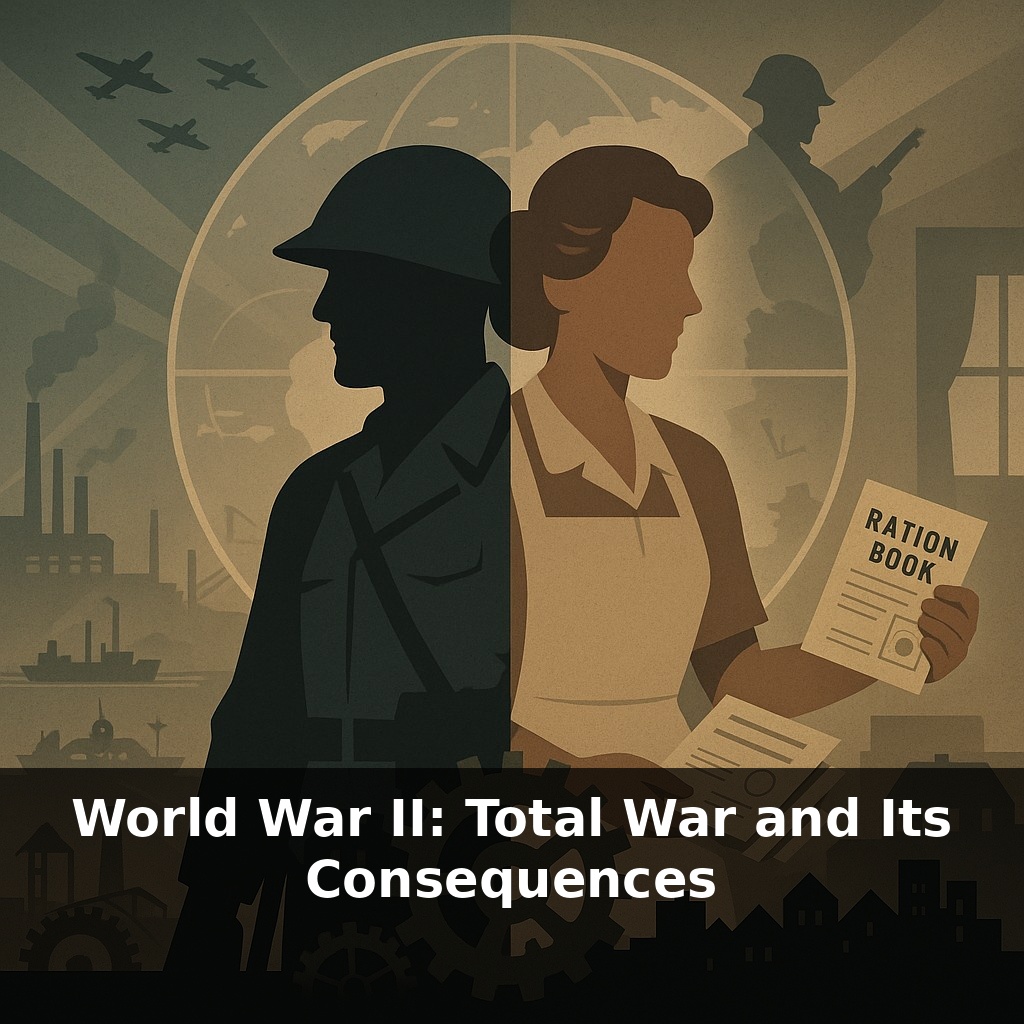
By 1945, even the idea of “civilian” had started to blur. Tax forms, ration books, draft notices, blackout curtains—paperwork and daily routines turned ordinary lives into moving parts of a vast war machine. Governments didn’t just ask for loyalty; they measured, planned, and scheduled it, turning wages, calories, and working hours into carefully calculated weapons. New ministries sprang up to decide who could buy shoes, who could change jobs, who got extra sugar or gasoline. Across continents, people were told that their personal sacrifices—missed meals, lost sleep, postponed dreams—were as crucial as any general’s strategy. Total war meant that the front line could run straight through your purse, your pantry, and your planner, as states learned to count and command almost everything people did.
Air-raid sirens, radio bulletins, and rumor did the work that posters alone could not: they taught people to reorder daily life around distant battlefields. In London, blackout curtains weren’t just regulations; they were nightly reminders that strangers in Berlin or Tokyo could shape your chances of waking up tomorrow. In occupied Warsaw or Nanjing, the stakes were harsher—curfews, sudden searches, and disappearances turned streets into maps of fear. Even neutral states felt the pull, as shortages, refugee flows, and anxious newsprint stitched them into a conflict they officially stood outside. Choices that once felt private—whom to hire, what to teach, which borders to guard—became quiet fronts in a global struggle, and small decisions could ripple outward like tremors before an earthquake.
Ration cards, casualty lists, and production targets were only the visible surface of something deeper: governments learning to treat whole societies as problems that could be solved with numbers. In Washington, London, Berlin, Tokyo, and Moscow, statisticians and planners sat with ledgers and punch-card machines, asking questions that sounded cold but felt urgent: How many calories keep a worker on their feet? How many hours at a lathe before mistakes become dangerous? How many tanks can a steel mill produce if all “inessential” uses are cut?
This new habit of counting lives and labor rewired economies. The United States converted car plants into aircraft lines, but it also experimented with wage controls, mass taxation, and price ceilings that reached into every store. In the Soviet Union, entire industries were uprooted and moved east of the Urals, piece by numbered piece, while workers slept in barracks beside their machines. Nazi Germany turned plunder and forced labor into policy, drafting millions from occupied Europe into mines, fields, and armament works. The Pacific empires of Japan and its opponents fought over rubber, oil, and rice as fiercely as over islands.
Science became another battlefield. The Manhattan Project gathered physicists, engineers, and machinists into secret desert towns, betting unprecedented sums that uranium and equations could end the war faster than any fleet. Radar networks, codebreaking centers like Bletchley Park, and new antibiotics all showed how quickly laboratory ideas could be turned into strategic tools. After 1945, that lesson didn’t fade; it flowed into peacetime research grants, nuclear power programs, and the quiet militarization of universities.
The human cost was layered. Soviet villages hollowed out by conscription and siege. Chinese provinces enduring famine and scorched-earth retreats. Colonized soldiers from India, Africa, and the Caribbean fighting on distant fronts, only to return home asking why the language of “freedom” and “rights” stopped at imperial borders. Their questions helped feed postwar movements that demanded independence in Accra, Hanoi, Jakarta.
When the guns finally fell silent, the habit of planning persisted. Bretton Woods institutions, the Marshall Plan, and new welfare systems all carried forward wartime assumptions: that states could steer markets, manage risk, and promise citizens a minimum of security. Even today, whenever governments talk about “mobilizing” for climate change, pandemics, or economic crises, they reach—knowingly or not—for tools first sharpened in those years when everything was counted, and almost nothing felt truly private.
On a smaller scale, you can see echoes of this wartime thinking in how postwar governments tackled public health. Vaccination drives, for instance, treated disease like an invading army: officials mapped outbreaks, calculated “herd immunity” thresholds, and scheduled school-based clinics the way logisticians once timed troop trains. In economics, the habit of planning resurfaced in housing and employment policy. Wartime experience tracking labor hours and production fed into postwar debates over minimum wages, workweeks, and job guarantees. Even education policy changed. States that had once trained pilots and codebreakers now funded math and science programs, hoping a steady flow of engineers would keep them competitive in the next global contest. Popular culture absorbed this mindset, too. Films, newsreels, and later television normalized the idea that distant decisions about budgets or treaties could reshape local lives, priming citizens to see themselves as participants in vast systems they would never fully see.
Today’s crises still echo those emergency blueprints. Climate summits count carbon like wartime planners once counted fuel, while pandemic responses weigh hospital beds against infection curves. Digital platforms now act like switchboards for public emotion, amplifying fear or solidarity within hours. As archives and algorithms filter what we remember, the next “mobilization” may begin not with sirens, but with dashboards, notifications, and graphs asking us, again, what we’re willing to trade for safety.
We inherit not just ruins and memorials, but habits of scaling up response: draft boards become data models, blackout maps become satellite views. Your challenge this week: whenever you see leaders invoke “wartime” language for a policy—on health, climate, security—pause and ask: whose effort is being counted, and who remains off the ledger?